Delia Bayona

BROWSE ALL FROM THIS AUTHOR HERE

[In]visible Cities: Meet the winners and honorable mentions of this competition proposing social housing for Lima

is not only an invitation to architectural design, but also to reflection and questioning of our professional commitment to the development of the most vulnerable environments and the creation of more inclusive, safe, resilient, and sustainable cities.

One way to make cities visible is by intervening in forgotten or peripheral areas, as well as by addressing basic needs, bringing them to light and raising an urgent call to action. A few months ago we announced the call for entries for this competition, and today it surprises us with the variety of responses. It is also interesting to see how participants from other countries view our context and what they propose; this is a great contribution, expanding the possibilities for multi-perspective interventions in building projects with and for society.

CIUDADES [en] VISIBLE is a competition that invited architects and engineers, whether students or professionals, to design in agreement with the beneficiary families: the Salazar, Acarraz, Teccse, Huamán, and López families. Five families, five homes. Housing is itself a basic need, making this competition both a city laboratory in search of alternative solutions for planned housing construction in a country like Peru, where nearly 70% of homes are self-built. The site of intervention is the 3 de Diciembre Community, located south of the city of Lima, in the District of Lurín.
'Ideario': Architecture Project Exhibition at the University of Lima

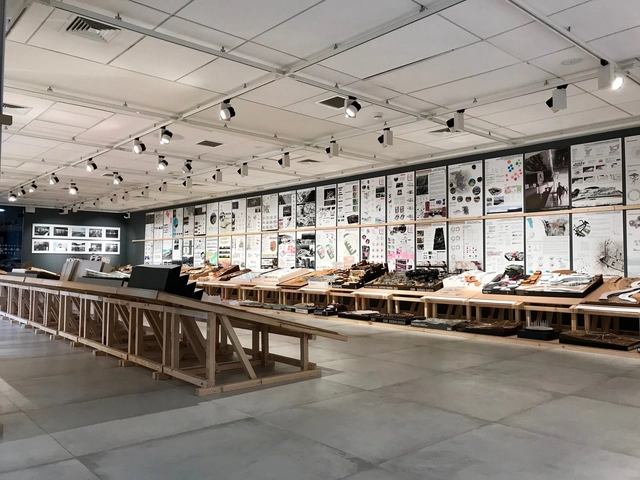
When a university opens its doors to the general public to showcase its work in detail, it is a luxury that should be taken advantage of. This is especially true when this opening features thesis projects and final degree projects, which require a great deal of reflection, effort, and originality, with a significant dose of realism as students near the end of their architectural training.

The collection of ideas that characterizes the graduates of the University of Lima is reflected in this diverse exhibition of their architectural projects. ‘Ideario’ is an exhibition organized by the Faculty of Engineering and Architecture in conjunction with the University of Lima Cultural Center. Nine thesis projects and 19 final degree projects will be on display until May 5 at the Cultural Center Gallery of the university. It is a must-see, as there is much to see and reflect upon.

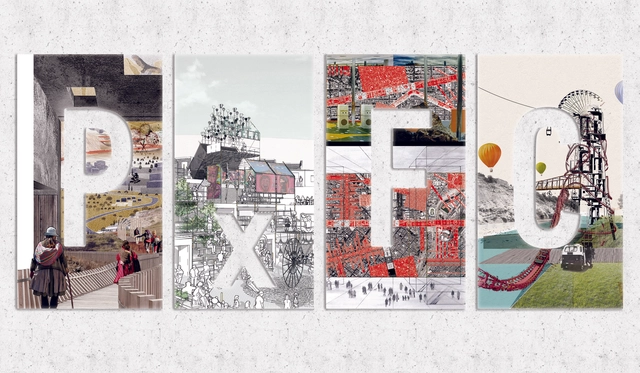
PxFC Exhibition: Experimental Final Degree Projects at PUCP

The projects on display show the current concerns of graduates to address critical problems throughout Peru, and their commitment to finding solutions beyond the limits of a discipline that needs to be rethought from the specificity of society and the national territory.

There is always a lingering feeling or fear that a project might remain just a dream upon presentation. This sentiment is heightened in a final degree project, where one might view it as the last opportunity to experiment, yet simultaneously the first opportunity to make it as realistic as possible. In what sense? Even as part of an academic exercise that allows for imagination and exploration, it can be developed with the challenge of addressing a real problem that benefits society and the country. In this way, students can finish their degree by opting for buildable dreams that go beyond the purely architectural.

This remarkable ambition and social consciousness are present in each of these diverse Experimental Final Degree Projects (PxFC) by graduates of the PUCP. These proposals explore the theoretical-practical limits of architecture and integrate with other fields—such as engineering, agriculture, sociology, politics, and art—resulting in projects that are not necessarily limited to specific building programs. We hope that many, regardless of their academic background, will attend, reflect, and incorporate these critical perspectives into our professional practice. The exhibition runs until May 11 at the university's Cultural Center gallery.

Meet the winners of the Plaza Paz Soldán National Competition in Lima, Peru

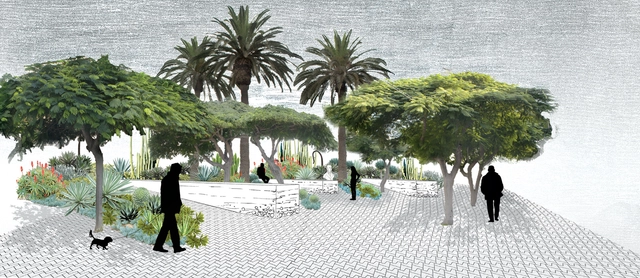
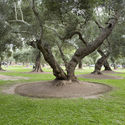
In a city like Lima, where cars continue to gain ground over pedestrians, a competition that attempts to reverse this dual inertia by prioritizing the pedestrian use of urban spaces is highly welcome—allowing people to not just cross a vehicular roundabout, but to linger in a plaza, for example. One only has to look at the finalist proposals to understand these aspirations, all of which present plazas of high architectural and artistic quality. If we can imagine it, we can make it happen. Beyond the results, each project inspires and paves the way for new ways of rethinking and cohabiting the city through public space.

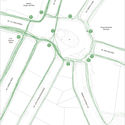
The Paz Soldán roundabout, an iconic, central location and one of the busiest points in the San Isidro district, will be given a new lease on life thanks to a comprehensive transformation that will convert it into a public plaza. The Plaza Paz Soldán National Competition, sponsored by the Municipality of San Isidro and Grupo Centenario, and directed by architect Gary Leggett, invited architects and artists to collaborate on proposing a public space to serve as a gateway to El Olivar forest. The call for entries received a massive response, with 160 teams registering and 60 architectural projects submitted.

On the Other Side of the Wall of Shame in Lima, Peru

Subscriber Access | 

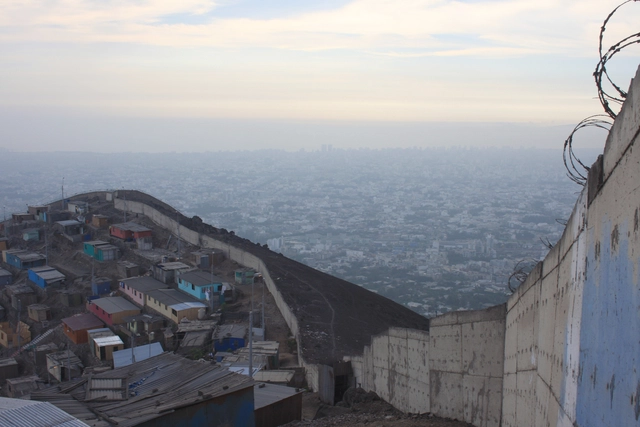
Warning: this article proposes a narrative according to the route taken from one side to the other of the wall, from the predictable to the most unpredictable. To better situate ourselves, the narrative will be told through my personal experience.

"Do you know the wall that divides the rich from the poor?," asked three Greek travelers who, after visiting the "pretty" side of Lima, suspected that something was hiding behind appearances. But, "how is it that from, even though you're from the other side of the world, you knew about the wall?" Well, news travels. And "why is this wall something that has to be seen in our city?" if it's not a cause for pride. I knew exactly what they were talking about. I spelled it out: the wall of shame. Certainly, I wasn't familiar with it in situ either, since I hadn't left my urban bubble, like many of those who live in these parts, so with the same curiosity, as a tourist of my own city, we made our way.

Architects Propose 120 Incremental Social Houses for Iquitos, Peru

Building and growing are two actions that should be considered more often than not at the same time. This is how the 2017 "Build to Grow" social housing competition, looked to establish bases that sustain a flexible way of living. The event took place in the Belén district in the city of Iquitos, on 3.7 hectares plot of land. The project that received first place proposed to locate 120 incremental homes, that alternatively allowed users to modify and expand it according to their needs and economic means. In short, a home with a solid nucleus formed by a structure that supports changing activities.

Paz Soldán Plaza National Competition: Call for artists and architects to transform the Paz Soldán roundabout into a public square

ATTENTION: With three weeks remaining until the final submission for the Plaza Paz Soldán competition, the organizing team has provided clarifications on important points, which we have added to the end of this post under the heading “LATEST NEWS.” These include the addition of a bicycle station and new files for consultation. Therefore, please remember to download the updated competition guidelines, which include these changes and new downloadable files. The deadline for registration and inquiries is this Friday, March 23, at 4:00 PM.

Paz Soldán Plaza National Competition: Call for artists and architects to transform the Paz Soldán roundabout into a public square - Imagen 1 de 4Paz Soldán Plaza National Competition: Call for artists and architects to transform the Paz Soldán roundabout into a public square - Imagen 2 de 4Paz Soldán Plaza National Competition: Call for artists and architects to transform the Paz Soldán roundabout into a public square - Imagen 3 de 4Paz Soldán Plaza National Competition: Call for artists and architects to transform the Paz Soldán roundabout into a public square - Imagen 4 de 4Paz Soldán Plaza National Competition: Call for artists and architects to transform the Paz Soldán roundabout into a public square - More Images+ 2

Leading women architects, urbanists, and historians reflect on the future of architecture in Peru

Subscriber Access | 

"I have two words to leave you with: inclusion and shine," McDormand said at the end of her speech after winning the top award for best actress. From drama to real life, what does that have to do with this? Two words from another discipline that resonate in architecture. Inclusion and shining may not seem related at first, but one way to interpret them (by combining them) is that by including ourselves as a society, we unleash the full brightness of our potential. And that is a small but powerful message for how we interact in the practice of our profession, achieving greater relevance in the pursuit of our social role.

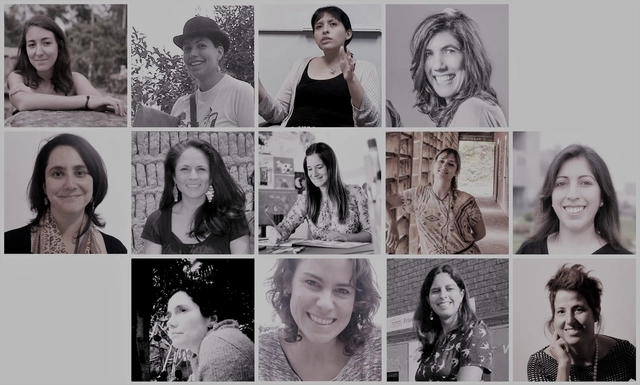
Accordingly, this publication features women with brilliant minds who play an important role in the country, linking architecture and urbanism with other disciplines. They contribute from different angles: one from criticism, another from art, another from education, one from drawing, a few from history... further enriching a profession so deeply connected to ways of living. For Women's Month, in honor of diversity and democracy, we bring them together to share a reflection on the future of architecture in Peru. Although they are different—some opening minds, others generating knowledge, and others building—they share that spark in their eyes when they speak confidently about their work, and that is what we frame here.

Toward a Specific Generic / LIMAPOLIS 2018 Workshop

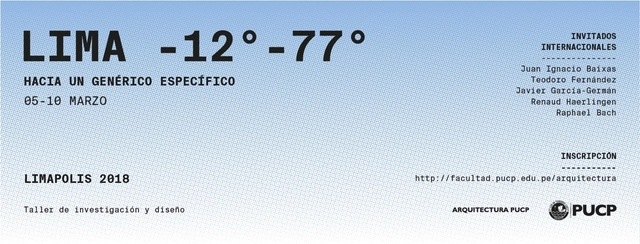
Since its inception, the LIMAPOLIS workshop has been a research and design studio characterized by constant experimentation with issues relevant to Lima's architectural reality, aiming to spark debate and provide strategies for creating better architecture. In this eighth edition, “Toward a Specific Generic” focuses on studying Lima's geoclimatic conditions, considering how the city has historically responded to them in a detached manner, to move toward an architecture more pertinent to the local reality. This theme was proposed by organizers Gary Leggett, Augusto Román, and Paulo Dam from the PUCP Faculty of Architecture and Urbanism, where the event will take place from March 5 to 10.

With this shared vision, the organizers have invited prominent international architects: Juan Ignacio Baixas (Baixas y del Río Arquitectos, Chile), Teodoro Fernández (Teodoro Fernández Arquitectos, Chile), Javier García Germán (Totem Arquitectos Asociados, Spain), and Renaud Haerlingen and Raphael Bach (Rotor, Belgium). Drawing on their expertise and specialties, they will guide the discourse on the city through four specific themes: structure, landscape, envelope, and light/color. Below are the details for this event, which is open to national and international students and architects.

[in]VISIBLE CITIES Competition: a mutual agreement between architects and families to build social housing in Peru

No to invisible cities.

Pay attention: this competition raises (and questions) three critical pillars of the architectural reality in Peru. On one hand, it addresses the integration of architects as citizens, whose social role is indispensable. Likewise, it seeks to make the city's forgotten sectors (and their inhabitants) visible in order to intervene in them—alongside them—by joining forces between professionals (knowledge/experience) and families (ideas/needs). Finally, it tackles a significant challenge: social housing, which is precarious and largely absent in our country, despite the latent opportunities for its relationship with public space. Behind this union of visions lies a sensitive message: we must broaden our perspective to address truly fundamental issues through architecture, in favor of creating visible cities.

Huacas in Perspective: Winners of the VI Lima Milenaria Photography Contest

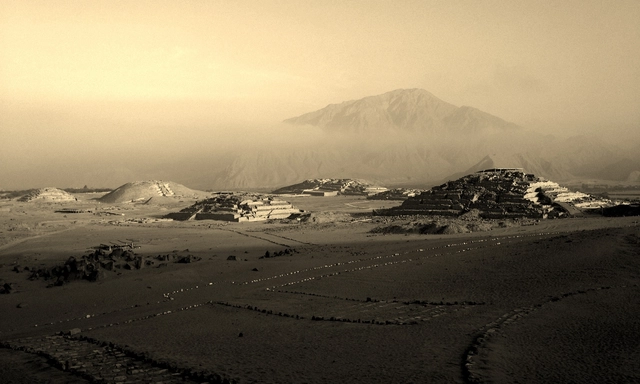
Although these are amateur contemporary photographs, we should look beyond the surface. These "false hills" hide huacas that—whether they were ceremonial centers, administrative complexes, or food storehouses—offer a message of peeling back layer after layer. Here, different stages of history and the ways of life of our pre-Hispanic ancestors are revealed, offering us a sense of wonder as we look beneath the overlaps of time. The huacas teach us to see with greater breadth and perspective.

6th Millennial Lima Photography Competition: Huacas

This is a special year for creating a new Lima with a memory; that is our decree (and our wish). Now more than ever: Let's reclaim the memory of Lima as a thousand-year-old city.

Amidst the shifting sands of Lima's reality, one of the most solid foundations is the huacas. And this is their year, as they will represent the Peruvian pavilion at the Venice Biennale. For this reason, to elevate and share them with more people, this edition of the 6th Photography Competition by Lima Milenaria focuses exclusively on photographs of these ancient ceremonial centers... huacas everywhere. The winning photographs will have the opportunity to be displayed at the Biennale, among other important prizes.

You don't have to go far to capture a huaca in time; just go for a walk (or dig through your archives). We are surrounded by them, or we live while surrounding them, even if we forget. This is an act to remember, commemorate, and better understand them. What is the relationship between Lima's citizens and the huacas in the city? See them with new eyes—don't just pass by; stop and admire them. So much history, wisdom, mystery, poetry, and reflection... Just don't delay in capturing them; the deadline for submissions is midnight on January 10. Read on to learn how to participate.

The After-Life Of The Architectural Model: Where Can History's Lost Models Go?

Subscriber Access | 

The architectural model: a tool, a sculptural artifact, a prized possession, and yet in the digital age of BIM and Virtual Reality, perhaps becoming an enigma, a relic for settling dust. And yet, we are still making them. If you imagine that famous photo of earth from space, of every model ever made in a single image, it raises the question - where are they all? Where does the architectural model go to die?

10 Archaeological Sites That Every Architect Should Visit in Peru

Subscriber Access | 

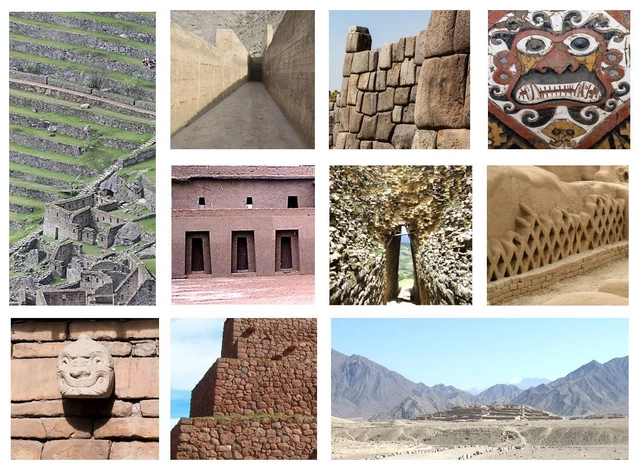
In Peru, you can not live without not knowing about or learning the lessons of the thousand-year-old architectural legacy of some of its many archaeological sites (19,903 to be exact). These places are full of inspiration, art, history, legends, and magic. Their stories are closely tied to their architecture and the ruins that hold mysteries that perhaps leave us with more questions than answers. But the sites' power to amaze us is something that every architect will appreciate.

This small list—rather than an invitation— is a provocation for the senses that lie within the architect-traveler’s soul.

Winning Projects Reimagine the Tourist Experience of Machu Picchu

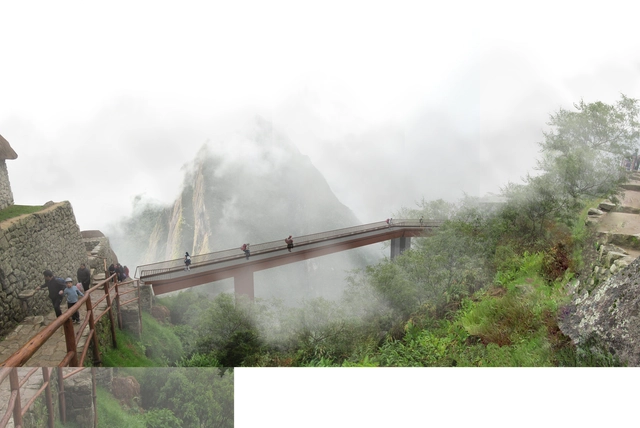
Historical preservation and integration with nature, two crucial themes in the development of the Peruvian structure whose territory is a synthesis of historical landscapes. The winning project of the “Ideas de Arquitectura” contest in Machu Picchu National Archaeological Park (Cusco) not only achieves both themes but also weaves and customizes them. The project mimics the architectural tradition of the place while bringing its own contemporary language. It creates bridges of new relations while respecting the preexisting ones, in continuation with the nature of the place, harmony between nature and history. And of course, it invites visitors to be part of this experience.

Learn more details about this project and its approach to what has been the development of landscape of its masterplan that was made for the Archaeological Park.

Winning Projects Reimagine the Tourist Experience of Machu Picchu - Image 8 of 4Winning Projects Reimagine the Tourist Experience of Machu Picchu - Image 12 of 4Winning Projects Reimagine the Tourist Experience of Machu Picchu - Image 18 of 4Winning Projects Reimagine the Tourist Experience of Machu Picchu - Image 21 of 4Winning Projects Reimagine the Tourist Experience of Machu Picchu - More Images+ 17