BFLS won an international design competition in 2007 to design a new building for the Royal Welsh College of Music & Drama, Wales’ leading music and drama conservatoire. The new addition to the College’s professional training and performance facilities will comprise the 150‐seat Richard Burton Theatre, along with the 450‐seat Chamber Recital Hall, four Acting & Movement Studios and an Exhibition Gallery.
More images and architect’s description after the break.
The Brussels’ Palace of Justice is a symbol for the power of Justice, dominates the skyline of Brussels and is a window to the past. Yet the stately justice building is hard to secure and to modernize.
This panel of architects and clients will explore what it takes to make your best case. Architect panelists will start with the initial “go” decision, and discuss strategies including selecting the team, the project approach, and the cover letter. Client panelists will describe the thinking that goes into developing an RFP and what makes for a convincing response. This session promises to result in some valuable advice in an especially challenging market.
Edinburgh-based Falconer + Jones shared with us their project Lugton Brae House, co-designed with Andrew Brown. It’s a small family home, to be constructed in the garden to the rear of the existing house (owned by the clients).
You can see more images and architect’s description after the break.
New Buildings New York, a program of the Center for Architecture Foundation, is a series of tours that provide a behind-the-scenes look at new building in the New York metropolitan area and are led by their architects, engineers and designers. All proceeds benefit youth and family programs at the Center for Architecture.
Doesn’t matter if it’s a medical technology campus, a residence, a housing project, or a public facility. The green roof looks amazing in this projects from all over the world. Check them all after the break.
Becton Dickinson Campus Center / RMJM The Campus Center at BD (Becton Dickinson and Company), a medical technology company that serves healthcare institutions, life science researchers, clinical laboratories, industry and the general public, is a 38,500-square-foot facility that bridges and blurs the boundaries between building/landscape, indoor/outdoor, roof/earth, figure/ground, and the two local business cultures of management/production (read more…)
The work of Los Angeles-based artist Megan Geckler lies somewhere between art and design, with architectural installations that are assembled from thousands of strands of multicolored flagging tape, a plastic ribbon typically utilized by surveyors to demarcate space on construction sites.
Architects Kutlu İnanç Bal and Hakan Evkaya shared with us their proposal for the İzmir Opera House Competition in Turkey. See more images after the break.
On the occasion of the Settimana milanese del Design 2010, during which the Japanese architect presented an impressive installation anticipating the new work of architecture, Kengo Kuma himself gave a video-interview on the meaning of the very “CCCWall” (photos here / video here), its conception and tangible character. The image and voice of the Japanese architect allow the viewers to approach the ceramic masterpiece which will be inaugurated in Casalgrande, Reggio Emilia.
Last week we featured projects from all over the world. We understand that you may have missed a few, so our selection of last week’s best projects come from Colombia, Portugal, Czech Republic, Austria, and Australia. Check them all after the break.
Argos, Building for an Electrical Generator at a Cement Factory / Felipe Gonzalez-Pacheco In July 2006, the project is the winner of an architectural contest, for the resolution of a “skin” for a technical building containing an self generation electrical plant for cement factory. The Factory wanted to generate also a corporative image with the building. Their purpose became a mutual opportunity to generate an experimentation laboratory of technical possibilities with the material they produce, with very low density concretes (read more…)
Portuguese architects OODA shared with us their proposal (in collaboration with Lencastre Arquitectos) for the Tram Museum International Competition in Porto, Portugal.
More images and architect’s description after the break.
Competition is open to entries worlwide and the work will span the entire length of the selected project, from conceptual design to construction oversight. Competition closes July 31, so if you think you may have the winning project, submit it right here. More information on the competition’s official website.
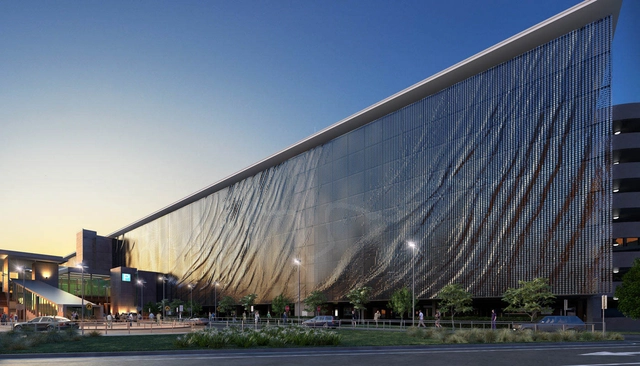
International art-based design studio Urban Art Projects (UAP) has announced their collaboration with artist Ned Kahn and the Brisbane Airport Corporation (BAC) to convert Brisbane’s new Domestic Terminal short-term multi-level car park in to an eight-storey kinetic public art project.
Kahn, who has developed an international following for his artworks that incorporate the use of natural elements such as wind and light will collaborate with UAP and BAC’s design team to create a 5000 Sq m kinetic façade for the new Domestic Terminal short-term car park. More information, images, and a video showing the effect that will be created after the break.
WORKshop will present its second exhibition from July 9th through October 2nd. Designed by the Toronto architecture firm Khoury Levit Fong, Scentscapes: Immersive Environments Inspired by Xi’an, will feature drawings of a public garden currently under construction in one of China’s ancient capitals, Xi’an, along with a site-specific installation titled Scent Squadron.
Based in Brooklyn and Toronto, the biannual publication explores a wide array of subjects in the social, political and cultural realms. Content in the first issue, which is currently available in bookstores, includes an interview with the Fiery Furnaces’ Matthew Friedberger; an investigation of the cultural and medical factors behind rising maternal mortality rates; a profile of a South African architecture firm working in Johannesburg’s shantytowns; and more.
Weekend is here. Wouldn’t it be nice to start it enjoying a great dinner on a fantastic restaurant? To give you some ideas, here’s our fourth selection of previously featured restaurants in ArchDaily. Check them all after the break.
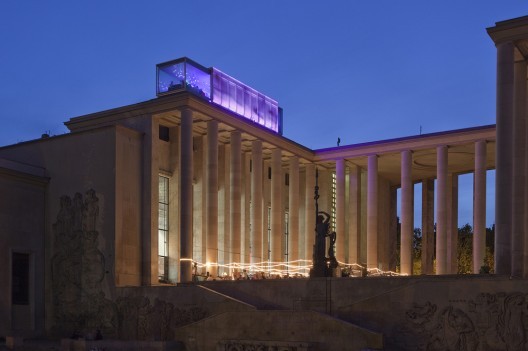
Nomiya: Temporary Restaurant / Pascal and Laurent Grasso omiya is an artistic project by Laurent Grasso with the collaboration of the architect Pascal Grasso. This is a temporary, transportable restaurant on the roof of Le Palais de Tokyo museum in Paris. The restaurant takes its name, Nomiya, from a very small restaurant in Japan. The structure features a dining room for twelve people with a panoramic view over the Seine and the Eiffel tower (read more…)
Thousands of buildings in the Netherlands lie vacant. Some of them for a week or a few months, many even for years. During the twelfth Venice Architecture Biennale, the Netherlands Architecture Institute (NAI) and Rietveld Landscape will highlight the huge potential of all that temporarily unoccupied space in making the Netherlands one of the top-five knowledge economies in the world. The exhibition Vacant NL, where architecture meets ideas is a call for the intelligent reuse of temporarily vacant buildings around the world in promoting creative enterprise. The Venice Architecture Biennale takes place from 29 August 29 to 21 November 2010.