Produce personalized presentation boards that distill complex concepts into simple visual representations with a few helpful tools and effects.


Produce personalized presentation boards that distill complex concepts into simple visual representations with a few helpful tools and effects.

Gustafson Guthrie Nichol (GGN) announced the beginning of construction of the CityCenterDC development by Hines|Archstone in downtown Washington, DC. A new mixed-use development located on the 10-acre site of the former convention center, CityCenterDC is one of the largest downtown development projects currently underway in any U.S. city. Gustafson Guthrie Nichol participated in developing the master plan for the site with lead architect Foster + Partners, and acted as lead landscape architect, working with DC-based Lee and Associates. Additional members of the design team include DC-based Shalom Baranes Associates, serving as associate master plan architect, project Architect of Record, and lead designer of the residential rental buildings.
Construction commenced on March 23, 2011, and is expected to reach completion by the fourth quarter of 2013. The project includes the development of Northwest Park, a lively addition to downtown DC, the creation of a Central Plaza, as well as dramatic terraces with green roofs and gardens incorporated into all the buildings. More images and description after the break.

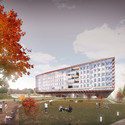
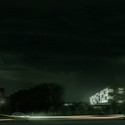
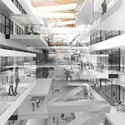
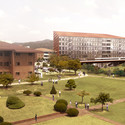
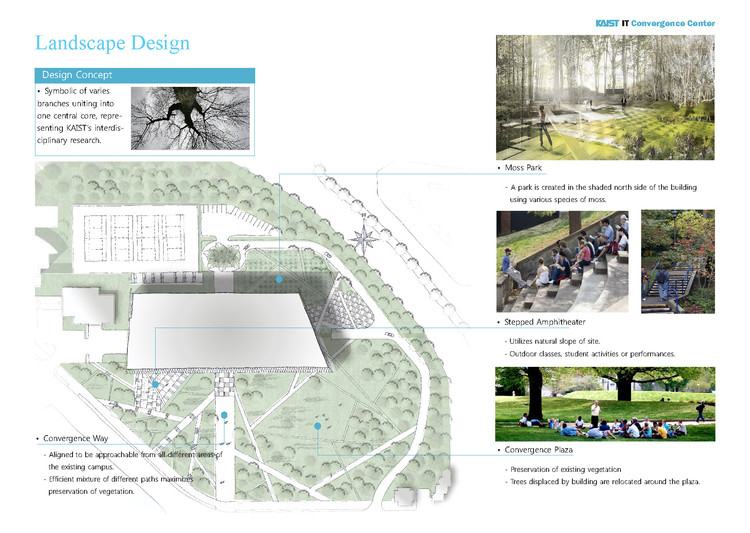
Open Paradox, MANIFESTO and ILKUN‘s proposal for the IT Convergence Center for KAIST (Korea Advanced Institute of Science and Technology), aims to provide a truly multi-disciplinary research and educational environment for the institute. Located on the sloped East Campus Plaza of KAIST, the building allows free-flowing interaction between students and faculty of multiple academic disciplines as well as with the remaining school population and the public, fostering an atmosphere of creativity and openness.
This proposal received 3rd Prize at the Design Competition and was the recipient of a 2010 AIA NY Design Award.
Architects: MANIFESTO Architecture P.C. (Design Architect) and ILKUN Architects & Engineers Ltd. (Local Architect) Location: Daejeon, Korea Consultants: Yoshinori Nito Engineering & Design P.C. Renderings: Courtesy of MANIFESTO. Design Team: Jeeyong An, Sang Hwa lee, Gi Young Park, JiYoon Oh, Sorae Yoo, Eunchung Na, Ulyong Moon, Sieun Lee (Manifesto) Ilin Hwang, Sung Jung Chough, Hyejin Choi, Hyunhee An, Byunghoon Kim, Yongik Won (Ilkun).

Croatian architects 3LHD shared with us their project Green Pavilion Restaurant, for which they received first prize in an invited competition during last year. More images and architect’s description after the break.

As this Church befits its central role in the community, this project also acts as a landmark and point of congregation for all in the area of Piacenza, Italy. The aim of Kuadra Studio is to keep the religious function of the building to the forefront while incorporating the necessary space and facilities for other, everyday activities. The concept for the design came from the idea of leaves: emphasizing the natural attachment to the earth and at the same time the spiritual detachment from it, creating a dynamic floating form to inspire worshipers with a material recreation of an ideal of the Church connecting earth and heaven. More images and architects’ description after the break.
The CAM FRAMIS Museum of the Vila Casas Foundation is part of a full redevelopment of the industrial neighborhood in the 22@ District of Barcelona. Architectural photographer Pedro Kok shared with us this video of the Museum designed by Jordi Badia of the BAAS studio.

We’ve passed the 45,000 photos in our Flickr Pool! As always, remember you can submit your own photo here, and don’t forget to follow us through Twitter and our Facebook Fan Page to find many more features.
The photo above was taken by George Rex in London, England. Check the other four after the break.

This week I’d like to introduce you to some books I’ve come across while traveling the city. This first one is CLIP STAMP FOLD, an encyclopedic compendium of radical little architecture mags from the sixties and seventies. More than just clip stamp fold these were also draw cut paste scribble slash ink. This brick of a book is a portable archive and you don’t have to wear latex gloves to handle. These small, independent publications curated the contemporary and collected what may have been the disposable present. The challenged the orthodox historicism of architecture with a hippy slant. I would have stolen some images for you, but alas it was wrapped in protective hygienic cellophane.
More after the break.

To mark the bicentenary of the death of Giuseppe Piermarini, (Foligno, 18th July 1734 – 18 February 1808), Kuadra Studio has organized a workshop to honor the work of the architect and was assigned area 8 with one of Piermarini’s follies, a design for a stylized coffee house; a circular building of which only a few plans still exist. A long standing exhibition in the Centro Arte Contemporanea in Foligno and a catalogue are the results of the workshop. More images and architects’ description after the break.

Paul Laurendeau Architects shared with us their winning competition entry for the Trois-Rivières Amphitheatre in Quebec, Canada. The centerpiece of the proposed Three Rivers on the St. Lawrence is to build an outdoor amphitheater with a capacity of 10,000 seats. For the realization of the amphitheater, the municipality has chosen to proceed with this design for a building of international significance. More images and architects’ description after the break.

The U.S. Green Building Council recently announced that more than 10,000 homes across the USA have earned LEED certification.
“Reaching this milestone signifies the continued transformation of the home building industry towards high-performing, healthy homes that save home owners money,” said Nate Kredich, Vice President of Residential Market Development, U.S. Green Building Council. “Market leaders across the production, multifamily, affordable and custom home segments have recognized that there are green homes, and then there are LEED Homes, and they are acting accordingly.”
The Ross Street House by RWH Design received its LEED for Homes Platinum rating in July 2009, the first of Wisconsin. The home has captured the attention of green enthusiasts throughout the country for far exceeding the requirements to achieve the highest LEED rating of Platinum.
More following the break.

Architects: ON design partners Location: Tokyo, Japan Project area: 21 sqm Project year: 2010 Photographs: ON design partners

Situated on the former Bethlehem Steel brownfield site the newly designed ArtsQuest Center at SteelStacks has transformed an industrial site and inspired a community. A unique hybrid project of old and new, the building’s 67,000 sqf will feature a 450-seat venue for live performances and a two-screen state of the art cinema.
“The design grew from the profoundly meaningful history of place here,” said Joseph N. Biondo AIA, Spillman Farmer Architects‘ Design Principal. “The Bethlehem Steel blast furnaces are iconic – they are America’s historic ruins. The arts center is deeply inspired by this former industrial site and the lives that were lived here. We wanted the building to make a compelling statement about the future of the arts and community here in Bethlehem. This project evolved from the energy generated by the friction of past and future, the human spirit that fueled the American industrial revolution, and the elegance of a finely crafted music box.”
The new Performing Arts Center by Spillman Farmer Architects will host a special dedication ceremony tomorrow Thursday, April 14th.
A video and further construction photographs of this project following the break.

French architects a/LTA shared with us their Senior’s Residence in Vern sur Seiche, France. More images and architect’s description after the break.

Led by Yasutaka Yoshimura Architects in association with Nowhere Resort, the main purpose of the Ex-Container Project is to provide immediate housing for those who were displaced following the earthquake and tsunami that hit Japan on 11th of March, 2011.

Reiulf Ramstad Architects will be hosting an exhibition that aims to explore the questions of this century that deal with the tension between local and global conditions of the natural and the artificial, between cyberspace and realspace, and between stillness and change. Their ambition is to create a contemporary architecture-based analysis of the site, from which emerges a sensitive interpretation of these conditions, paving the way for architectural design.
Zaha Hadid joined by Patrik Schumacher, Stefano Boeri, Mario Piazza, and Mark and Giovanna Sammicheli Silva spoke to a packed house of students in Milan yesterday. The conversation, held at the Politecnico, lasted over two hours. This coming August Abitare will be releasing a special issue Being Zaha Hadid.

This week our Architecture City Guide is headed to the city stars fall on. With a few notable exceptions, one can hardly be called a starchitect if s/he hasn’t designed something in Minneapolis. Since 2005 the starchitects that have fallen on this “City of Lakes” include Jean Nouvel, Herzog & de Mueron, César Pelli, Michael Graves, Steven Holl, and Frank Gehry. This is a surprising number for a city just north of 380,000 people. Few cities of this size could boast as much. What’s more our list of 12 is far from complete. There are many wonderful historic and contemporary buildings mixed in with the explosion of starchitecture. Please leave comments of buildings one should not miss when visiting Minneapolis.
Architecture City Guide: Minneapolis list and corresponding map after the break!

Architects Matias del Campo and Sandra Manninger, former recipients of MAK-Schindler Scholarships for the Artists and Architects-in-Residence Program in Los Angeles, teamed up in 2003 to found the Viennese studio SPAN, which designed the Austrian Pavilion for Expo 2010 in Shanghai together with Zeytinoglu ZT. The team conceives of architecture as a process and works in the field of applied architectural theory, i.e. at the interface with research. Their projects are centered on future-oriented strategies of designing. These employ medial technologies and involve the development of architectural models from organic systems which are then placed in relation to each other via dynamic spatial programs.
For the MAK Gallery, SPAN planned a spatial intervention transferred into a black box. “Formations” will unfold its meaning in various scenarios consisting of models, animations and architectonic elements, providing the observer with novel insights into a laboratory of contemporary architectural production. The individual stations and levels of the exhibition, based on organic patterns of movement, refer to one another and oscillate between abstract, dynamic forms and hybrid structures.
Images and more information on the exhibition after the break.

Nuovo Palazzo Della Provincia di Bolzano by OFL architecture and rabatanalab was born out of the desire to establish an historical continuity between the present and the past in Bolzano, Italy. The study was carried out on the innovative facade system as a new organism that recalls the iconography of the symbols of the city, such as the Duomo, while using contemporary technology.
More on this project after the break.

Author, architect and materials expert Blaine Brownell recently published a book on his travels to twenty leading material and design innovators in Japan. The book includes interviews with Tadao Ando, Shigeru Ban, Kengo Kuma, Kazuyo Sejima, and others. Brownell took on this journey to discover the connections between materiality and transience in their work. For centuries the Japanese culture has treated materials with an uncommon reverence. Regarded as rich resources of inspiration, materials are consecrated when they are handled or altered according to their “internal voice”. Brownell sought to find how today’s daily inundation of new materials has affected this thoughtful approach. The discussion is carried out with text and stunning photographs that help illustrate his main points.
Table of Contents following the break.

Today designers will be gathering from all of the world in real time to exchange ideas, challenge view points, push boundaries and most importantly discuss the future of the profession.

“BIArch is a place for the production and dissemination of architectural knowledge, anchored in a specific place and culture but open to the exterior.” Josep Lluís Mateo, President of the BIArch Board of Directors, Chair of Architecture and Design at ETH Zurich and Principal of Mateo Arquitectura
The Barcelona Institute of Architecture (BIArch) is an international institution set up to further the interaction between academic research, specialized practice and the dissemination of contemporary architecture. BIArch seeks to promote new ways of considering and practicing architecture within the context of rapidly changing technological, environmental, and economic conditions.
The Institute is currently receiving applications to the second edition of the MBIArch Master in Architecture. The post-professional degree program consists of an innovative curriculum covering Architectural Design, Urban & Territorial Studies, Energy & Building Technologies, Digital Media, as well as History, Theory, & Criticism. Supported by an outstanding international faculty, the course combines lectures, seminars, studio work, and on-site workshops in aiming to bridge the gap between professional training, critical analysis and design-based research.

Five amazing offices we published in 2009 for our seventh selection of previously featured projects. Check them all after the break.
Patio Alameda Building / Baixas del Rio Arquitectos This Building is the first stage of an ensemble of buildings belonging to the Universidad Católica called “Patio Alameda “, which is part of the Central Campus of the university placed on the Alameda Avenue in Santiago’s downtown. Alameda is the city’s main avenue and runs East – West. This group of buildings was designed to form a “fourth patio” related to the three patio traditional building of the university (read more…)

Participation is open to all graduates of architecture and engineering faculties coming from all over the world. The theses, made individually or in groups, must have been discussed in the period between January 1, 2009 and October 31, 2011.
But you can browse the last one: 417