Los Angeles is the personification of our suburban nation, and this archetype is both celebrated and condemned for how it has shaped our society. It is now 55 years after the Federal Highway Act changed our national landscape, and 50 years after the dismantling of Pacific Electric Railway changed our metropolis. Once deemed the city of the future, LA is on the precipice of a new epoch. A sea change in demographics, cultural allegiances, and lifestyles are beginning to shift our collective decisions in terms of the way we will live, work, play and travel. Like our predecessors, what grand decisions can we make right now to construct our shared future?
Modostudio shared with us their winning project in an invited competition which challenged participants to design a building able to host the activities of the foundation. It will be located on the top of a mountain facing the valley towards Bozen. The site has a spectacular panoramic view and an amazing surrounding. More images and architects’ description after the break.
LEEAD Consulting entered the recent Taichung Gateway Park International Competition and while their proposal did not win, they have shared their design for our review. Images of their proposal, LiquidScapes, and a brief narrative are after the jump.
Tony Owen, namesake of Tony Owen Architects has shared with us his firm’s latest project, a pair of townhomes in the in the Sydney suburb of Newtown. Additional images of the residences and a description of their relationship to contemporary urban Japanese architecture after the break.
In this two part video film maker John Thornton, a.k.a Rusty Scupperton, reconsiders what post-modernism is all about, as made popular byRobert Venturi. Through a series of interview of Venturi’s colleagues and excerpts from the architect himself, Thornton gets a better understanding of the architect’s influence and sense of humor in regards to architecture.
Funny I should say marriage. But to some degree, the relationship between the client and the master builder is a marriage of sorts. It also has an analogy to becoming pregnant. But I will save that for another post. I am married. For almost 20 years… and yes, to the same person. 4 awesome, yet exhausting little offspring, add even more chaos to the mix. Back to the point. The homeowner and team, whether a DESIGN / BUILD team or an architect and accomplice needs to be anchored in trust, communication, and equal vision.
Just like a marriage. My guess is, the more the merrier, adds inherent conflict, and will probably not work out. Less is more. Trying to decide to go to the movies is never simple in my family. The easy solution is ask them if they would like to join us for a family movie or would you rather mommy and I go to movies and you guys get a babysitter? The choice is simple and clear-cut.
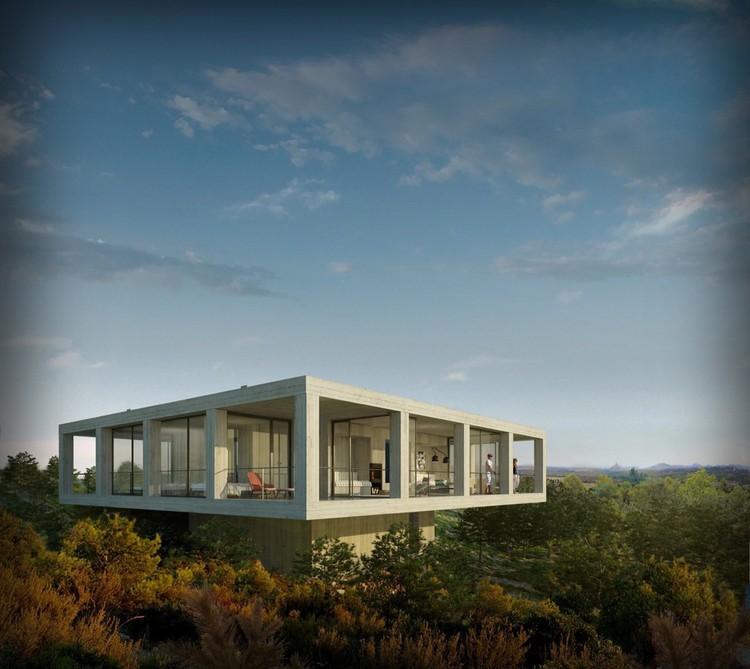
Solo House Casa Pezo is part of the Solo Houses concept, series of eight to ten vacation homes designed by some of the talented young international designers. Pezo Von Ellrichshausen Architects, Mos Office, Didier Faustino and his studio Mésarchitectures, Sou Fujimoto, Studio Mumbai, andTNA – Takei-Nabeshima-Architects are among the architects designing the 200 sqm size homes, with the first collection to be set in the countryside of Matarraña.
The Australian architecture firm IAPA recently won the South Song Museum Heritage Park competition and has wished to share their winning design with out readers here at ArchDaily. Follow after the break for an accompanying description and images from the architects.
The E Tower is a high rise residence that will serve as a landmark within its newly built urban environment while seeking to bring the amenities of a world class hotel to tower’s residents The E Tower is located in an area of Eindhoven whose urban plan was drawn up by the Dutch landscape firm West 8. The original brief for the area includes the E Tower, the E Block and a slender end piece of the adjacent Block J, which are all apartment buildings in this emerging district. A gap between the E Tower and Block J will shape the area’s entrance while simultaneously providing an outdoor space. Each building in this emerging district has been named after one of the world’s cities with the E Tower taking the title of ‘New York’, aptly reflecting its prominent stance within the cluster.
Although Brazil has been growing quickly as a nation, its economic growth has been stinted by the country’s lack of investment in infrastructure. In preparation for the 2014 World Cup and the 2016 Olympics, Brazil is expected to spend over one trillion dollars from the Brazilian government and as much as $34 billion from private investors. The money will go toward numerous construction projects designed to increase and improve upon Brazil’s roads, railways, stadiums, hotels and airports. More information after the break.
Karawitz Architecture recently announced the design for their passive co-housing project in Paris. Their principle of a self-governed independent residential initiative with 14 apartments (R+7), commercial premises, gardens (ground floor and roof area), car parks and communal areas (community house, laundry, bike shed and other areas) aims to reflect a new construction trend: private individual buyers joining together to form a cooperative to fulfil their own property and future housing project, in partnership with the SEMAVIP (Paris Site Manager) and Paris City and to share spaces and equipment.
Collaborating with Tongji Architecture Design & research Institute , Atelier XÜK has won a design competition for a renovation project of a historical elementary school in Wuxi. Additional images of XÜK’s winning design after the jump.
HMS-Plan has presented ArchDaily with their plans for the 2011 architectural competition of the main square of Ujpalota, in Budapest. Images of their proposal and a narrative from the architects after the break.
Symbiosis Designs LTD recently won the design competition to build Techno Group Headquarters in Amman, Jordan. The building massing concept creates a negative space that would be a certain interruption to the continuous street frontal façades, hence a specific and differentiated visual field is announced where the void becomes a captive. More images and brief project description after the break.
Simon Takasaki shared with us his competition entry for a monument in Duhamel, Germany. Holding the path of the history of the place and its use to its open, undefined future, the 30 meter high walk-in sculpture is characterized by the special treatment of the history of the site and the end of the mining industry. More images and architect’s description after the break.
2:pm Architectures, S. Touzani and F.&F. Oudor chose to work on the climate crisis and to think about how to recycle the actual urban matter in Bordeaux, France. This utopian answer offers to fill the block center and to cover the actual old stone buildings. In that way, the transition is really slow and time itself does their work. The old stone will disappear and let those strange big mushrooms recompose a new urban landscape. The underfaces are printed with the old roofs and stay here like a witness of the old times. More images and a brief description after the break.
For 2:pm Architectures, it is important to prove that today, building a sustainable and energy-efficient building is not necessarily synonymous with building in wood. Sustainable development must begin with a general reflection of the building process, including its materials. Therefore, the project is the choice of expressing a habitat in the density of implantation and two totaling 11 units. These two types present two ways to integrate into the site, two wills of dialogue with the slope which meet the demands of the various programmatic typologies. More images and architects’ description after the break.
The participants should take into consideration the advances in technology, the exploration of sustainable systems, and the establishment of new urban and architectural methods to solve economic, social, and cultural problems of the contemporary city including the scarcity of natural resources and infrastructure and the exponential increase of inhabitants, pollution, economic division, and unplanned urban sprawl. More information on the competition’s official website.
At a screening of The Pruitt-Igoe Myth: An Urban History in New York City, a man in front of me wondered aloud “Do you think there are more urban planners, or St. Louis people here?” The film’s crowd drew heavily from both and also attracted people with interests in social housing, modernism, racial tensions, architecture, and documentary films. Prior to the screening, the crowd was easily divided into two groups: those with an interest in Pruitt-Igoe as a case study, and those with a personal connection to St. Louis city’s triumphs and struggles. By the end of the show, The Pruitt-Igoe Myth left every viewer knowledgable about the city’s past, as well as invested in St. Louis’ future. More after the break.
Entries from across the globe have flooded in, with some of the world’s most iconic buildings being shortlisted to set the benchmark for the Architectural world in 2011. This year looks set to be the toughest competition yet. With practices flying in from all over the globe, The Emirates Glass LEAF Awards 2011 is now regarded by many of the world’s architectural community as the annual event for viewing quality international design and build projects.
The awards will be celebrated and honored at London’s Landmark Hotel on September 16th, 2011 for the buildings and design solutions that are setting the benchmark for the future of architecture and design. The Architectural community from across the globe will gather at The Emirates Glass LEAF Awards which will double up as an international networking event. This gathering of industry experts will include a judging panel comprising of key individuals drawn from various areas of the international architectural design and construction community. More images and the complete shortlist awards after the break.
Although often criticized for being especially liberal in its approach to crime and punishment, Norway focuses intensely on ensuring that ”doing time” is done in a dignified way, and inmates’ sentence should be a dress rehearsal for living a life without crime once they have completed their sentence. The Halden Prison in Halden, Norway by HLM arkitektur in collaboration with Erik Møller Arkitekter is considered to be the world’s most humae prison and it will be the new home for Anders Breivik, the Norwegian right-wing extremist responsible for the deaths of 76 people last week.
I am constantly amazed by the extremes architects go to to realize their “vision” or to impress or even merely serve a client. Clients demand so much and architects seem to willingly bend to insane schedules that tax their people to the maximum. In the age of extreme everything, architecture is extreme working.
Of course sometimes good things can emerge from the pressures of compressing schedules. There are synergistic flows that can magically occur when people are working under the pressure of an impending deadline. Granted, sometimes pressure is a good thing that allows creativity to emerge.
Voted the most important building of the 20th century in a poll conducted by the American Institute of Architects, Frank Lloyd Wright’s Fallingwater this month celebrates its 75th anniversary. This residential mountain retreat masterpiece by Wright was designed in 1935 for legendary Pittsburgh department store owner Edgar Kaufmann Sr. and his family. Drawing crowds of 160,000 visitors a year to Western Pennsylvania’s picturesque Laurel Highlands, Fallingwater redefined the relationship between man, architecture, and nature with Wright’s integrated design of the existing waterfall and the house itself. Commemorating the anniversary, Rizzoli has published a 382 page book entitled Fallingwater complete with specially commissioned photography just for this book.