This talk with designer Tom Lloyd of Pearson Lloyd and architect Louise Grassov of Schulze+Grassov, will look at the how urban design and architecture affect the way we live and move around our cities. With a presentation by both and an opportunity for questions, this talk will delve into how these two practitioners’ feel that lockdown and Covid 19 will influence the way they view their practice.
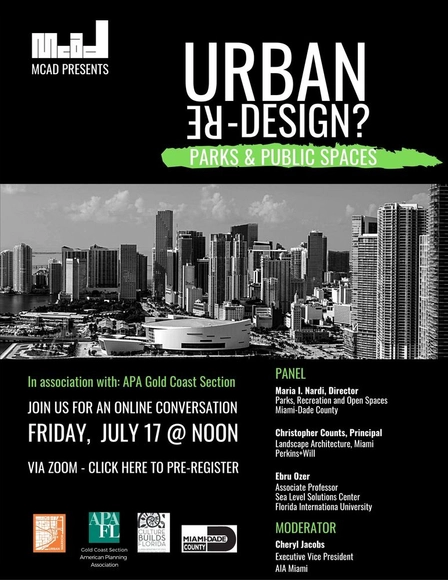
Miami Center for Architecture and Design (MCAD) will hold an online conversation where experts will discuss urban re-design in parks and public spaces.
Join us for a discussion of how university leaders are working toward enhancing the value of each student's learning experience and institutional life in higher education, with a focus on social equity.
Over the past few months, the world has experienced many significant changes and our collective relationship to public spaces is among them. How do we find a new way to exist and share in public space? How do we do that safely? Can we rediscover the joy of our public spaces and build better normal around them?
Density may be the mst universal characteristic of cities, where people, ideas, goods and services come together. This panel discussion addresses challenges—both immediate and ongoing—the coronavirus pandemic will have on the multi-family and mixed-use sites that are hallmarks of urban density. Four esteemed panelists will share informed perspectives on temporarily reprogramming large complexes toward greater public health and safety, along with their predictions of new approaches and priorities that may affect developments still in design and planning stages.
Bruce Presents, the Bruce Museum’s program series featuring thought leaders in the fields of art and science, returns on Thursday, June 4, 7:00 – 8:30 pm (EDT), with a Zoom virtual panel discussion: Architecture 20/20: New Visions for Public Spaces in the Age of COVID-19.
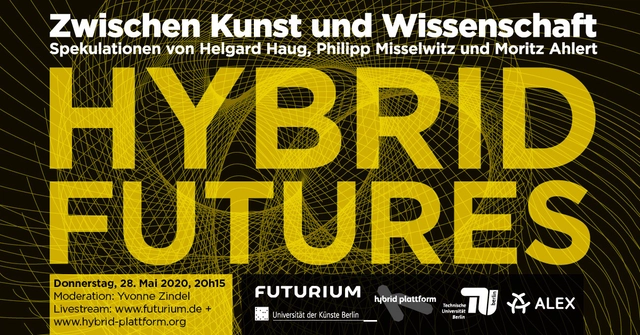
“Hybrid Futures. Speculations by Helgard Haug, Philipp Misselwitz and Moritz Ahlert” Art and science between the realms of past, present and future 28 May 2020, 8:15 pm, live at www.alex-berlin.de, with interactive participation via social media. In German. For further information about the event visit: www.futurium.de and www.hybrid-plattform.org.
Short description The Hybrid Plattform and Futurium are inviting the public to another “Hybrid Futures” event, where artists and scientists come together to talk about past and present visions of the future that have inspired their work. In the second edition of the series the author and theatre director Helgard Haug will speculate together with the
When we came together in February to celebrate the launch of Gathering, we considered transformational retail experiences rooted in brand values; the desire to physically experience a brand – both by drawing energy and inspiration from being in a store to the tactility of the product; and the role retail environments play as a third space in our larger communities. Repeatedly we heard the refrain; “bad retail is dying.” We discussed how retail brands have adapted to embody their values, designed for experiences, and built authentic connections with their consumer base. In today’s context we’re considering the future of that
Trentini Spaces and Design have created a new platform for design discussions, the first talk show for architects and designers on Zoom - Trentini Talk Show. The first season of the show is hosted by Vēsma K. McQuillan, an architect and a professor from Kristiania University College in Oslo.
Every week, an internationally recognised professional in their field will be invited to discuss current topics in architecture and design. The first episode of the show will be Isolation: a Time For Reinvention, where together with Vēsma various topics will be discussed, namely the current situation in Oslo, the question of the
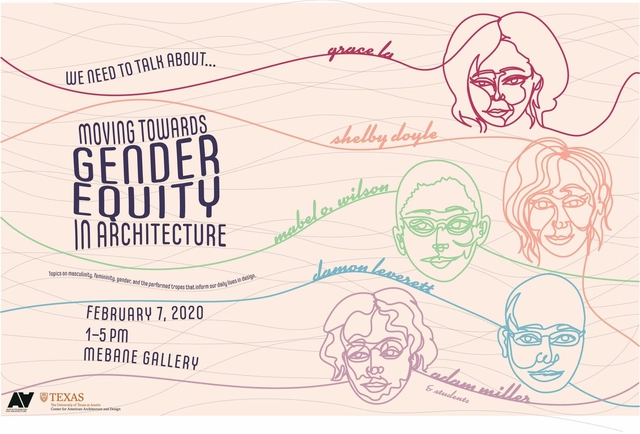
The gender chasm in architecture persists. Students see it in their mentors, practitioners experience it in the office, and media representation of the profession follows in kind. While schools of architecture are more and more demographically gender-balanced in their student populations, faculty and the practice both remain vastly skewed, indicating that programming in schools may be leading genders into the profession inequitably or “losing” certain populations along the way, or that the bridge between academia and practice is broken. This doesn’t even include the experience of people of non-binary genders in architecture, of which documentation is almost non-existent. Without equal
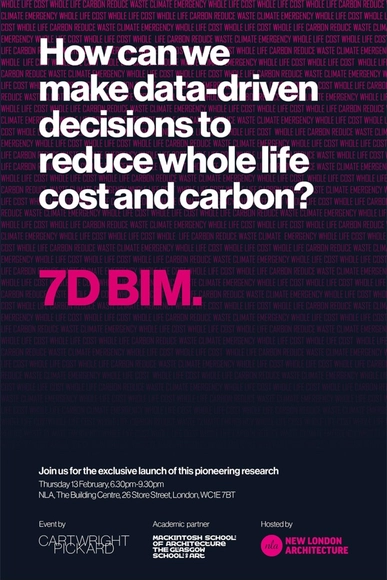
As we embark on a new decade, discussions surrounding the sustainability and longevity of our buildings have reached fever pitch, particularly within the context of the UK’s commitment to a 2050 target of carbon neutrality and a 33% reduction in whole life cost by 2025.
Leading the way in innovative thinking is Cartwright Pickard, who alongside the Mackintosh School of Architecture have conducted research into new software that will greatly assist the government in achieving these essential targets.
The revolutionary technology will integrate advanced BIM (Building Information Modelling) with cloud-based whole life cost and carbon databases, enabling those commissioning and designing buildings
On February 11, join d.talks for a conversation about storytelling and inclusion. At Let’s Talk About . . . Togetherness, our guest speakers will highlight the importance of stories in community building: Passed down over time, stories help shape people’s relationship to a place, to build community upon understanding and empathy . . . but, What happens when stories go missing, and some perspectives remain under the radar?
Let’s Talk About . . . Togetherness will take place on Tuesday, February 11, at the Calgary Central Library. Doors open at 6 p.m., program starts at 6:30 p.m. Tickets are $12
We connect with our built environment through stories, most of which are passed down over time. Join us on November 19 for an exploration on how stories go missing, or how some perspectives remain below the radar. Community is built upon understanding and empathy. What changes as we bring different stories together?
Speakers:
Avnish Nanda / Legal Advisor Michelle Robinson / Host of Native Calgarian Despina Stratigakos / Architectural Historian
When: September 19, 2019; 6:30 p.m. Where: Calgary Central Library, Patricia A. Whelan Performance Hall Tickets: $12 advance, $6 students. $15 at doors.
Los Angeles is a privatized city that has historically lacked public open space, ranking 66th in the country. Within its 4,751 square miles sprawl, there are too few places for people to congregate and recreate, especially along light rail and bus rapid transit lines, which offer a new way to experience the city.
As the region works to increase our mobility in time for the 2028 Olympic & Paralympic Games, millions of people will be successfully traversing 10 – 40 miles stretches without a car — all the way from Westwood to Downtown, Long Beach to Montclair, Santa Monica to Hollywood.
Join design talks (d.talks) in a discussion on the role of design in an often overlooked topic: waste. In two generations, we’ve shifted from refillable glass bottles to single-use packaging. Serial replacement has become invisible. Our city has reduced tonnes of waste entering the landfill with recycling and composting options. If we envisioned a future of zero-waste, what’s left to be done?
To explore the subject, d.talks is bringing together a panel to talk about waste from different perspectives. The panel includes Lourdes Juan, founder of the Leftovers Foundation; Sharon Howland, leader of program management for waste and recycling at the City
A public event at Harvard GSD examines the lower sky as a site of mobility
Increasing congestion and advances in autonomous technology are set to transform how we move around our cities. Many are now looking to the sky — the third dimension — as an expansive space for new kinds of mobility. Autonomous flying vehicles, such as cargo drones and flying taxis, have the capacity to disrupt how we move goods and passengers around urban space. Responding to these real-world changes, AERIAL FUTURES: The Third Dimension examines Urban Air Mobility (UAM), asking how scalable and on-demand UAM models could reduce road traffic, pollution, accidents and the strain on existing public transport networks. Within these opportunities are also challenges to overcome: noise, community acceptance, safety, cyber security and seamless integration with existing aircraft operations.