The exploratory mud structure project, designed and built by Architecture for Humanity Tehran (Rai Studio) + Architecture Faculty of Razi University, demonstrates a strong focus on humanitarian design through sustainable and low budget construction methodologies. The workshop not only provided the students with an enriched academic experience, but the opportunity to reach out to an underdeveloped region. More images and their description after the break.
Late last month the AIA announced that it is in support of the International Green Construction Code (lgCC) which will be a guide and model that helps architects and builders design buildings that conserve energy and move to a sustainable design strategy. The AIA is part of a long list of supporters which include ASHRAE, the US Green Building Council and the Illuminating Engineering Society. For architecture and engineering, this is a step in the right direction. This provides designers with a tool that makes responsible design less cryptic by offering solutions for energy saving strategies.
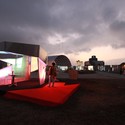
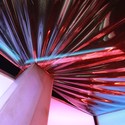
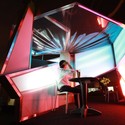
15:15 Raincatcher by YS Groundwork is the result of a competition entry for the contemporary design of one of Hong Kong’s oldest urban traditions: the Hawker Stall – Dai Pai Dong. A Hawker Stall is a kitchen, a dining room and a living room – a space for passersby to enjoy public space, interact with strangers, and grab a bite to eat on their way to their next destination. Initially exhibited at the 2009 Hong Kong Shenzhen Bi-City Biennale of Urbanism and Architecture, YSGroundwork has won the opportunity to realize their design and prove that their twist on tradition will add vitality and innovation to the Hong Kong’s streetlife.
The New York office of top international architecture and design firmPerkins Eastman shared with us their design for the Lekhwiya Sports Complex—a mixed-use sports venue that will be the home stadium for Qatar’s premier football team, Lekhwiya Club. The 19,529 sm (210,210 sf) complex also will be used as a training site and home base for a guest team participating in the 2022 World Cup. More architects’ description after the break.
Upon finishing their second film, Waterline: Chicago’s Urban River Corridor, Adam Gross from Spirit Of Space shared with us the third and final film of the series on the Phil EnquistHarvard Studio. As a walk through the students’ final designs, 12 DESIGNERS, 12 VISIONS presents the culmination of an intense research-based design project for this eclectic group of students.
Denton Corker Marshall recently won an international design competition to design the new Australian pavilion in Venice’s Giardini della Biennale, the heart of the prestigious Venice Biennale events. The new pavilion will be the first of the 21st century contributions to the Giardini, which is undergoing revitalisation by the Venice Biennale. It will replace Australia’s current pavilion, designed as a temporary structure by Philip Cox in 1988. Within a footprint of approximately 320m2, the two-level pavilion will provide a new flexible and adaptable exhibition space to showcase Australian visual arts and architecture to international audiences at annual biennales. More images and architects’ description after the break.
Taking place at the University of Oregon from August 11-20, the ‘Marking the Forest’ design workshop will be run by Satellite Architects for the Architectural Association as they will explore the inner workings of the forest, investigating the biodiversity of the woodland and the commodification of the tree. They will skim the surface of the politics of the forest and conceptualize this information into a design that will be realized in the forest. The workshop will be divided into research (studio and woodland lectures), experience (raft trip and mill visits), design (studio design and crits with prototype building in the workshop) and assembly (assembly in the woodland). The project will also be documented and presented as a book from AA Publications. The deadline for applications is July 28, 2012. More information after the break.
Known as an architect, artist and cartoonist, Jimenez Lai has lectured on and exhibited his work nationally and internationally. He is known for his imaginative cartoon narratives and architectural installations. He is the founder of Bureau Spectacular and currently an assistant professor at University of Illinois at Chicago. His graphic novel, Citizens of No Place, will be published by the Princeton Architectural Press with a grant from the Graham Foundation this year.
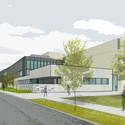
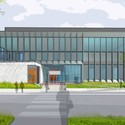
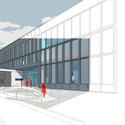
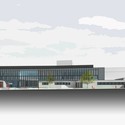
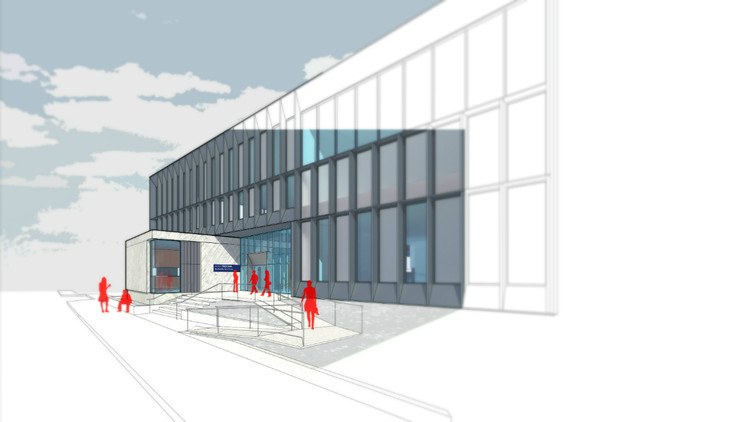
Deborah Berke & Partners Architects have released their plans for the expansion and renovation of I.M. Pei’s 1969 Michael C. Rockefeller Arts Center (RAC). Located at Fredonia’s State University College in New York, the visual and performing arts complex has served as a major cultural center for western New York and northwestern Pennsylvania. Continue reading after the break for more.
The West Kowloon Cultural District Authority (WKCDA) recently launched a design competition to deliver one of the first landmark buildings for the West Kowloon Cultural District, the Xiqu Center. The Chinese opera venue will provide a world-class facility for the preservation and development of the art form in Hong Kong and will be designed to host and produce the finest examples of Cantonese and other Chinese opera performances.The Xiqu Center, scheduled for completion around the end of 2015, will be the first of 17 core arts and cultural venues to be opened within the District and one of 15 proposed performing arts venues. The deadline for submissions in April 10, 2012. More information on the competition after the break.
The Slant Awards Spring 2012 competition, which is open to all, challenges participants to design a concept plan for a city sector which is undergoing urban renewal. The city in question is not a real city, it has been designed solely for this competition, and its location is not being specified. It is a generic city that could be almost anywhere in the world and participants are free to choose the country in which you would like this imaginary city to be located. This is a worldwide competition open to all those who have an interest in landscape design and urban planning, and students are especially encouraged to enter. The deadline for submissions is June 11, 2012. For more information, please visit their official website here.
Among the guests, there will be architects and structure designers, winners of 9 important awards, such as Residential Property Award 2011, The Emirates Leaf Glass Awards 2011, World Architecture Festival 2011 and European Steel Design Awards 2011. Alongside these experts, there are also going to be present world leaders in glass field – Saint-Gobain Glass, Guardian and AGC – and leaders in curtain walls – Permasteelisa. We invite you to INGLASS to meet those who will create tomorrow’s architecture. More after the break.
We recently received a book we wished we had earlier, Writing About Architecture. Lange’s book pulls from “lessons learned from her courses at New York University and the School of Visual Arts.” ”The book offers works by some of the best architecture critics of the twentieth century including Ada Louise Huxtable, Lewis Mumford, Herbert Muschamp, Michael Sorkin, Charles Moore, Frederick Law Olmsted, and Jane Jacobs to explains some of the most successful methods with which to approach architectural criticism.” The book “could serve as the primary text for a course on criticism for undergraduates or architecture and design majors.” We here at ArchDaily are now using it as a resource. We have a feeling the pages will be worn through pretty quickly.
https://www.archdaily.com/215279/writing-about-architecture-alexandra-langeAmber P
Designed for the Boral Brick Awards 2011-2012, ‘The Urban Cloak’ proposal by Jonathan Gibb is an addition to an existing inner city 2 storey brick building, to adapt and add a multi-levelled apartment building. A cloaked figure; standing amongst the debris of style, industry and waste: veiled by a multiplicity of individual bricks, reading as one. At once a sun and rain screen, and veiling against on-lookers sight. The existing building is left, but affected by the new. Its old roof is discarded and the paint of the facade shed, revealing the identity of the brick. More images and architects’ description after the break.