International architecture firm Kohn Pedersen Fox Associates (KPF) recently announced that their design for the 120 million square foot master plan for Meixi Lake in Changsha, China is being realized. A new city in the West Changsha Pioneer Zone in Hunan Province, Meixi Lake is centered around a 3.85 kilometer‐long lake. Upon completion, the city will be home to 180,000 inhabitants, and will provide residents, workers and visitors sustainable neighborhoods for living, working, recreation, culture and entertainment. More images and architects’ press release after the break.
The first prize in the DesignByMany competition for the Bus Shelter challenge was recently awarded to Milos Todorovic for his AdaptByMany proposal. By adapting to local conditions, transferring aesthetic ideas to users, and putting functionality as its primary role, this proposal stood out. According to Glenn Katz, one of the DesignByMany judges and an AEC Education Specialist at Autodesk, the proposal was chosen for “its simplicity, providing a rich kit of parts and elements that can be combined in interesting and flexible ways to create any number forms responding to site conditions.” More images and Todorovic’s description after the break.
KSP Jürgen Engel Architekten was just awarded the first prize for their design of the Dual Tower for the High-Tech and Research Campus in Foshan, China. The 170-meter high dual tower denotes the start of the new business district in the south of the city, a prefecture-level city in the southern Chinese province Guangdong. Its exposed location, height, and function in the urban fabric as the first building on the Sino-German High-Tech and Research Campus means that the dual tower is conceived as a landmark. More images and architects’ description after the break.
Earlier this week, Architect Robert K. Levy optimistically declared that the study which will evaluate the federal law limiting Washington building heights is a “win-win” situation for everyone involved. Writing for The Washington Post, Levy states: “By conducting a detailed, comprehensive city-wide study, the D.C. Office of Planning and the NCPC will produce analyses and recommendations leading to a fine-grain, strategic plan for building heights across the District. Ultimately this study is a win-win proposition for all stakeholders.”
But can the situation really be so rosy? While Congress spends 10 months studying and debating the possibility of making alterations to the capital’s zoning policies, urbanists, planners and citizens have already begun weighing in on the matter – and opinions are decidedly divided. Many question the true motivations behind the possible changes, and whether those changes will truly improve the livability and sustainability of the city - or just alter it beyond recognition.
We’ve gathered both sides of the argument so you can make your own informed decision – after the break…
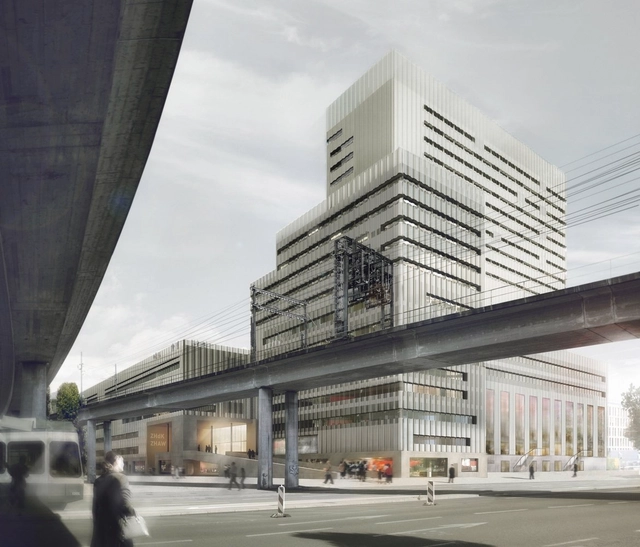
The Toni-Areal is a crucial part of the plan to breathe new life into Zürich West. The building was formerly a milk processing facility, and the new design by architecture firm EM2N features spaces for cultural events, as well as the Zürich University of the Arts and two departments of the Zürich University of Applied Sciences.
The Toni-Areal is one of the largest construction projects ever undertaken in Zürich and will be the largest construction site in Switzerland during its realization phase. The total usable floor space is 108,500 m2, of which the colleges comprise 84,500 m2. The remaining 23,500 m2 are dedicated to housing, cultural events, restaurants, and small retail shops, as well as parking and technology. The construction price—including basic upgrades and tenant upgrades—amounts to about 350 million Swiss francs.
The Bartlett School of Architecture, UCL teamed up with Roca London Gallery to create the MArch Architecture Unit 22 end of year show – ‘Bartlett Architecture Dares to Care’, which is on display until December 18. Executed through the creation of Zoetropes, their study was focused on social and environmental sustainability, and the role architecture plays in preserving and empowering vulnerable communities. Each Zoetrope depicts the daily actions of an individual belonging to a vulnerable community. By designing for the everyday tasks, consideration is given to the role the built environment plays in protecting or helping them, rather than focusing purely on aesthetics. For more information, please visit here.
Presented by The Architectural Review and sponsored by the Danish architectural hardware design company, d line, the winners of the 2012 ar+d Awards for Emerging Architecture for young professionals under the age of 45 included projects of exceptional merit. This year’s four winning projects include a glass house in Japan, a community centre in rural earthquake-prone Bangladesh built on low-lying land susceptible to chronic flooding, an innovative 10-family condominium in Winnipeg, and temporary facilities for a nomadic music festival that had been commissioned at the last minute due to emergency circumstances. Original and practical, thoughtful and inventive, these projects demonstrate fresh approaches to a variety of architectural challenges. More information after the break.
The Seville 24/7 center, proposed by Ayrat Khusnutdinov & Zhang Liheng, adopts the famous Spanish traditions of street life. Their project would create a retreat from the harsh sun of Andalucia, Spain and extend the street life to 24 hours of the day and 7 days of the week. Seville 24/7 is not only about holiday or cultural side of Seville, but more importantly, everyday human interaction. More images and architects’ description after the break.
The Sketch, Script, Score. Figures of Architectural Thinking event is a conversation between Wiel Arets, Peter Wilson and Cino Zucchi presenting the “Inspiration and Process in Architecture” Moleskine book series. The event takes place at ANCB The Metropolitan Laboratory in Berlin on December 14th at 6:00pm. Which role does drawing still have in the design process? Which are the most frequent sources of inspiration to influence the theoretical work that is behind the making of architecture? The debate means to investigate the role that tools like drawing, sketching, taking notes, still have in the design process of contemporary architects. The discussion will encourage debate on what could be the tools of architectural thinking and design, in relation to drawing which remains the most powerful means of conceptualizing and representing architecture.
The proposal by Joan Alomar, of Estudio Lunar, presents a building that completes the urban block and blends in to the neighborhood of Casablanca. This concept leads the architecture that mimics the events at it’s surroundings, the nature, vernacular architecture, etc. To blend is the rational sustainable concept to exist without causing a disturbance. Sustainability as a complete concept is not only about saving energy, the building first needs to be socially useful and improve the neighborhood, that’s the first target of this market; it’s not only a market hall. More images and architects’ description after the break.
The proposal for the ‘Yad Lebanim’ (Fallen Sons’ Commemoration) memorial homes are designed as programmatic hybrids, teaming a military memorial hall with a civic community center. Designed by architects Moshe Fluhr, Lee Davidson Lehrer, and Yinnon Lehrer, the project reflects a constant dualism in Israeli Society, struggling to exist between the extremes of past and present, war and peace, sacred and profane. The 2.5 hectare site, which is situated in the entrance to Ramat Yishay, gives the opportunity to answer the needs of the community, while creating a building that emblemizes local values. More images and architects’ description after the break.
In the virtualized information era, Plan 01 believes the design for the Helsinki Central Library should be more than ever a “physical space”. The project should be a place for sensory experience, a place where culture becomes an opportunity to meet and exchange ideas, a place where the civil forum is recovered from the virtual and returned to the urban world. Their concept becomes a symbol in stone and wood that opens its heart to the city and offers visitors a retreat for body and mind. More images and architects’ description after the break.
Swiss architecture practice, Boltshauser Architekten, recently won an international competition to design a new aquarium in the center of Basel, Switzerland. Their concept, titled ‘Seacliff’, was noted by jury members as being the best match for the public image cultivated by the Basel Zoo. The above-ground building space proposed by Boltshauser was smaller than any of the other competition entries, offering the best solution from an urban development perspective. Beating out such prominent firms as Zaha Hadid Architects, David Chipperfield Architects, and Caruso St John Architects, Boltshauser’s winning project is due for completion in 2019 with an estimated cost of £54 million. More images and information after the break.
Temple University’s Master of Architecture program is now accepting applications for fall of 2013. Located in Philadelphia, a thriving cultural center with a vibrant community of architects and designers, the program connects students with leaders in the profession, including local practitioners and prominent national educators.
The Master of Architecture program of the Tyler School of Art is housed in the new architecture building within Temple University’s Center for the Arts, where students and faculty work alongside colleagues from Fine Arts, Music and Dance, Film and Media Arts, and Theater. The architecture building has state of the art equipment for digital fabrication and studios and labs for all of the department’s programs.
This week we’re going to spotlight one of our greatest contemporary filmmakers, Tim Burton. In the 1989 film Batman, Burton generates a whole gothic environment, full of art deco and art nouveau buildings within Gotham City. Locations were inspired by urban spaces from New York City, Los Angeles, West London, Chicago, Pittsburgh, Tokyo, to Hong Kong (even though Gotham City was a well-known nickname for New York City, before Batman was ever written).
If you didn’t check out our article on Architecture & Batman, do so now – and let us know which Director you think does Gotham best in the comments below…