

Miu Miu Aoyama Store / Herzog & de Meuron

Miu Miu Aoyama Store / Herzog & de Meuron - FacadeMiu Miu Aoyama Store / Herzog & de Meuron - Table, ChairMiu Miu Aoyama Store / Herzog & de Meuron - ColumnMiu Miu Aoyama Store / Herzog & de Meuron - ChairMiu Miu Aoyama Store / Herzog & de Meuron - More Images+ 7

Tokyo, Japan
  • Category: Store
  • Herzog & De Meuron Team: Jacques Herzog, Pierre de Meuron, Stefan Marbach, Iva Smrke Kröger, Yuko Himeno, Caetano Braga da Costa de Bragança, Osma Erik Lindroos, Roman Aebi, Cristina Génova, Carlotta Giorgetti, Yuki Hamura, Ryuhei Ichikura, Christina Liao, Áron Lőrincz, Keisuke Ota, Günter Schwob, Mariana Vilela, Tiffany Wey
  • Executive Architect: Takenaka Corporation
  • Structural Engineering (Sd Phase): 
Schnetzer Puskas Ingenieure ag, Basel, Switzerland
  • Lighting Consultant: 
Sirius lighting Office Inc., Tokyo, Japan
  • Facade Engineering (Sd): Emmer Pfenninger Partner ag, Münchenstein, Switzerland
  • Landscape
: Vogt Landschaftsarchitekten, Zürich, Switzerland
  • Structural Engineering: 
Schnetzer Puskas Ingenieure ag, Basel, Switzerland
  • Façade Engineering: Emmer Pfenninger
  • City: Tokyo
  • Country: Japan
More SpecsLess Specs
Miu Miu Aoyama Store / Herzog & de Meuron - Facade
© Nacasa & Partners

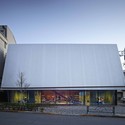
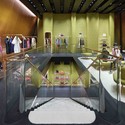
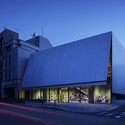
Text description provided by the architects. The project for Miu Miu is sited diagonally across the street from the celebrated Prada Tokyo Epicenter – also designed by Herzog & de Meuron – in an elegant neighborhood that has, over the past two decades, become a showplace of architectural invention. In contrast to the transparency of the all-glass Prada building, however, the understated metallic surface of the Miu Miu façade is opaque, which lends a more intimate quality. The architects say: “Contrary to expectations for a site that is home to so many luxury brands, Miyuki Street in Aoyama Tokyo is not particularly beautiful or elegant. The architecture is heterogeneous – a hodgepodge of freestanding buildings of different heights and shapes, with neither historical tradition nor common standards. Never meant to be a space of its own, the street is a purely technical and functional link between Omotesando and the Aoyama Reien cemetery farther down the road. Despite single trees here and there, the atmosphere is not inviting, like a boulevard or a plaza. Tokyo is pure, quintessential city, its territory exploited to the full with absolutely no leeway for the individuality that we take for granted in European cities.

Content Loader

Project gallery

See allShow less
About this office
Cite: "Miu Miu Aoyama Store / Herzog & de Meuron" 31 Mar 2015. ArchDaily. Accessed . <https://www.archdaily.com/614983/miu-miu-aoyama-store-herzog-and-de-meuron> ISSN 0719-8884

© Nacasa & Partners

Miu Miu 青山店 / 赫尔佐格和德梅隆事务所

You've started following your first account!

Did you know?

You'll now receive updates based on what you follow! Personalize your stream and start following your favorite authors, offices and users.