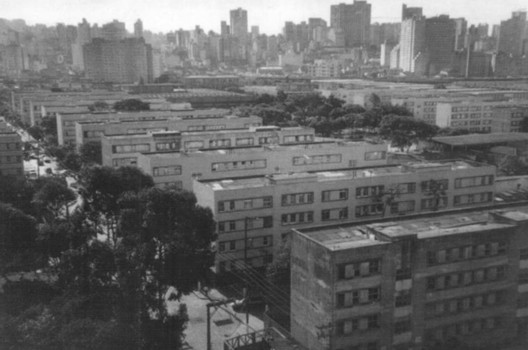
The original plan for the Várzea do Carmo Housing Complex, developed by a team from the Industrial Workers' Retirement and Pensions Institute (IAPI) and coordinated by the architect and urban planner Attilio Corrêa Lima, is one of the most avant-garde proposals of the period discussed in this book. Its urban planning, radically modern and rationalist, goes beyond established models of residential neighborhoods: it proposes creating an urban centrality with a working-class housing complex as its starting point.

Located adjacent to the Tamanduateí River valley, on a vacant plot of land about one kilometer from Praça da Sé—the point zero of the city of São Paulo—the complex was conceived as an urban development hub in an undervalued area on the outskirts of the center, along the axis leading to the Ipiranga neighborhood, an area of high industrial concentration.