One in three streets in the city center of Barcelona will be transformed into a green axis to prioritize pedestrians and cyclists over cars. Along these streets, 21 intersections will be converted into public spaces so that everyone in the area has access to a park less than 200 meters away.
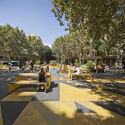

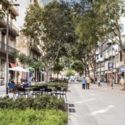
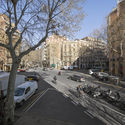

“We want Barcelona to be a sustainable, livable city!” explains Janet Sanz, deputy mayor for ecology, urban planning, and mobility. “And we know that today, in our public spaces, we have many social and community activities. But we also know that public space is dominated by private car transportation—whether moving vehicles or parking spaces.”

The new urban plan will be implemented over the next 10 years at an estimated cost of $44 million. This project is a variation of the “superblocks” concept, a design that limits car traffic within a nine-block area, allowing vehicles to circulate only around these spaces.
Superblocks
“The idea behind superblocks is to take space away from cars and give it back to people, as 60% of public space is currently occupied by cars,” reports Mark Nieuwenhuijsen, a researcher and professor at the University of Barcelona’s Health Institute, who was responsible for the study analyzing the health impacts superblocks will have on the population.
Urban planner Salvador Rueda’s original proposal aimed to reduce air and noise pollution levels, encouraging more people to engage in physical activities in public spaces, increasing green areas, and also combating the formation of urban heat islands.
In 2016, Barcelona created a superblock in the Poblenou neighborhood. Rueda had envisioned 500 similar spaces in his proposal, which would improve public health and could prevent up to 700 premature deaths per year, according to Nieuwenhuijsen’s study.

A Modern Reinterpretation
This new urban plan is a simplified version of the superblocks, as it does not restrict vehicle traffic across the entire area involved, making it easier to accept. “There is resistance to limiting vehicle use in Barcelona,” the professor explains. Some business owners believe that reducing car traffic could have a negative impact on sales, when the opposite has actually been proven—pedestrians tend to window-shop and enter more stores than drivers.
Although these changes are considered “minor” compared to the original plans, they already help improve the area. The Eixample neighborhood, chosen as the setting for this new urban proposal, was originally designed to feature large green areas, but over the years it became occupied by apartment blocks and other developments.
By limiting traffic and vehicle parking on 21 streets while implementing bike lanes, bicycle racks, playgrounds, and green areas, public health will benefit from access to parks and spaces for physical activity, as well as a quieter environment with cleaner air and a milder climate.
Fewer Cars, Better Health
According to Nieuwenhuijsen, this initiative should be widely replicated. Switching to electric cars does not offer a complete solution to the urban problems associated with automobile use. Car pollution does not come solely from engine emissions; it is also caused by tire wear, which releases microplastics and a highly polluting “dust.”

Car use also encourages sedentary lifestyles and increases the demand for roads and parking spaces that displace green areas. Furthermore, vehicles are among the leading causes of death worldwide. In a relatively small city like Barcelona, it makes perfect sense to prioritize alternative modes of transport, while also considering ways to reduce the need for travel—an issue that should be included in future urban planning proposals.
Via CicloVivo.
This article was written by Natasha Olsen. The translation is powered by AI.