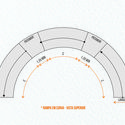
Fitting a ramp into a layout can be a designer's nightmare. But anyone who has ever had to climb a steep ramp in a wheelchair or push someone else knows firsthand how much of a difference a well-designed ramp makes. NBR 9050, from 2015, establishes the technical criteria and parameters to be observed in the design, construction, installation, and adaptation of buildings, furniture, spaces, and urban equipment to ensure accessibility.
To make our readers' lives a little easier, we will compile some Brazilian technical standards into short, simple, and highly visual posts. This, of course, does not replace a thorough reading of the actual standard to resolve more specific questions related to all aspects of the design. However, we will highlight several key points to consider when designing in compliance with the code. For designing accessible ramps:
The first step is learning how to calculate the slope using a simple equation: