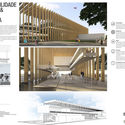
Participating in architecture competitions can be a great opportunity to boost a firm, or to step away from the routine by developing ideas that wouldn't normally pass a client's scrutiny. However, to catch the jury's attention among hundreds of entries, the project's graphic presentation plays a key role. Beyond presenting relevant ideas in response to the brief's questions and debates, an organized board is essential as a synthesis of the process. In trying to compile these ideas graphically, a series of questions arises regarding the presentation style and how it will help convey the project's core concepts clearly to the jury.
Plans, sections, elevations, collages, renderings, diagrams, texts, and graphic elements. Board dimensions never seem large enough to hold so much information. With this in mind, we have compiled a series of essential tips for developing your boards in architecture competitions. Check them out below:
Composition


.jpg?1528722204 "Competition Board Layout: Do's and Don'ts")