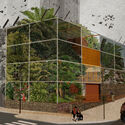
Around 80% of the Brazilian population lives on what was once forest and is not even aware of it. In Brazil, history has been—and continues to be—forged by opposing the city to the forest, within a civilizational matrix fundamentally based on the devastation of native ecologies and their replacement by monocultures and invasive species. In just a few centuries, we have transformed a megadiverse forest continent into sterile environments through urban standardization, bleak architecture, and unsustainable landscaping, imposed as a design project. We live on former forests but resist thinking of cities as forest ruins. [1]