New Architecture for New Maribor Art Gallery Competition Results

The Maribor Municipality (Slovenia) and the jury members under the auspices of the International Association of Architects announced the winners and award holders of the open international competition for the new UGM / Maribor Art Gallery. The Competition Committee received over 200 attractive entries from around the world proposing solutions for the new, 14,000m2 UGM including 8,000 m2 of gallery premises, a Children’s Museum, an Architectural Centre and a Creative Industry Centre, museum library and retail.
See the winners and honourable mentions after the break.
House in Hamadayama / K+S Architects

Architects: K+S Architects / Nobuya Kashima + Aya Sato
Location: Tokyo, Japan
Structure Engineer: SHI (Takumi Shinbo)
Site Area: 178.83 sqm
Built Area: 89.12 sqm
Total Floor Area: 141.69 sqm
Project Year: 2006
Photographs: Hiroshi Ueda
Bibliotheque Montarville-Boucher-de la Bruere / Briere, Gilbert + Associes

Architects: Briere, Gilbert + Associes
Location: Boucherville, Québec, Canada
Project Architect: Martin Briere
Existing Area: 1,700 sqm
Extension Area: 1,470 sqm
Budget: $3.4 M
Project Year: 2009
Photographs: Christian Perreault
Between Cathedrals / Alberto Campo Baeza

Architect: Alberto Campo Baeza
Location: Cádiz, Spain
Project Year: 2000-2009
Photographs: Javier Callejas
Hiding in Triangles / Philip Modest Schambelan + Anton Fromm
Schambelan + Fromm teamed together to design a mountain bike hotel in Pregasina, Italy. The hotel seems to cling to the side of a mountain, approximately 500 meters above the northern tip of Lake Garda. With the project’s geometric contorted aesthetic and proximity to a variety of routes, trails and single tracks, the hotel intends to attract extreme sports enthusiasts who would be visiting the Alps.
More about the hotel after the break.
Silhouette® FR Window Shadings / Hunter Douglas Contract
This month, we would like to introduce Silhouette® FR Window Shadings, a great product from the Window Coverings line of Hunter Douglas Contract.
A category-defining combination of functionality and appearance, Hunter Douglas’ exclusive Silhouette FR ® windows shadings filter light while reducing glare as well as block light and provide privacy. Suspended between two sheer facings of polyester, adjustable fabric vanes can be raised and lowered like standard shades and opened or closed like horizontal blinds.
When the vanes are open, the shadings work like sheers, filtering light to eliminate glare and create an inviting glow. Vanes can be tilted to block light and provide privacy, and the shadings roll up completely into a slim headrail, allowing unobstructed views.
Key Features
- GREENGUARD Indoor Air Quality Certified® and GREENGUARD Children and Schools certified for low-emitting products’
- Fabrics meet all requirements of NFPA 701 small scale flammabiltiy testing for commercial applications
- Up to 88% ultraviolet protection with vanes open and 99% with vanes closed
- Motorization available
- Backed by Hunter Douglas Contract Lifetime Guarantee
Product Details
- Headrail: 3″ x 2-9/32″ or 3-3/16″ x 2-1/2″, standard/tilt-only/oversized configurations, fabric-covered.
- Mechanism: continuous cord loop.
- Fabrics: 18 colors, all FR *, avaliable in Originale™ classic translucent woven fabric and Bon Soir™ light-dimming fabric.
- Widths: 12″ to 96″ (standard), 6″ to 11-7/8″ (tilt-only), 12″ to 120″ (oversized).
- Heights: 16″ to 96″ (standard), 16″ to 120″ (oversized and tilt-only). Minimum height for motorized products is 12″.
- Options: motorization/remote operation, inside/outside or end mount, dust covers, non-standard cord drop lengths, 2-on-1 headrail.
Fabrics & Colors
Originale™ Translucent Fabrics

Bon Soir™ Light Dimming Fabrics

Technical Information

1. Headrail End Caps
2. Limit Screw Assembly
2a. Limit Screw
2b. Rotator
2c. Limit Nut
3. Screw
4. Universal Rotator Rail
5. Clutch Assembly
6. Screw
7. Cord Loop
8. Universal Cord Tensioner
9. Headrail (OPTIONAL: Fabric Covered)
10. Ratchet Limit Assembly
11. Bottom Slat
12. Bottom Rail
13. Bottom Rail End Caps
14. Balance Weight
15. Weight Clips
16. Fabric
17. Hold-Down Bracket
18a. Universal Cord Tensioner Mounting Bracket
18b. Universal Cord Tensioner Mounting Bracket Flush Mount
Design Options
EASYRISE™
This continuous cord loop and clutch assembly makes operating large shades easier.
TOP-DOWN/BOTTOM-UP
Provides the ultimate choice in versatility, with the option to operate shades from the top down, the bottom up, or in combination to meet all your privacy needs while still giving you access to natural light.
TWO-ON-ONE HEADRAIL
Two shadings share the same headrail; each shade operates independently.
SPECIALTY SHAPES
Uniquely shaped windows pose challenges in providing privacy and light control and keeping your space energy efficient. Hunter Douglas has taken on these challenges by offering the following options: perfect and imperfect arch, perfect and imperfect extended arch, circle, angle, octagon, oval, hexagon, trapezpoid, perfect and imperfect quarter circle. Vanes remain in fully opened position and are non-operable. Inside mounts only.
MOTORIZATION
Versatile range of motors and controls to maximize shading benefits.
TILT-ONLY
For narrow windows. Shades cannot be raised or lowered, but vanes may be positioned from fully open to fully closed.
ADDITIONAL OPTIONS
Inside mount, outside mound, end mount (max width = 84″), dust covers, optional cord drop lengths – color-coordinated sizes: 2′, 3′, 4′, and 5′ for standard and oversized rails. White available in a 1′ length, and 12′ increments from 6-16′ lengths.
Projects that use this product
Smedinghuis
Rabobank
This post is part of our ongoing effort to create a database of architectural products, a useful resource for all architects, with the help of our partners.
Hunter Douglas Contract is a business partner of ArchDaily.
“Have a Nice Day” / We Are You
Swedish architects We Are You were recently awarded 1st price in a competition for their proposal “Have a Nice Day” for a new student residential house in Toronto, Canada. You can see more images, a video, and the architect’s description after the break.
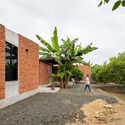
Tropical House / Camarim Architects

Architects: Camarim Architects
Project Location: Mundau, State of Ceara, Brazil
Project Architects: Vasco Correia & Patricia Sousa
Site area: 2,400 sqm
Floor Area: 400 sqm
Project Completion: 2008
Photographs: Nic Olshiati
Roadmap 2050: A Practical Guide to a Prosperous, Low-Carbon Europe.
AMO is a design and research studio inside OMA, a think tank operating on the boundaries of architecture: media, politics, sociology, sustainability, technology, fashion, curating, publishing and graphic design. Some of their works include the barcode flag for the EU and a study for Wired magazine.
And while OMA covers sustainable strategies on a building or master plan scale, AMO is approaching it on en European scale as one of the five consultants conducting technical, economic and policy analyses for Roadmap 2050, an initiative by the European Climate Foundation which looks to chart a policy roadmap for the next 5-10 years based on the European leaders’ commitment to an 80-95% reduction in CO2 emissions by 2050. You can download a brief of Roadmap 2050 in PDF.

The goal is to achieve a 2% energy efficiency saving per year in order to meet this goal, with power and vehicle transportation being the most important areas.
Through the complete integration and synchronization of the EU’s energy infrastructure, Europe can take maximum advantage of its geographical diversity. The report’s findings show that by 2050, the simultaneous presence of various renewable energy sources within the EU can create a complementary system of energy provision ensuring energy security for future generations.
AMO’s work focuses on the production of a graphic narrative which conceptualizes and visualizes the geographic, political, and cultural implications of the integrated, decarbonized European power sector.
On their study you can find an interesting approach to a diverse european energy grid, including energy trade and the use of new non-traditional sources.

The image of “Eneropa” appears as a new continent based on its energy production: Biomassburg, Geothermalia, Solaria, the Tidal States… are part of this new territory. Other branding concepts are introduced on the study, creating a tangible image of this ambitious plan, which reminds the powerful (yet simple) idea behind the barcode flag.
You can download the full study in PDF format at the Roadmap 2050 website.
More after the break:
Cave Restaurant / Koichi Takada Architects

Architects: Koichi Takada Architects
Location: Maroubra, Sydney, Australia
Project Team: Koichi Takada, Robert Chen
Construction: Bonar Interiors
Project Year: 2009
Photographs: Sharrin Rees & KTA (under construction)
Winners announced for Four Mile Run Bridge Competition
The Four Mile Run Bridge Competition has announced its winning entries, awarding Team Arup/Grimshaw/Scape with the First Prize.
For years, Northern Virginia’s Four Mile Run has functioned as a flood control channel and a border between the City of Alexandria and Arlington County. More recently, growing community interest in revitalizing and celebrating the Run has resulted in the Four Mile Run Restoration Master Plan. The plan outlines a broad range of ambitious, feasible goals to restore the ecology of the Run while re-establishing it as a cherished park space and a means of stitching together communities.
The winning team was chosen based on the strength of their professional skills and the potential for their conceptual design to become an icon for the Four Mile Run and its surrounding community.
Seen at Bustler. See the winners after the break.
Grappa / Katsuhiro Miyamoto & Associates

Architects: Katsuhiro Miyamoto & Associates
Location: Takarazuka, Hyogo, Japan
Site Area: 116.70 sqm
Built Area: 50.36 sqm
Total Floor Area: 114.70 sqm
Project Year: 2006
Photographs: Courtesy of Katsuhiro Miyamoto & Associates
Vakko Headquarters and Power Media Center / REX

Last year we presented you this interesting project by REX during its construction stage, where you could see how an unused structure was converted into the new headquarters for Vakko, integrated with a new complex steel structure. The project is now completed, and we can see the final result with photos by Iwan Baan and a complete set of drawings and diagrams courtesy of REX.
Despite the mix of the existing concrete structure with the new additions and the complex inner core (dubbed the “showcase”), the exterior of the building is read as a whole. The structural “X” of the glass panels on the facade break the monotony of the box on the outside, contrasting with the mirror like finish of the volume on top.

The “showcase” fills the central void with a mirror finish that turns the volume into a sculpture (as seen on the photos and on the showcase elevations below), while housing different programs that benefit from the arrange of the boxes, such as the auditorium, meeting rooms and showrooms.
REX once again shows innovative structural solutions in relation with the program, together with new uses of materials as we previously saw on the Wyly Theatre in Dallas.
After the break, the architect’s description:
Location: Istanbul, Turkey
Clientes: Vakko and Power Media
Architect: REX
Key personnel: Erez Ella, Tomas Janka, Mathias Madaus, David Menicovich, Tsuyoshi Nakamoto, Joshua Prince-Ramus, Ishtiaq Rafiuddin, Tieliu Wu
Consultants: ARTE, Autoban, Buro Statik, Cedetas, Dora, Eleksis, Front, Gurmen Muhendislik, Lamglass, Norm Tecnic, Say Yapi, STEP, Superpool, Cem Mimarlik
Area: 9,100 sqm (98,000 sqf)
Completion: 2010
Program: Headquarters for a Turkish fashion house—including offices, showrooms, conference rooms, auditorium, museum, and dining hall—as well as the television studios, radio production facilities, and screening rooms of its media sister-company
Photography: REX, Iwan Baan
Complexe sportif de l’Assomption / Les Architectes FABG

Architects: les architectes FABG
Location: Montréal, Québec, Canada
Program: sport complex
Contractor: L’Archevêque & Rivest
Budget: 15,000,000 $ can.
Building area: 8,500 sqm
Total floor area: 8,500 sqm
Project Year: 2008
Photographs: Steve Montpetit
Porciúncula de la Milagrosa Chapel / Daniel Bonilla Arquitectos
Daniel Bonilla Arquitectos‘s latest project is an open chapel in La Calera, Colombia that is gently nestled into the surroundings. The simplicity of the geometry adds a touch of elegance to the pious space, as the natural features of the environment, wind and light, create “an essential harmony.”
More images after the break.
modeLab Parametric Design Workshop
ModeLab will be conducting a Parametric Design Workshop in New York City, April 24/25. This workshop will engage the conceptual and technical domain of parametric design by introducing participants to systemic processes capable of registering and responding to a range of diverse ecologic criteria.
Emphasis will be placed on workflows that utilize constraint-based design, associative modeling techniques, and environmental influencers to discover novel and inventive design solutions. For more information and details, click here.
NB20º5 / YH2 Architecture

Architects: YH2 Architecture
Location: Grande Anse, Nouveau Brunswick, Canada
Project Team: Benoit Boivin, Marie-claude Hamelin, Loukas Yiacouvakis
Owner and builder: Jocelyn Jean
Project Area: maison: 1000 pi.ca. /atelier d’artiste: 1000 pi.ca.
Project Year: 2005/2007
Photographs: Courtesy of YH2 Architecture
AIA New York announced 2010 Design Award Winners

The eminent juries convened for the AIA New York Chapter’s Design Awards announced the thirty-four winning projects at a symposium on March 1 evening at the Center for Architecture, 536 LaGuardia Place.
The thirty-four selected projects and the architecture firms behind them – many of whom were on hand for the event – represented exceptional work by AIA New York members in four categories: interiors, architecture, unbuilt work, and new for 2010, urban design. Each winning project, granted either an “honor” or “merit” award, was chosen for its exemplary originality. The criteria used by the juries included design quality, program resolution, innovation, thoughtfulness and technique. Jurors included San Diego professor Teddy Cruz and Los Angeles luminary Craig Hodgetts, FAIA, and Canadian architects Brigette Shim, Hon. FAIA, and Gilles Saucier. There were 425 entries in four categories, including close to two hundred submissions in the architecture category alone.
Complete list of winners after the break.