
New “Cabaña” & Accesses to a Country house / Hidalgo Hartmann

Uploaded by — Filed under: Houses ,Refurbishment ,Selected , , , ,
 

Architects: Hidalgo Hartmann – Jordi Hidalgo Tané & Daniela Hartmann
Location: Girona,
Project year: 2004
Technical Architec: Mateu Batlle
Client: Lluis and Montserrat
Contractor: Constructions Santa Pau S.L.
Constructed Area: 375 sqm
Photographs: Hidalgo Hartmann

The structure and location of country houses is the result of a century-long study of ways to
overcome conditionings such as topography and climate, and search for integration and
harmony with the surrounding landscape.

Most country houses were built in phases, as one can see in the variety of styles, continuously added. Thus, rural architecture is based on implicit and traditional design processes, which although do not exclude formalization, do limit it to a strong relation with the existing elements. The neutral character of the country houses typology, allowed the introduction of new constructive and decorative elements, as well as the necessary amplifications.

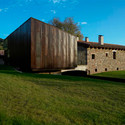
The composition of the three buildings is located in the end of a valley and laid aside a slope in the terrain at north. Consisting of the main house, a hut and a smaller annex, it totally domains the valley that precedes it.

The intervention emerged from the reasoning and experimenting when connecting the different parts intended to preserve, and redefining new accesses to them.

The existing volumes added to the main house, which originally had both ground floor and 1st floor, were moved and separated from the main building, creating a void between the main house and the new annex. This cut in the soil becomes the distribution hall to the three different pieces, uniting the spaces at ground level and providing daylight through the soft ramp on the other side of the entry.

roof plan

The three volumes remain separated at first floor, suggesting the image of the typical dispersed country houses, common in this region.

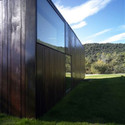
The new annex is shaped like an abstract volume, remaining those volumes of existing shed-roofs totally enclosed with sheets of different dimensions. The special detail of the union, made by a deep-shadow joint between each piece, recalls the separated wooden laths farmers used to use when closing big openings in the facades of their storage houses. Considered as a very private space the annex contains only a bedroom, bathroom and dressing room, where three main openings reveal the exterior surroundings.


Thumb up Thumb down 0

The bridge looks great. What a nice place to retire.

http://www.contemporaryartdaily.com

 
# November 23, 2008 at 11:01
Thumb up Thumb down 0
musser says:

I would have loved to see more of the interior space, but the EXterior is wonderful.

 
# November 23, 2008 at 17:54

Leave a Reply »


Latest Comments »

This reads like a practice note from the Institute.[+]
We’re a group of volunteers...[+]
Hi Bistra, Thanks for the generous feed back. It was a great home to be...[+]
Ideologically reminiscent of Le Corbusier’s Ronchamp[+]
Elliot, Yes, it only includes the works by firms who have shared...[+]

Upcoming Architecture Events »

got events? invite us! click here

Architecture Books & Magazines »

Mark Magazine #33

Mark Magazine #33

We recently received the newest edition of Mark Magazine. Number 33 offers in depth looks of several  projects ArchDaily has previously featured such as: Sunset Chapel by BNKR Arquitectura, iGuzzini Illuminazione Spain Headquarters by MiAS Arquitectes, Villa Geldrop by Hofman Dujardin…


Made to Measure: The Architecture of Leers Weinzapfel Associates

Made to Measure: The Architecture of Leers Weinzapfel Associates

Made to Measure is a monograph showcasing the work of Leers Weinzapfel Associates, an architecture firm based out of Boston, Massachusetts. Leers Weinzapfel Associates first gained prominence by taking on infrastructure projects that are often left to engineers. Where…


Thermally Active Surfaces in Architecture / Kiel Moe

Thermally Active Surfaces in Architecture / Kiel Moe

Departing from the simple question Why do we heat and cool buildings with air?, this book focuses on the technique of thermally active surfaces. This technique uses water in building surfaces to heat and cool bodies – a method


Our partners »

AD on iPad via Pulse

Browse by date »

Browse by category »

Friends »