
• Share
  • share this article via emailshare by email
  • Share
  • share this article via emailshare by email

Cruz del Sur Building / Izquierdo Lehmann

By Nico Saieh — Filed under: Offices , Selected , , , ,
 
© Cristobal Palma

© Cristobal Palma

Architects: Izquierdo Lehmann / Luis Izquierdo W., Antonia Lehmann S.B.
Location: Santiago, Chile
Structural engineering: Santolaya y Asoc.
Main contractor: Echeverría Izquierdo
Site Area: 3,987 sqm
Project Area: 43,129 sqm
Project Year: 2006-2007
Construction Year: 2008-2009
Photographs: Cristobal Palma & Luis Izquierdo

© Cristobal Palma © Cristobal Palma © Luis Izquierdo © Luis Izquierdo

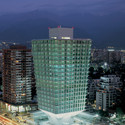
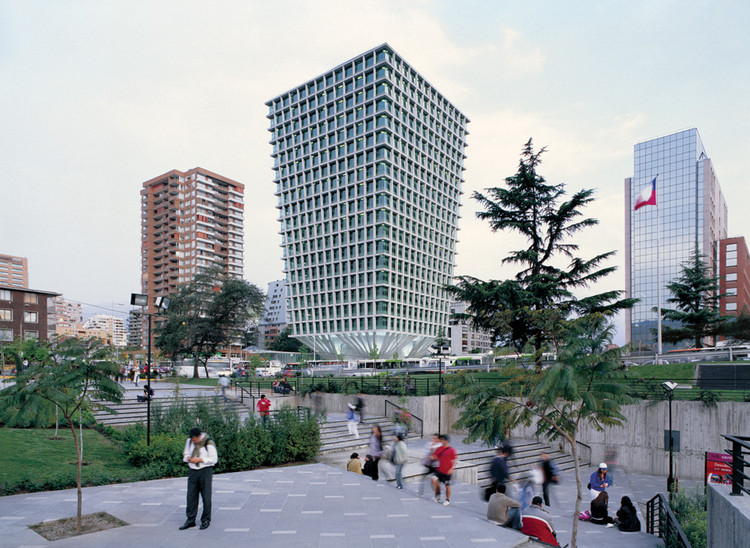
The project consists of an office tower with a commercial complex in the base, located at the intersection of Apoquindo Av, main axis of Santiago, and Americo Vespucio Av, the capital’s circular beltway. This place is poorly laid out despite its urban importance as a cloverleaf intersection surrounded by several buildings of varying height and quality, many of which were shaped by a disastrous old regulation of gradients nicknamed “the shoe shine box”.

The site has immediate access to Escuela Militar Metro Station, which has the highest daily traffic flow in the entire subway network. It has an approximate area of 4,000 sqm resulting from the merging five lots purchased by the architects. The largest part of the layout is roughly square shaped.

floor plan 01

floor plan 01

The site is opened on three fronts: to Apoquindo Av to the north, to Cruz del Sur St to the west and Felix de Amesti St to the east. Given its location, the tower is facing Apoquindo Av. axis coming east from a mile away, as visual culmination for an emerging sub-center whose business park is developing rapidly throughout the avenue.

The applicable regulations allowed to raise towers up to 21 floors, with a buildable area of 18,738 m2 (cornering was necessary, considering the impact of land value in market selling price), with square shaped plants averaging approximately 1,000 m2 each, and a vertical circulation core containing a battery of eight elevators plus two enclosed double stairwells and services, occupying an area of approximately 15 x 15mts. In addition, regulations required a two storey commercial complex, with a continuous facade on the property’s perimeter facing the three streets, whose allowed floor area was approximately 4,000 sqm -if we don’t count the tower’s entry points and parking lots.

© Cristobal Palma

© Cristobal Palma

Finally, it was also required to provide 600 parking lots, whose total surface area was 18,000 m2, which divided by the available land area, resulted in five underground floors. Thus, the volume of the building is quite constrained by the application of the regulations.

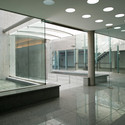
Given the high pedestrian density and scarcity of public space in the sector, the project’s first decision was to clear the ground level as much as possible, freeing up the site’s inner surface as an extension of the public space. This was made possible by hiding underground a major part of the program’s commercial area and withdrawing the rest of the complex’s structure to the borders at the back of the property, so as to allow an interior corner square. Furthermore, it was deemed possible to structure the tower in such a way that only the shaft of the vertical elevator system rests on the ground, considering the ratio between height and base of the maximum allowable building volume and the fact that it is placed in the center of square floor plans, hence avoiding torque reactions of the structure under seismic stress.

section 02

section 02

Initial structural analysis confirmed the possibility of having the shaft itself to resist both baseline shear stress and torsional moment of the estimated volume’s mass. Moreover, matching tower-underground structural module was unnecessary by having only basic vertical circulations inside the underground shaft. This way, an optimum result of 27m2 per lot was achieved on these parking floors.

We had already emphasized in prior office tower projects that the essence of this architectural type lays on the vertical overlapping of several reproductions of the ground surface, just like land plots linked by a vertical street -a fact that indeed poses a structural challenge. This certainty is radically exposed by concentrating vertical circulations, services and the tower’s supporting structure into one single central core.

elevation north

elevation north

© Cristobal Palma

© Cristobal Palma

Therefore, floor plan surface starts to increment above 4th floor in order to offset the reduction of the volume’s base surface and to corner the total allowable built area. This allows us to: -Reduce shaded areas produced by the suspended tower over its base, thus improving the ratio of covered outdoor space.

  • Reduce the angle of diagonal bracing attached to the perimeter structure supporting several overlapped slabs.
  • Increase the sellable area in the upper floors, whose price is higher.
  • And to define the outline of a memorable landmark facing the axis of Apoquindo Av. On the other hand, it also allowed open floor plans by reducing the slabs’ supporting elements to one single shaft plus a set of perimeter columns.
© Cristobal Palma

© Cristobal Palma

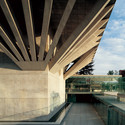
Continuous floor to ceiling windows are shaded by columns and a full perimeter eave, standing upright with a set back distance of 90 cms. from the outer edge of the slabs and pillars, thus expressing the supporting structure through the volume exterior. Glazing setback plus screen printing and differentiated reflectivity according to lighting and thermal requirements for each different area of the facades together resulted in a reduction in energy consumption of up to 25% in comparison to nearby buildings of the same category.

Building costs turned out to be inferior to initial estimates related to towers of similar characteristics. This is very important because we believe that a design with economic results demonstrates wit while purifying the rethorics of architecture; after all, the efficient use of available resources is an infallible condition for achieving beauty.

© Luis Izquierdo

© Luis Izquierdo

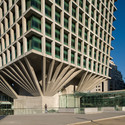
Seeing the towers from below, the closer we get to the elevated volume, the more clear and evident is the triumph of supporting structure over gravity; afterwards, our visual range is unable to grasp totality, shifting scale and perception into a sense of danger, like vertigo. Both the trapezoid shape of the facades and the distorted grid of overhanging columns supporting the edges of the slab perimeter aim to heighten stillness and immobility as part of the essence of architecture:

The perception of the facing surface and its subsequent mental assimilation induces an equivocal adjustment due to its distorted orthogonal grid, varying according to the shifting reference of the subject in approaching the building. This project sought to integrate the consideration of mass, gravity and weight with the perspective condition of perceived space, both decisive aspects in the experience of architecture.
 

31 comments »

Thumb up Thumb down 0
Architist says:

Thats a peice of engineering triumph.

 
# December 3, 2009 at 08:03
Thumb up Thumb down 0
asr says:

Esta muy guapo, este edificio.

 
# December 3, 2009 at 08:05
Thumb up Thumb down 0
Nicolas says:

Are all those elevators really necessary? its not a big building.. looks nice though.

 
# December 3, 2009 at 08:28
    Thumb up Thumb down 0
    fengfeng says:

    yes,it’s necessary

     
    # December 4, 2009 at 03:47
Thumb up Thumb down 0
kagayakitecture says:

well… From the detail… not good… overally… I’m quite pleased with the shape of the building…

 
# December 3, 2009 at 09:23
Thumb up Thumb down 0
matt says:

I like how simple it is, and yet how weird the perspectival effect is.

 
# December 3, 2009 at 10:24
Thumb up Thumb down 0
Arquipablo says:

the brutalism is back!

 
# December 3, 2009 at 10:25
    Thumb up Thumb down 0
    sullka says:

    I actually thought it was a brutalist building from the 70s that got renovated, not new construction.

     
    # December 3, 2009 at 12:47
Thumb up Thumb down 0
Abe S. says:

I agree with Kagaya. That shape is marvelous, but some of the smaller elements don’t seem well thought out. Oh course, a great first impression.

 
# December 3, 2009 at 11:25
    Thumb up Thumb down 0
    gorgos says:

    Could you give some examples?

     
    # December 3, 2009 at 12:18
Thumb up Thumb down 0
mARCo says:

A similar thing was doing by italian’s architects B.B.P.R in the project of Torre Velasca near the Dome of Milan… They were very innovative, in fact the project was gone up in the 1958…The design of the pillars is identical!!!
I think that this project is good for the using of materials and the warping of the plans…but it is not so innovative for this time…the shape now could be more whole than the 50′ years!!!

 
# December 3, 2009 at 13:41
    Thumb up Thumb down 0
    evan says:

    Very far from having identical pillars as Torre Velasca.
    Great structural achivement on a seismic area.
    Congrats!!

    Torre Velasca:
    http://www.aviewoncities.com/img/milan/kveit0738s.jpg

     
    # December 3, 2009 at 14:22
      Thumb up Thumb down 0
      mARCo says:

      The shape’s Pillar isn’t edentical but it is in the sostance…sorry, but i think that the structure project isn’t so far from BBPR’s Design…the idea to put outside the elements is in the end the same…

       
      # December 4, 2009 at 17:25
    Thumb up Thumb down 0
    erdo says:

    are you joking us?? is not the same… cos this is a office tower… and here I thing that is a new door that they open for us in Chile… for be a dared in our desing… and you know more top is the floor in office and apartmen is more expensive… they solve this thing inside a beautifull form… cos more top is more space to give you… then more money… that all we search.. or not??? good design… good money… doog vibes.. good life.

     
    # December 3, 2009 at 23:33
      Thumb up Thumb down 0
      mARCo says:

      I’m not very sure with my english and basically i don’t know the real condition of Chilean Architecture…It’s possible that they have opened a new way to do architecture…but if you talk about the building’s shape you could confirm that the association with Torre Velasca is not so wrong….

       
      # December 4, 2009 at 17:29
Thumb up Thumb down 0
gorgos says:

I think its rather refreshing to see a building where the structure is so evident without decorative elements. The structure is the architecture.

 
# December 3, 2009 at 14:32
Thumb up Thumb down 0
gabriel silva says:

I think anyone is reading what the architects of the building are writing…
“Glazing setback plus screen printing and differentiated reflectivity according to lighting and thermal requirements for each different area of the facades together resulted in a reduction in energy consumption of up to 25% in comparison to nearby buildings of the same category…
-Increase the sellable area in the upper floors, whose price is higher.”
That`s really important… In the other hand, I think this is not a nice building, comparing to others in this beautiful area of Santiago, but it really has the most powerfull idea.

 
# December 3, 2009 at 15:28
Thumb up Thumb down 0
Formula says:

Welcome to the 60`s…

Good engineering.

 
# December 3, 2009 at 18:36
Thumb up Thumb down 0
trimtab21 says:

Wow! I didn’t know concrete work could be so beautiful! Awesome details!

 
# December 3, 2009 at 20:17
Thumb up Thumb down 0
frank Wilson says:

totally disagree! What detail are you talking about?

It is a great case of architectural BRUTALISM!!!!

NO MORE SAID.!!!

 
# December 4, 2009 at 00:09
Thumb up Thumb down 0
james says:

im so jealous
they’d never do that here in Australia

 
# December 4, 2009 at 01:07
Thumb up Thumb down 0
Patricio Paredes says:

Marco, you are so wrong…

 
# December 4, 2009 at 16:46
    Thumb up Thumb down 0
    mARCo says:

    why?? What do you think about???

     
    # December 4, 2009 at 17:19
    Thumb up Thumb down 0
    mARCo says:

    I hope you know the Brutalism, the structure is the design!!!
    So what could be define different in this project?
    the sheafs of Pillars are the first character of the layout!!!
    could you say to me where is the innovation?

     
    # December 4, 2009 at 17:33
Thumb up Thumb down 0
A Sphere says:

่it’s just a cantilevered slab,
isn’t it?

 
# December 5, 2009 at 04:15
    Thumb up Thumb down 0
    gorgos says:

    I dont think so. The slab as you say has little to do with it apart for the horizontal forces, its not a cantilever.

    I think the columns that run in the facade, carry the loads. At the base these inclinated columns in the facade suddenly make an even more powerfull inclination towards the inside. The fact that this region where this even more powerfull inclination happens is not habitable has no importance structurally. Its the same principle.

    I think its very subtle how the columns and slabs form larger openings on the floors above. It gives the structure this unusual appearance, without being very evident.

     
    # December 5, 2009 at 06:07
Thumb up Thumb down 0
nonono says:

looks like building on Tiny Toons films

 
# December 5, 2009 at 21:14
Thumb up Thumb down 0
Jordi says:

Is this a monument to the ugliness?

 
# December 6, 2009 at 03:21
Thumb up Thumb down 0
Simon says:

Hi,

Well the building is one thing, but can we have details on the urban park in front. Now that does look interesting? Project? Designer?

 
# December 7, 2009 at 10:21
Thumb up Thumb down 0
Eric says:

Love it.

 
# December 8, 2009 at 22:59
Thumb up Thumb down 0
mike says:

wow, these architects had a lot of people fooled into thinking this was some sort of original brutalism design piece….this is a blatant copy of two buildings in sydney about 6 blocks from each other….terrible cut and paste job….. go here and see for yourself………

http://www.sydneyarchitecture.com/cbd/cbd4-016.htm

http://www.sydneyarchitecture.com/cbd/cbd4-013.htm

 
# July 28, 2010 at 20:06

25 links to this article »

Leave a Reply »

Want to have your own avatar? Get yours at Gravatar.

Latest Comments »

Please describe the heating and cooling of the home. Include insulation...[+]
Brilliant!!! What a great piece of Public Zoo Architecture!!! Love the...[+]
Most of these are really uninspiring. Half of them look like...[+]
Desire to go green is getting more and more crazy…[+]
All I could say is that this guy is really something else! The sphincter house!...[+]
Sorry, Moshe Safdie, I like the interiors, they are outstanding, and I...[+]
R Goldschmidt on Prefabricated Nature / MYCC:
Simple, great material, easy to made and nature friendly![+]
I don’t understand why bad critique is not accepted on...[+]
果然是野心勃勃的煤老 板的房子。[+]
I like this renovation. The idea of using...[+]

Links Recommended about Architecture:

Architecture Books & Magazines »

Expanded Practice: Höweler + Yoon Architecture / MY Studio

Expanded Practice: Höweler + Yoon Architecture / MY Studio

The title “Expanded Practice” comes from how Höweler + Yoon Architecture / My Studio have named their design methodology. And in this book it’s not just a title, as the book is really a guide on how this young…


Different Repetitions: Buildings & Projects / Medić & Puljiz

Different Repetitions: Buildings & Projects / Medić & Puljiz

A monograph on recent works by Medić & Puljiz edited by dutch editorial 010 Publishers.
You can check our previous features about this practice:

Cap Gemini Campus (Netherlands)
Tianjin Urban Planning Museum (China)
Villa Meindersma (Netherlands)
Menzis office building…


Modern Construction Handbook / Andrew Watts

Modern Construction Handbook / Andrew Watts

A good construction manual is a must have for any architect’s library.
The Modern Construction Handbook by Andrew Watts is in my opinion one of the best construction manuals these days, covering construction systems in an extensive way. The…


Our partners »

Browse by date »

Friends »