
- Area: 16000 m²
- Year: 2009
-
Photographs:Torben Eskerod
Text description provided by the architects. 1. VISUALIZING THE COLLECTION
Expressing a unique and appropriate architectural concept
The design of the second phase of the Darwin Centre project is characterized by a compelling and strong architectural concept in order to contain and represent vast entomological and botanical collections housed within the Natural History Museum.

The Cocoon
The solution to resolving the various Client requirements and to clearly symbolize the world class collection of specimens is the ‘Cocoon’, an architectural translation which forms the inner protective envelope.
The scale of the Cocoon form is such that it cannot be seen in its entirety from any one position. This emphasizes its massive scale. The shape and size give the visitor a tangible understanding of the volume of the collections contained within.

The collections housed in the Natural History Museum are among the world’s most extensive and treasured. In order to adequately preserve, maintain and represent this collection, a structure suitable in both its expression and physical construction was necessary. The Cocoon does this by creating an icon, which represents preservation, protection and nature. It is constructed of 300mm thick walls, with a defined geometric form based on mathematical equations. The surface finish is ivory-coloured polished plaster, resembling a silk cocoon, in which a series of expansion joints wrap around, resembling silk threads.

2. RESPECTING THE SITE
Respecting the existing architectural heritage
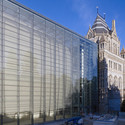
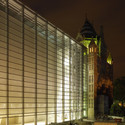
The second phase of the Darwin Centre is intended to manage the difference in scale, architectural approach and to create a physical link between the original landmark Alfred Waterhouse Museum building and the more contemporary addition of the first phase of the Darwin Centre. It also serves as a landmark building in its own right, the full height glass wall partially revealing the solid 3-dimensional form of the cocoon within.

Bridging past, present and future
The second phase of the Darwin Centre improves and transforms the existing buildings into something more than the sum of its parts. The new building links existing and new buildings into a dialogue forming a set of dynamic, spatial experiences, bridging the past, present and future for the museum.
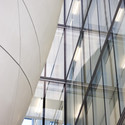
The smooth curved form of the immense cocoon is an iconic feature of the new Darwin Centre building and the public atrium space is dramatic, tall and filled with daylight.
The second phase of the Darwin Centre completes the western portion of the Natural History Museum estate, linking the existing buildings and enhancing and clarifying the circulation patterns within the museum for both staff and visitors.

3. MAXIMIZING ACCESS FOR ALL
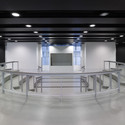
Public access to the scientific core of the second phase of the Darwin Centre takes the form of a visitor route up and through the cocoon, overlooking the science and collection areas without compromising the central activities of protection, preservation and research.

Passing through the Cocoon, the visitor enters a new space where the boundaries between the inner and outer worlds of scientific research are blurred.
The visitor can experience the Darwin Centre as a compelling and interactive learning space, observing the scientific and research activities without interrupting scientific work in progress.