
Fray Leon house / 57 STUDIO

Uploaded by — Filed under: Houses ,Selected , , , , ,
 

Architect: 57 STUDIOMaurizio Angelini / Benjamín Oportot
Location: Santiago, Chile
Collaborator: Felipe Zamora
Project year: 2006–2007
Construction year: 2007–2008
Structural Engineer: Claudio Hinojosa
Construction: Jorge Carrasco
Materials: / Steel / Travertine
Photographs: 57 STUDIO

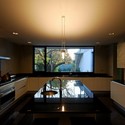
This is a residence for a family who looks for a more extensive terrain and ampler spaces, without leaving the traditional neighborhood where it has lived for almost 30 years. Located on the east side of Santiago, the main characteristics of the neighborhood are the presence of old growth trees and huge lots with houses that have a limited relation with the street.

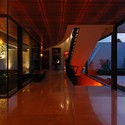
Eliminating an old building and respecting the native trees with major presence and landscaping value on the site, the spaces are organized on an “H” form plant with a second level over the central wing, following the same space relation pattern of the house that the family left. This “H” form space distribution adapts well to the site form without touching the trees and creating different patios that harness their presence from the interior.

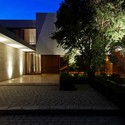
The interior spaces are organized around a native tree (Cryptocaria alba) that accompanies the access from the south. Through the hall, the presence of an enormous avocado tree (Persea americana) is framed towards the north, and a private wing towards the east is delimited by an old macrocarpa cypress (Cupressus macrocarpa) and some crape myrtles. Over the central wing, a second private level extends in all of its length, leaving on one end a terrace at the height of the tree’s crowns. On the west wing, the public spaces open towards the northern garden through a porch, and the service areas direct their view towards an ashleaf maple (Acer negundo). The wing of services extends towards the south by means of a roof with an opening that surrounds a native Crinodendron patagua that separates the closed garage from the rest of the house.

The swimming pool is located towards the west on the site´s lowest point, where the ground drop helps to conform one of its borders, articulating its presence to the rest of the garden.

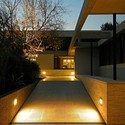
The house is preceded by an extensive paved esplanade that, being requested as an open visitor’s parking area, prolongs the approach of the visitor towards the main access where the Cryptocaria alba gains a major presence.


Thumb up Thumb down 0
Jeison says:

Beautiful, beautiful house. I am everyday more amazed with chilean architects. Congratulations.

 
# July 6, 2009 at 14:07
Thumb up Thumb down 0

What as magisterial presence this house has. The rear elevation I find particular inspired with its twin pergolas extending the interior spaces and the majestic tree that dominates this facade.

It is a little bit hard to tell without seeing the building in person but the materials palate doesn’t quite seem up to the rigor of the volumes. There just may be a few too many textures for my taste. Perhaps I believe the volumes and proportion speak for themselves without the need of the slatted ceilings or mixed flooring. However, these are minor criticisms in a magnificent project.

Terry Glenn Phipps

 
# July 6, 2009 at 19:54
Thumb up Thumb down 0
Benjamin says:

very nice. i love the straight lines and simplicity of this design. has a lot in common with FLW’s early work i think.

 
# July 6, 2009 at 20:54
Thumb up Thumb down 0

A magnificent celebration of horizontality.

I’d have one.

 
# July 6, 2009 at 23:33
Thumb up Thumb down 0
Yerko Jeria says:

It demonstrates how perennial Neutra’s approach is. When you have lots of space (such is the case in Chile’s affluent areas as it was in Neutra’s Californian study houses), buildings designed expanding horizontally ( Neutra’s spinning organisation) just by doing that they embrace the surrounding natural landscape. It just works so well. Congratulations from London.

 
# July 7, 2009 at 08:53
    Thumb up Thumb down 0

    For many years I lived at Richard Neutra’s VDL research house in Silverlake and in 3 other Neutra houses in Los Angeles. My experience is the opposite of what Yerko is indicating. In fact, the VDL was built as an experimental exploration of what could be done utilizing the maximum space available within the lot lines of urban infill architecture. There was no requirement for expansive horizontal spaces in order for Neutra’s architecture to flourish.

    While I agree that there are elements of this project that recall some of RJN’s lessons, they are not dependent on space. Neutra was at his best confronting the real problems of urban living.

    Terry Glenn Phipps

     
    # July 8, 2009 at 21:05
Thumb up Thumb down 0
Rupesh Jamkhindikar says:

Wonderful place to live. Amazin…very thoughtful and sensitive..

 
# July 8, 2009 at 04:38
Thumb up Thumb down 0
Lite says:

This is so nice!

 
# July 8, 2009 at 10:55
Thumb up Thumb down 0
Yerko Jeria says:

Terry, it is interesting what you are saying. I was actually referring to the Kauffman house approach which in my view is not your ordinary urban plot size (at least in Santiago it wouldn’t be) To me it is clearly in connection with the landscape that surrounds it and at least from pictures you do not notice the boundaries of the plot but the surrounding hills etc.And the way the house opens in various directions and the views you obtain from inside and from the intermediate spaces to me, are due to the plan organisation. Anyway sounds great you have lived in a Neutra house, wow. Take care

 
# July 9, 2009 at 07:55
Thumb up Thumb down 0
Joseph Fornés says:

It is of course a magnificent house and the Neutra lessons well explored. However this type of architecture makes difficult the reduction of thermal exchanges with outside (a lot of thermal bridges are there) and then, is a little bit overpassed by the current concerns of durable development which are looking for low energy houses or even passive houses. Todays architecture should look for new ideas meeting the new constraints of compact design, external isolation, solar energy capture, low production energy materials, etc.

 
# August 1, 2009 at 17:54
Thumb up Thumb down 0
Peter says:

One of the best houses on archdaily!!

 
# October 1, 2009 at 11:30
    Thumb up Thumb down 0
    Derian says:

    agreeeeee!!….

     
    # August 18, 2010 at 03:43
Thumb up Thumb down 0

1:32 PM Jul 6th

RT @archdaily: Fray Leon house / 57 STUDIO http://bit.ly/14Hlom

Thumb up Thumb down 0

1:35 PM Jul 6th

RT @archdaily: Fray Leon house / 57 STUDIO http://bit.ly/14Hlom

Thumb up Thumb down 0

1:49 PM Jul 6th

saving my pennies for a house such as this http://bit.ly/8NRE6

Thumb up Thumb down 0

2:08 PM Jul 6th

Fray Leon house / 57 STUDIO | ArchDaily – http://shar.es/607H

Thumb up Thumb down 0

2:08 PM Jul 6th

Fray Leon house / 57 STUDIO:
Architect: 57 STUDIO – Maurizio Angelini / Benjamín Oportot Location: Santiago, Ch.. http://bit.ly/8HPp3

Thumb up Thumb down 0

2:39 PM Jul 6th

Case Study what? http://bit.ly/8NRE6 Who says straight lines can’t be sexy? #architecture

Thumb up Thumb down 0

4:30 AM Aug 6th

http://bit.ly/8NRE6 – I love the lighting in this place. It gives it a very relaxed feeling.

Thumb up Thumb down 0

8:53 PM Oct 14th

Очуметь домик! Нет ума – строй дома! http://t.co/adOUTrTM

Leave a Reply »


Latest Comments »

We’re a group of volunteers...[+]
Hi Bistra, Thanks for the generous feed back. It was a great home to be...[+]
Ideologically reminiscent of Le Corbusier’s Ronchamp[+]
Elliot, Yes, it only includes the works by firms who have shared...[+]
Nice! If not a little too cold of a...[+]

Upcoming Architecture Events »

got events? invite us! click here

Architecture Books & Magazines »

Architectural Modelmaking

Architectural Modelmaking

“The representation of creative ideas is of primary importance within any design-based discipline, and is particularly relevant in architecture where we often do not get to see the finished results, i.e. the building, until the very end of the…


Review: De Stoel van Rietveld: Rietveld’s Chair, book + film by Marijke Kuper & Lex Reitsma

© Jules Gianakos

“It is hard to tell what the value of something eventually will be”
– Gerrit Rietveld, 1937.
This new insight into a classic illustrates Gerrit Rietveld’s transition from humble cabinet maker’s son to Architect and leading designer in the De…


Combinatory Urbanism: The Complex Behavior of Collective Form

Combinatory Urbanism: The Complex Behavior of Collective Form

Thom Mayne recently sent us his latest book, Combinatory Urbanism: The Complex Behavior of Collective Form.  MIT Professor of Urban Design and Landscape Architecture, Alan Berger, hails this book as “nothing short of a tour de force and should be…


Our partners »

AD on iPad via Pulse

Browse by date »

Browse by category »

Friends »