Visit our Products section to learn more about architectural products.

Soe Ker Tie House / TYIN Tegnestue

By Nico Saieh — Filed under: Featured , Houses , , ,
 

Architects: TYIN Tegnestue
Location: Noh Bo, Tak, Thailand
Project team: Pasi Aalto, Andreas Grøntvedt Gjertsen, Yashar Hanstad, Magnus Henriksen, Line Ramstad, Erlend Bauck Sole
Client: Ole Jørgen Edna
Program: 6 sleeping units
Budget: 68.000 NOK (Approx. 10.000 USD)
Project year: November 2008 – February 2009
Photographs: Pasi Aalto
TYIN tegnestue is a non-profit organization working humanitarian through architecture. TYIN is run by five architect students from NTNU and the projects are financed by more than 60 Norwegian companies, as well as private contributions.

Through the course of the last year TYIN has worked with planning and constructing small scale projects in Thailand. We aim to build strategic projects that can improve the lives for people in difficult situations. Through extensive collaboration with locals, and mutual learning, we hope that our projects can have an impact beyond the physical structures.

situation plan

In the fall of 2008 TYIN travelled to Noh Bo, a small village on the Thai-Burmese border. The majority of the inhabitants are Karen refugees, many of them children. These were the people we wanted to work for.

A few months prior we came in touch with Ole Jørgen Edna from Levanger, Norway. Edna started his orphanage in Noh Bo in 2006, and was now in need of more dormitories. From sheltering 24 children, the orphanage would grow to house almost 50. The Soe Ker Tie project was finished in February 2009.

The main driving force behind the project was to somehow recreate what these children would have experienced in a more normal situation. We wanted every child to have their own private space, a home to live in and a neighbourhood where they could interact and play. These six sleeping units are our answer to this.

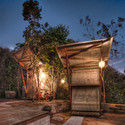
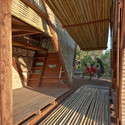
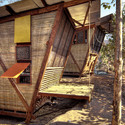
Because of their appearances the buildings were named Soe Ker Tie Hias by the workers; The Butterfly Houses. The bamboo weaving technique used on the side and back facades is the same used in local houses and crafts. Most of the bamboo is harvested within a few kilometers of the site. The special roof shape of the Soe Ker Tie Houses enables an effective, natural ventilation, at the same time as it collects the rain water. This renders the areas around the buildings more useful during the rainy season, and gives the possibility of collecting the water in drier periods.

The iron wood construction is prefabricated and assembled on-site, using bolts to ensure reasonable precision and strength. Most of the materials is delivered by the Karen National Union on the Burmese side, and this dependency on tropic timber has led to a line of difficult and complex problems to be addressed.

By raising the buildings from the ground, on four foundations cast in old tires, problems with moisture and rot in the construction are prevented. After a six month long mutual learning process with the locals in Noh Bo we hope that we have left something useful behind. Important principles like bracing, material economization and moisture prevention may possibly lead to a more sustainable building tradition in the future.


37 comments »

Lucas Gray says:

FANTASTIC! Great use of local materials and relating to the local vernacular architecture. This is just a wonderful project all around, from design, to detailing, to the humanitarian aspect.

 
# June 22, 2009 at 08:23
One says:

Some details makes me think that this is a rather difficult building to assemble with little presence of architects on site, but the space is wonderful I am just hopingthat this hut provides enough satisfaction to the demands set by the people. How imaginative it is to be able to form a space of inhabitation like this! remarkbly asian, alternative to any Euro style. Fantastic.

 
# June 22, 2009 at 08:41
rodmen says:

I believe these spaces are beautiful indeed but for us Architects and not for the folks living in them…Granted, It’s a good project and very well appriciated but I feel that the people who this was built for have lived in similar spaces for centuries only because they’ve had no other option but to…I think these “homes” look like glorified huts. Call me crazy…

 
# June 22, 2009 at 09:52
farflung says:

lovely work.
my concern is the size of the gutter shown in the section when the monsoon hits.

 
# June 22, 2009 at 10:02
rodrigo bocater says:

it seems to me more like a shelter than a house. can´t imagine people living there much longer. in fact, from someone who have nothing, this little wood-bamboo house its quite nice!

but after that, i start thinking about the rainwater collection and the bamboo walls. shore they will have some problems with bugs and the ‘wind-sided’ rain.

hope this might beenig usefull for those peoples

 
# June 22, 2009 at 10:16
NIM says:

It looks really nice and inspiring for the kids. The decision to create more units instead of one big building is also good.

But there could be questions about practicality. Having lived in tropical climate for so long, I am not sure that besides collecting water and allow natural ventilation, the roof and the wall can well protect heavy rain in monsoon season. It seems more perfect for Australia climate as we can saw similar character in that region. I think the problem of the roof (or other form of surface) should be investigated more in creating specificity on the site.

 
# June 22, 2009 at 11:17

Incredible!
Modern but local… something every architect should thrive for!

 
# June 22, 2009 at 15:08
Laura says:

ME ENCANTA!

 
# June 22, 2009 at 18:29
Cameron says:

Now this is honesty!

 
# June 23, 2009 at 00:39
patj says:

brilliant, after endless zaha type boring repetitive articles here we finally see some honest, functional design that makes a huge difference to ordinary peoples lives, inspiring – congratulations to the designers – good job guys

 
# June 23, 2009 at 08:35
utopianrobot says:

@rodmen, it sounds as if these huts are located in the orphanage so they don’t need much more than a place to sleep as there are additional facilities for other daily needs.

as far as the construction is concerned these types of projects are weighted towards students learning advanced building techniques rather than “educating” local builders. look at the rural studio at Auburn University in the U.S., what they do could not be repeated by local people as some sort of new “folk” tradition.

my other concern is the site orientation, a south facing entrance in a tropical climate is going to be really hot, even though it is all bamboo siding, especially with that up-turned roof. also, i would have raised the huts up higher to get more cooling and respite from bugs and water.

 
# June 23, 2009 at 08:41
Liam says:

Beautiful, true and honest….
Straight Nectar Architecture

 
# July 6, 2009 at 08:08
Aparan Surve says:

This is elegant and simple. It makes best out of what is available..asian conventional and sustainable wisdom.

 
# July 15, 2009 at 03:36
    Andrew says:

    Except the “wisdom” comes from European (Norwegian) students :)

     
    # July 20, 2009 at 14:31
      Aparan Surve says:

      that is even better..good values spread and acccepted widely.cheers

       
      # July 21, 2009 at 00:27
marc says:

i love how the textures interact with each other here.

 
# August 17, 2009 at 10:02
Guyguy says:

Love it!!!

 
# August 20, 2009 at 04:51

Links to this article »

Leave a Reply »

Want to have your own avatar? Get yours at Gravatar.

Latest Comments »

and I thought the Postmodernism movement was dead…[+]
i think the basic idea breaking the appartments in puzzle like pieces to form unit,...[+]
love the picts, it has an ethereal quality to it for sure.[+]
From Dusk Till Dawn[+]
David Basulto on Rosa Muerta / Robert Stone:
Why not? If the author wants to decorate it that way, it’s ok. Actually, I...[+]
Haven’t a clue. I was unable to force myself to care enough to finish his novella....[+]
It is good– better than jurgen meyer: simpler...[+]
A pretentious, egotistical blowhard, and in the field of architecture? How utterly...[+]
I fully understand that it is not just about the building. I fully understand the idea,...[+]
I like the stair and the external view I can’t imagine the spaces...[+]
The building is beautiful. But it’s not about the building only… its about...[+]
Stourley Kracklite on 4 Houses / On Office:
I like purism as well as the next guy, so I am very interested in how the...[+]

Browse by category »

Our partners »

Browse by date »

Friends »

Proudly hosted at »