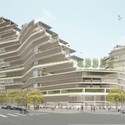
Co-Op Canyon / Standard Architecture

By — Filed under: Architecture News ,Housing ,Sustainability , , ,
 

Standard Architecture‘s conceptual design, , has recently received an honorable mention for the Re:Vision Dallas competition.  The competition provided participants with the opportunity to create an innovative and sustainable prototype for an urban community. Standard’s radical approach focused on how the residents could potentially gain equity through participation in construction, agricultural, maintenance, education and conservation programs central to the sustenance of the community. 

More images and information after the break.

Co-Op Canyon creates a sustainable, zero carbon space fit for 1,000 users.  Inspired by the cliff dwellings of the Anasazi Indians, the Co-Op features terraced urban conditions which overlook a lush urban canyon.  The dwelling terraces are lined with front yard gardens that host native plants varying in color and texture, while backyard gardens emphasize the ends of the terraces.   The garden allotments, in addition to communal farms, are dispersed throughout the terraces allowing residents to grow, exchange, and share canyon-grown produce.

Food acts the connecting thread that ties the community together.  The community farm is the focal point of the southern canyon, situated on the stepped terraces that link the levels of the canyon floor. Produce from the community farm is either consumed in the community kitchen or sold in the market spaces below.  The kitchen offers classes and food tastings focused on nutrition as well as a place to share family cooking techniques. The kitchen is part of a holistic approach to health that includes exercise and intergenerational social interaction encouraged by work in the canyon’s gardens.

The canyon walls are relatively thin which allows ample natural light and air circulation within the dwellings.  At the street level, the porous walls form the threshold between the community and the urban context, linking the terraced canyon floor to the streets of Dallas.  


may sound familiar because we interviewed them a few months ago to get to know the upcoming firm.  For more information about the Re:Vision Dallas Competition and Standard Architecture’s proposal.


Standard LLP: architect Jeffrey Allsbrook, partner Silvia Kuhle, partner Project team: Alexis Caver, Kazu Shichishima, Brandon Bown, Alex Babich, Gregg Oelker

Coen Partners: landscape architect Stephanie Grotta, principal Erica Christianson, Bryan Kramer

Thornton Tomasetti: structure Bruce Gibbons, principal, Christopher Kahanek

IBE Consulting: MEP, sustainable design Peter Simmonds, senior associate, Patrick Wilkinson

Davis Langdon: cost estimate Ethan Burrows, associate principal, Jane Northey

Atelier 10: sustainable consultant Claire Johnson


Thumb up Thumb down 0
nico says:

LOVE IT!

 
# June 11, 2009 at 11:10
Thumb up Thumb down 0
Emily S says:

RT @archdaily: Co-Op Canyon / Standard Architecture http://bit.ly/2l4Kt8

 
# June 11, 2009 at 12:10
Thumb up Thumb down 0

#architecture Co-Op Canyon / Standard Architecture:
Standard Architecture’s conceptual desig.. http://bit.ly/7BYhK

 
# June 11, 2009 at 12:35
Thumb up Thumb down 0
Alexander says:

Well Developed Concept! Interesting.

 
# June 11, 2009 at 12:17
Thumb up Thumb down 0
Chris Hardy says:

Reminds me of the ruins of the Colosseum in Rome

 
# June 11, 2009 at 12:32
Thumb up Thumb down 0
Jonjon says:

Very nice…

 
# June 11, 2009 at 12:37
Thumb up Thumb down 0
Haily Zaki says:

Thanks @archdaily for a great post on Co Op Canyon http://bit.ly/7iTpO

 
# June 11, 2009 at 14:01
Thumb up Thumb down 0
MJ says:

I usually don’t like their work, but this one is different…
This is what I call Architecture!

 
# June 11, 2009 at 14:27
Thumb up Thumb down 0
Robert says:

I like that the concept develops from bottom up thinking, as it engages with community. I was at a talk at the RIBA recently on Bimimicry and I thik that the future will be about a more holistic cohesive architecture just like this. The sustainable agenda is really moving in the right direction. Thinking is joined up and doesn’t stop simply with growing of crops but looks at nutrition and education.

I would like to see this project develop in more detail as I think it offers much potential.

 
# June 11, 2009 at 14:32
Thumb up Thumb down 0
PH says:

Love the diagrams!

 
# June 11, 2009 at 23:27
Thumb up Thumb down 0
Partick Bateman says:

who has time to grow crops as well as work?

 
# June 12, 2009 at 02:47
Thumb up Thumb down 0
Arthur says:

i think it has yet to get beyond all the utopic atmosphere it releases..i do not believe it will work and function as described

(“The kitchen offers classes and food tastings focused on nutrition as well as a place to share family cooking techniques. The kitchen is part of a holistic approach to health that includes exercise and intergenerational social interaction encouraged by work in the canyon’s gardens….Produce from the community farm is either consumed in the community kitchen or sold in the market spaces below.”)

it would probably turn out as a very ermetic comunity/society, it will alienate people from the rest of the city/urban life, and btw, which people that live in the city and have a somewhat busy and active life still have the time to practice this kind of architecture and “intergenerational social interaction” thay preach. Well, if they would be in some kind of cult together maybe, they could even hold hands while they plant the seeds..and the women will all be named Rain and have dresses made of wheat.

i think this (self)”sustainable” ideea is a bit misunderstood and surely over preached..this along with “green” and “ecological”.

thank you

 
# June 12, 2009 at 05:57
Thumb up Thumb down 0
Arthur says:

i meant “..time to practice this kind of agriculture..”

 
# June 12, 2009 at 06:00
Thumb up Thumb down 0
Ralf says:

I prefer the term, “green”. A project can be “sustainable”, if the people can get almost anything in the same place, food, water, energy.

 
# June 12, 2009 at 15:24
Thumb up Thumb down 0

@ericcoreyfreed I really like that one. http://bit.ly/2l4Kt8 also, treehugger called today wanting briefs on the top TEN, so thats coming.

 
# June 12, 2009 at 18:17
Thumb up Thumb down 0

Jaw-droppingly beautiful? Yep. Innovative to the nth? You bet. Utopian? I hope not forever. http://tinyurl.com/mj9xrl RT @ericcoreyfreed

 
# June 12, 2009 at 18:19
Thumb up Thumb down 0
Robert says:

Arthur you take a rather dim view to this proposal. How would you approach this project brief?

This was for a “opportunity to create an innovative and sustainable prototype for an urban community”. So I think they have made a good attempt. Sure it is a bit shocking that you grow veg but haven’t cities had allotments for years so that people can grow there own food. There are plenty of opportunities to sell veg through these schemes.

Why does this have to a ‘hippy’ commune? I am sure that the Architects do not attend to lock people inside and make them grow carrots 24/7. I am sure you would be allowed out to work.

I think these conceots are the basis of a way forward. However there must be a change of attitude from the public. How can attitudes be changed which aren’t dictitorial. Well I think that a bottom up approach that allows community to participate in the design process will mean that issues, like those expressed by Arthur, can be accomodated.

 
# June 14, 2009 at 12:16
Thumb up Thumb down 0

RT @UrbanRevision Although this came in 4th in @urbanrevision Dallas, it’s been getting a lot of attn: http://bit.ly/2l4Kt8 @ericcoreyfreed)

 
# June 15, 2009 at 12:42
Thumb up Thumb down 0

Co-op Canyon – 4th in @urbanrevision Dallas, but getting a lot of attn: http://bit.ly/2l4Kt8 (via @ericcoreyfreed) (via @UrbanRevision)

 
# June 15, 2009 at 14:17
Thumb up Thumb down 0
Arthur says:

ok..i always am for “opportunities to create innovative prototypes” and i also believe they are the way to obtain progress in our field.. and indeed the public should be educated towards a way of living(the question is if we have the moral ground to do that but that is another issue). You have to agree this project targets a certain and quite limited segment of the population(thats what i was trying to suggest by the somewhat streched comparison with “hippies”) and also one that would agree to make some interresting compromises in the way they live, work, provide their food and relate to other members of their “enclosure”. Of course i didnt imagine they would grow carrots 24/7 but its also hard to imagine a bussiness man or a career person taking the time after long hours to attend the veg garden. I guess it all comes down to what kind of people will you put in there. Im sure its possible technically and all that, but ultimately its a matter of people choosing to live there, their comfort and subsequent personal development.(because educating them towards something also means providing them with support and therapy after :)). I’m just not sure this kind of participative architecture mixed with small scale agriculture will function. we should not try to simplify the complex human needs(primal or social) or at least not pretend we can manipulate them or contain them by such means.

a few words about the formal aspect(i see it’s quite popular to engage that quite relative subject too around here). like someone already said here, it looks more like the colloseum than a canyon. of course i can see the similarities in some areas(layers, vertical profile etc.), but..if you are going to get inspired from this kind of concept, do it all the way not just with a few elements..the primary symbolic atributes of the canyon are length and direction..maybe time. i cannot see any of these here. Also the canyon is a threshold, a place where different identities come together, a place that has not only the qualities of those two elements but also that draws power from they’re coexistance. identities are confirmed, the result is more impressive that either of them separately.

this project did not have however another crucial element needed for this kind of “utopia” we are talking about: the fascination part. Did not get that “blade runner” kind of vibe from this. the study is elaborate, i respect the ideea, the work behind it, the innovative intent, just think it misses the edge to work and to be followed.

 
# June 16, 2009 at 09:33
Thumb up Thumb down 0
CMO ARCH says:

This is awesome! I tried to do this in a 4th year project once, but it never really worked out because of the height restrictions in the DC area (which is where our proposed site was). It just didn’t have the same effect…but this is just fantastic!

 
# January 31, 2010 at 13:06
Thumb up Thumb down 0
Ben says:

would be grateful if someone could tell me what software was used? thanks

 
# August 30, 2010 at 15:42
Thumb up Thumb down 0

5:43 PM Jun 7th

Incredible #Eco-friendly Architecture In the Eco-Complex Competition! See more here: http://bit.ly/lDtUc6

Leave a Reply »


Latest Comments »

aaaaaaaaaaaaand I’m done.[+]
Now GO decorate some wall.[+]
The best chance of making the UK a...[+]
Architects have no use for cutesy, valueless generalizations about their...[+]
He said it himself…”Architect s are not funny.”[+]

Upcoming Architecture Events »

got events? invite us! click here

Architecture Books & Magazines »

Passive Solar Architecture / David A. Bainbridge and Ken Haggard

Passive Solar Architecture / David A. Bainbridge and Ken Haggard

David Bainbridge, founder of the Passive Solar Institute, recently sent us his book Passive Solar Architecture. The book is a great introduction for anyone interested in passive solar architecture. The content is kept simple and straightforward. It allows any…


Volume # 28: Internet of Things

Volume # 28: Internet of Things

This issue of Volume explores architects’ roles in the age of the internet. For us at ArchDaily, this is a topic we find very interesting. We ask all the architects we interview how the internet has changed their practice;…


MacMag 36

MacMag 36

We were excited to receive Mackintosh School of Architecture’s 36th addition of MacMag – a student publication that catalogues the work of the student body in a way that is as much about the graphical expression as it is…


Our partners »

AD on iPad via Pulse

Browse by date »

Browse by category »

Friends »