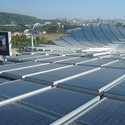
Construction is finished for Japanese architect Toyo Ito’s Solar Powered Stadium in Taiwan. The stadium’s roof is covered by 8,844 solar panels. The stadium is located in Kaohsiung, Taiwan and it was built to coincide with the opening of the World Games, to be held this July.
The “World Games Stadium” holds 55,000 spectators and it cost $150 million to build. The stadium will hold the record for largest solar-powered stadium in the world with it’s 14,155m2 roof. It could potentially generate 1.14 gigawatt hours of electricity every year, enough to power up to 80% of the sorrounding neighbourhood.
Seen at deputydog. More images, after the break.
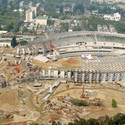
- Taiwan Solar Powered Stadium by Toyo Ito


wow. a designer who has mastered his domain.
Hidden due to low comment rating. Click here to see.
Hi Greg,
I think they’re connected to the grid system where the excess power generated will be stored on grid, it works just like the normal centralized system where the user will be charge for how much power they used. While this being on-site power generator, this stadium doesnt have to pay the power they used, as only the excess will be send to the grid. This is just a way to reduce the number of new power plant to support the increasing demand. This is what i’ve been told. And the solar power that u used on boat need battery storage as its off-grid. Hope it helps. :)
makes the US seem so friggin ass-backwards its not even funny
I….am impressed. This is probably the best use of photovoltaic panels I have ever seen. Finally, going green was thought of as being a sleek integration to the entire structure, instead of an add-on afterthought. I’m a fan.
that is all.
Fino- Well stated. This thing kicks ass.
Why couldn’t eiseman done this in AZ? Oh yeah, he is American, and always badmouths environmentalists. – oh and it was supposed look like a snake.
http://www.flickr.com/photos/crive/2432708117/
I look forward to seeing more projects this sleek and solar. btw 1.14gw of energy is HUGE
It’s too bad stadiums in the US always seem to try to harken back to the old school fields of 100 years ago. It just makes them look like they were taken out of a tacky theme park.
that has to be my most favorite stadium now….and also the stadium to make me think, why havent we been incorporating solar paneling into stadiums the past 30 years?? seriously, this just makes other stadiums look ridicules.
This is one of very few projects that thinks beyond it’s own needs and actually affects the surrounding community in a positive way other than a visual or social impact. Yes, the use solar panels in stadiums is a very logical and underused application. Congradulations Mr. Ito.
impressive… but i am not sure about the cost…
150million is a funny number for such stadium with 55.000 seats and photovoltaic roof… i would expect something more expensive… if it’s the true cost, then there’s no excuse for not building roofs like these…
I posted this at parq, its a great stadium and a great source of energy. More images can be found at: http://www.archtracker.com/kaohsiung-stadium-toyo-ito/2009/05/
Stunning.
Fino, I couldn’t agree more !
First example of inspired use of Photovoltaics,
WOW !
But ok you could be boring and say that they are not used to max efficiency as the inclination is defined by the skin…
Makes me think, imagine the same thing with a skin reacting to the position of the sun, with solar panels which tilt to follow the sun. The whole building would then change aspect, just like the H&deM stadium in Munich but without the LEDs… Anyone ready for a challenge?
i think if they were to apply this shifting skin, which would be fantastic, then the costs would go up. much higher than 150 prob. but it would be more efficient. yet this is the first stadium of its kind. i do not think we could ask for more on this one. im sure ito went through nightmares about how to convince the developers.
I agree with all you guys, but just one little thought on the side: did you read the prise-tag? It is actually possible to build about five stadions for that prise, of course cheap materials, no details, no design, no enviromental conciousness. Nonetheless, this one practically functions as a power-plant, it is actually a plus-energy-house, so the extra investment will pay off on the long run. But you have to have the dough first.
simply great.
This should be shown in every school of architecture worldwide.
MZ, You sound like you work for a standing seam metal roofing company.
This is amazing..beauty and actually works. What a great idea. Makes some big name architects who preach about sustainability look a bit small.. Great work and I hope other architects will see this and follow this closely.
snake!great..
well this is a great design and i really nice idea for the roof facade… i like the way toyo ito combines the useability and the design here…
jsut one thing about the stadium as a stadium… its quite dissapointing that the supporters are that far away from the action so it will lack the certain ambiance imho…
Ito has highlighted (yet again) what an architect is capable of – not just raising consciousness in designs but at the business end too. Goodness knows how hard he had to work to gain the go-ahead. This work is head and shoulders above all the ones that pinned all their hopes on … well, you form your own conclusions. A delicious theory would be if the management behind the “large” stadiums curtail the extortionate fees that players and managers demand; we may see all stadiums of the future taking to Mr. Ito’s lead. I believe a month’s salary from a top football team would be near enough to pay for their own worthy stadium?
Parallels can be drawn from all scale and scope of work undertaken by an architect. A similarity could be the “LONDON EYE” … I understand DMJB fought their way through the planners, funding, designs … and now, see how glorious, financially satisfying … and copied all round the world.
Congratulations to Ito and the World Games Stadium.
lets vote! toyo ito’s stadium or the bird’s nest?
It is also very impressive to see how the exterior enveloppe opens up and creates a square… very good urban gesture…
for that reason I vote for Ito’s stadium
Come on guys, what’s up with the U.S. Bashing! Beautiful design no doubt…but let’s not count on eggs before they hatch. Let’s see how efficient this stadium really is once it’s up and going…About the overall cost, I don’t believe it for one sec….
“the extra investment will pay off on the long run” how do we know this as a fact?? As responsible architects we should not react to beautiful form and/or an interesting concept but instead on practicality and function! This stadium is amazing! but to assume all these ‘green fantasies’ based on theoretical future assumptions is, in my opinion, rather naive of us Architects. How do we know what the maintenance of all these solar panels going to be? Will the costs offset the efficiency? Will this building really meet the expectations once put into practice? I think the building is spectacular! but I will not jump the gun yet by saying it is a sensible peace of architecture. Hope it will…
well, it’s only through big investments in the alternative energy market that it will become more and more efficient, even if this isn’t the most perfect sustainable building they are at least trying, and from tries you can learn.
Your questions about it’s true efficiency seem just as much “based on theoretical future assumptions”, they’ve probably put all this on balance before someone paid for it, and if not we should just be glad they’re spending their money on things like this instead of big falic buildings.
How much energy did it take to build all those solar panels??? How much energy was used to build all the digital/electronic infrastructure to make this thing go??? Is it really green?
Good point Taragon on what the future might hold on these types of buildings but hasn’t the damage already been done?
Aside from the Green topic, I love the building as architecture! PERIOD!!
I don’t understand why we are talking here about great architecture. This is a great engineering!!! Though an architect has his role, I would think it’s relatively minor in projects like this. It’s a beautiful piece in every aspect… I wish I could cooperate with so brilliant engineers.
Pritzker material, I hope this seals it. Another project by him that seems stunning and complex on many layers.
“The show must go on…”
Bo Lucky – what are you talking about?
Is it only architecture when we as architects have no obligation to a complex programme (I hope not)? or are you talking about the structure of the skin?
If you look closer you might find other layers than the computergenerated skin…
I would also like to know what architecture you DO like (name one example!)? and what projects you do yourself..?
@Lasse
Let’s limit the discussion to the above project. It’s pointless to do otherwise… so, how would you estimate an extent of the input of an architect in this architectural/engineering marvel? How would you define difference between a gem of architecture as opposed to a gem of engineering?
Bo Lucky – I’ve read all your lectures on energy efficiency, defining architecture … please please educate me on the definition of a “gem of engineering”? I want to learn so I can pitch it to Mr. Calatrava.