SFMOMA reveals the design for the museums new expansion, designed by the Norway-based architecture firm Snøhetta. The expansion transforms the current Mario Botta-designed building into a scale that “meets the museum’s mission.” Increased public circulation, flexible gallery space and intuitive navigation are a few of the projects main goals.
Continue after the break for more information, images and video.
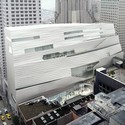
The new expansion responds to the physical and urban terrain of San Francisco. A series of stairs and platforms lead visitors into the museum, echoing the cities trademark circulation networks of “paths, stairways, and terracing”. The increased network of pedestrian routes intends to enliven the streets, while free ground-level galleries entice people to enter.

New entrances open the building up to the city on every side. Two main entrances lead into a central public entry that accesses all galleries. The use of glass, outdoor terraces and a new sculpture garden intends to further open the building up to the city and strengthen community engagement.

“Intuitive navigation” leads museum-goers through the 130,000 square feet of gallery space, double the current amount. A variety of education spaces directly interact with the galleries throughout the building. A large, multifunctional gallery will accommodate education programs, live performances and special events. Flexible design and lighting will allow the museum to showcase any type of exhibit.

A glass-enclosed gallery will replace the current Fire House 1 on Howard Street. The museum will relocate the facility and construct a new, state-of-the-art firehouse nearby on Folsom Street as a ten million dollar gift to the city.
Reference: SFMOMA
- SFMOMA Expansion Aerial View Southeast © Snøhetta
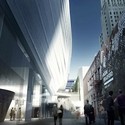
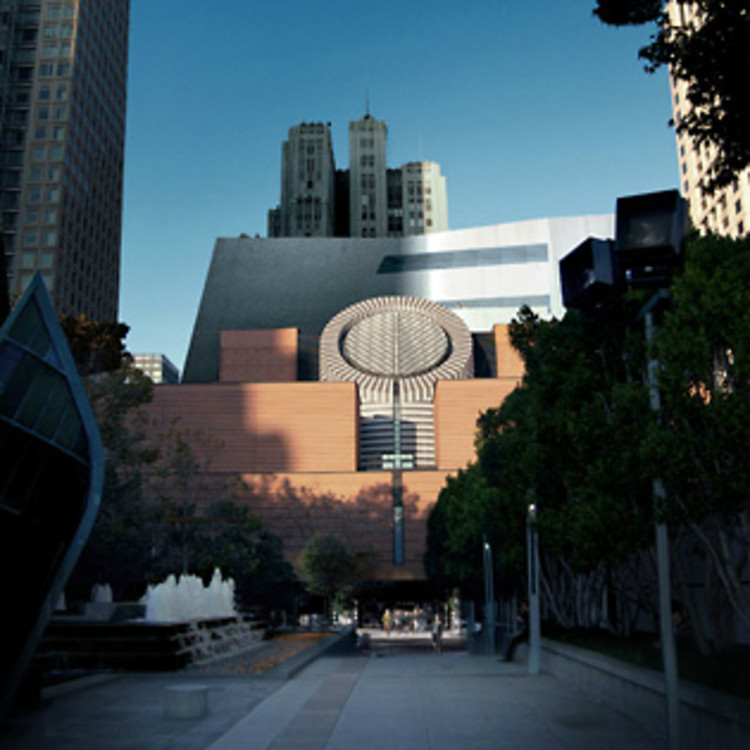
- SFMOMA Expansion View from Yerba Buena Gardens © Snøhetta
- SFMOMA Expansion View from Howard Street © Snøhetta
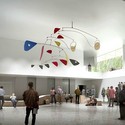
- SFMOMA Expansion Art Court © Snøhetta
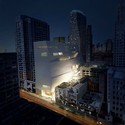
- SFMOMA Expansion Night Aerial View Southeast © Snøhetta
- SFMOMA Expansion Aerial View (sketch) © Snøhetta


I’m sorry but this design just doesn’t do it for me. The proportions are awkward, it has no form, and its pedestrian level presence is completely absent. The final “hero shot” of Botta’s elegant symmetry is destroyed by its underwhelming, weak, hideously under thought and lopsided white profile.
Snohetta you could do better.
I agree – this does not do it for me.
The proportions, the scale, the color,
the genius loci.
Disaponitment from a favorit office.
They can definitely do better than this !!!
“it has no form” sounds good to me
Man! It rapes Botta’s beautiful building!
The current SFMOMA has all the personality of a Sears department store. Little attention has been paid to showing off the magnificent art to its advantage. The DeYoung, a few miles away, is a superb setting.
The facade mimicks one of my own projects which I haven’t shown to anyone. Nice to see it work :)
Poetic background for Botta and depth of sensibility
Poetic background for Botta and depth of sensibility!!!???? are You kidding??? I think that your comment is more poetical than the building itself.
That’s the worst work from Snohetta. Maybe is a good functional building but aesthetically and proportionally is wrong, an amateur work for such a great architects. wrong, if i was a part of Snohetta i wouldn’t sleep, i would feel embarrased for such an awful work.
Get that away from Botta’s work!!
Snohetta’s original design was just lousy. They’ve only succeeded in making it worse. Let’s nuke this eyesore before it gets built.
Snohetta has allowed for an invisible building,
more like a canvas that allows it’s surroundings
to speak. The Botta building is really trying
to say too much-it’s more about an iconic building and not a place. Snohetta’s addition
may balance that out.
Invisible It is made when you take the language and aesthetic of what surrounds you and then You become part of it. So, do the math, You need glasses. Snohetta building is the oppositte of invisible and the opposite of a canvas.
Botta’s building “have” to say too much. Snohetta’s building has nothing to say.
I suppose a more appropriate term would be
faceless and not invisible. The exterior elevations although “visible” allow for a
white vertical base for the adjacent buildings to read and contrast against.
It looks more like a white flag waving behind Botta’s building, simply saying to everyone “I give up!”.
This is terrible, the architects should look at how Tadao Ando’s Modern of Fort Worth respond to Louis Kahn’s Kimbell Museum.