
Vila Joiosa Auditorium Theatre / Arquitecturas Torres Nadal

Uploaded by — Filed under: Cultural ,Selected , ,
 

Architects: José Mª Torres Nadal y Antonio Marquerie Tamayo
Location: Alicante,
Collaborators: Christohp Schmid, Iván Capdevila, Andrés Silanes, Mabel Toledo, Leticia Ballester
Structural Engineering: BOMA, Agustí Obiol
Acoustical Engineering: Jaime Llinares, José Forteza
Rigger: Rafael Pastor + Francisco Pérez Martínez
Promotor: Ayuntamiento de La Vila Joiosa
Project year: 2002-2004
Construction year: 2005-2007
Photographs: José Mª , Lluís Casals, Juan de la Cruz Megías, Subarquitecturas

THE IMPORTANCE OF THE PROJECT OF LA VILA JOIOSA IS ITS ABILITY TO BUILD ITSELF AS A PUBLIC PROJECT GENERATING A PUBLIC SPACE.

Indeed, the volume of construction which requires the program of a large auditorium is huge. It is one of the programs with a greater volume to be inserted in the city. And it is essentially, a horizontal volume. And generally, unless it falls into a capricious situation, the ideal is to be blind to avoid any kind of noise pollution.

level +250 plan

These three conditions: its huge volume of construction, its “dumb” condition and its generally horizontal condition, make of this a program that is inserted with difficulty in the city.

… UNLESS IT DOES NOT CREATE ITS OWN URBAN SPACE WHICH TRIES TO BELONG …

It is like creating a circle of art and then enter it … We proceeded in this way to think and build the AUDITORIUM. An auditorium is a main program (hall + foyer) and a series of complementary programs generally in order of magnitude much smaller.

We combined them in a way that the smaller programs surrounded the main program, that they were organized in that “arm”. On the other hand they connected the two ends from the hall to the foyer, like a rolled whiting.

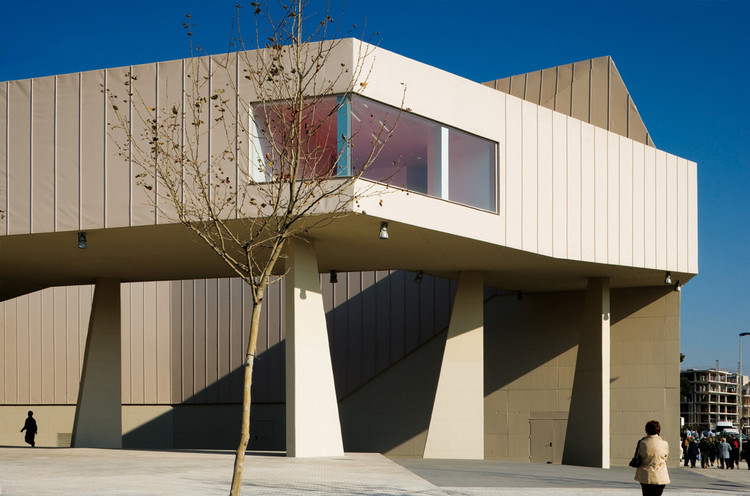
This arm generates a public space, an uncovered space, a large square that allows the access to the auditorium to be an encounter through that space. It is an area which proposes the celebration of the musical or theatrical activity outdoors and allows to have the feeling of entering to the spatial and public area of the Auditorium even before its access itself.

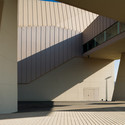
It is a place that generates a shadow, which casts a circle of shade in both plant and section. In plant because this shade builds an area which both separates and unites the project with the city. In section, because that shadow interpose as a layer built that cuts the main volume and gives a smaller scale more urban. In this way, a depth is created that in principle the auditorium, plan and wall, obviously does not possess.

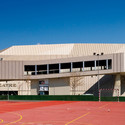
The geometry that we proposed was a geometry that reminded us of the mountains, the buildings that do not distinguish between the plans of facades and roof. In an extraordinary way it proposes solutions of continuity between the horizontal or inclined plans, of the roof and the vertical or inclined plans of the facades.

A single material covers the building walls and ceilings. A piece of sustainable plastic in its construction, development and elimination.

In this way the project reconstructs the image of the mountain that we saw from the place where now the auditorium is located.


Thumb up Thumb down 0

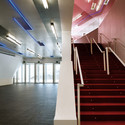
particularly liked the treatment of color in interior space

gostei particularmente do tratamento de cor no espaço interior

 
# March 9, 2009 at 13:39
Thumb up Thumb down 0
Ceno says:

seems to be old fashioned for me..

 
# March 9, 2009 at 23:07
Thumb up Thumb down 0
rkw says:

cheap and ugly…….wannabe modern architecture…….
i dont like it…

 
# March 10, 2009 at 05:36
Thumb up Thumb down 0
the big black and white zebra says:

I am sorry to be negative, but this bulding is truly ugly. First of all on-line translators are not good tools, especially for architectonic diatribes or wishy-washy poetical justifications… it makes unclear thought process’ impenetrable.

It is nice that the building is covered in a single skin, albeit with many ribbed interruptions, and that the plastic is sustainabl,e but the puckering makes it look like it is a temporary covering stapled on.

You may complain about being constrained by the linear nature of the site. I don’t see that there is the imposition of that contraint. Only because the architects have used a large part of the site for public open space does it make the planning of the auditorium linear.

I was surprised given the assurance of the architects about their response to the harsh noise pollution of the city that one of the auditorium walls is an external wall.

The handrail is a piece of white painted angle iron. The details are crude… well, I could go on, and on, and on, and on. But finally, why have the architects used the imagery of the mountain as a basis for their aesthetic, why… I don’t understand… is it

To show that the culture of a city must rise above it’s day to day existence, or is it that
the pinnacle of a societies achievements are shown through their Art, or
when patrons use the centre they must be transported to the high ground and clean air of the cities cultural expression?

No, it is because it “… reconstructs the image of the mountain that we saw from the place where now the auditorium is located”…

Poor
… and I agree it looks like a poor seventies arts centre in a forgotten UK provincial city, done by an architect who had got very excited about Hans Scharoun’s Philharmonie building.

 
# March 10, 2009 at 09:36
Thumb up Thumb down 0
Martin says:

Aren´t you just tired of this “objects” that land all over the world?

Shouldn´t a City Hall with auditoriums and outside activities be a useful, warm, public place to visit and enjoy? It must be a scary place to visit at night.

 
# March 11, 2009 at 18:27
Thumb up Thumb down 0
wartian says:

The selected materials for external cladding is tasteless. The overall architecture gesture looked cumbersome and bulky. The building does not show aesthetic judgment and sensitivity. The complexity and intricacy of the geometries resemble roadside trash. The floating passage is an indescribable failure, reminds me the low-cost air terminal passenger way, has nothing to do with elegance and style.

The slanting planes and diagonal lines in the plan is the incarnation of deconstruction of failure one, leaving a black spot on spanish contemporary architecture.

Anyway, the interior designer does a good job! the dazzling red is fashionable and chic.

 
# June 12, 2009 at 11:50
Thumb up Thumb down 0
sc says:

Does anyone know the maker of the chairs in the auditorium?

 
# May 16, 2011 at 22:00
Thumb up Thumb down 0
NadalFan says:

Rafael Nadal-best player in history

Miranda

 
# June 12, 2011 at 08:04
Thumb up Thumb down 0

11:53 PM Oct 4th

Wow. This is a very pretty theatre. http://bit.ly/SaXrd

Thumb up Thumb down 0

1:03 PM Feb 13th

Vila Joiosa Auditorium Theatre / Arquitecturas Torres Nadal | ArchDaily http://t.co/GO47eab via @archdaily

Thumb up Thumb down 0

1:03 PM Feb 13th

Vila Joiosa Auditorium Theatre / Arquitecturas Torres Nadal | ArchDaily http://t.co/GO47eab via @archdaily

Leave a Reply »


Latest Comments »

The dia-grid is obviously not a structure here, just cladding pattern….....[+]
丫丫solkee on Use white, or very white
So cute~~~~!!!!!![+]
...[+]
Love it![+]
Sergio Marquez on Pier+ / AECOM and BIG
Big really likes the contour tool…[+]

Upcoming Architecture Events »

got events? invite us! click here

Architecture Books & Magazines »

This is Hybrid / a+t research group

This is Hybrid / a+t research group

Following years of research, a+t publishers presents the first theoretical-practical book on hybrid buildings. Taking its inspiration from the four issues of a+t magazine’s Hybrid series, the book takes a look at the theories and projects which have had…


MARK Magazine #35

MARK Magazine #35

As you well know already we love MARK Magazine, and this issue fails to disappoint. It has projects from many of the architects we have featured here on ArchDaily such as, StudioGreenBlue, Heri&Salli, Clavel Arquitectos, Kengo Kuma, Colboc Franzen, Studio Velocity, Takeshi Hosaka, Fuhrimann Hachler, Toyo Ito, Nieto Sobejano, L3P…


Architectural Lighting: Designing with Light and Space / Hervé Descottes with Cecilia E. Ramos

Architectural Lighting: Designing with Light and Space / Hervé Descottes with Cecilia E. Ramos

As part of Architecture Briefs series, produced by The Foundations of Architecture, this short book on lighting gives a very good introduction into architectural lighting. The authors start by explaining the six visual principles of light; illuminance, luminance,…


Our partners »

AD on iPad via Pulse

Browse by date »

Browse by category »

Friends »