





-
Architects: Philip Johnson, Howard Barnstone, Eugene Aubry
- Year: 1971
-
Photographs:Chad Kleitsch, Adelaide de Menil Carpenter, Romano Cagnoni
Text description provided by the architects. In 1964 Mark Rothko was commissioned by John and Dominique de Menil (who are also founders of the nearby Menil Collection that is housed in the Renzo Piano-designed Menil Museum and Cy Twombly Gallery) to create a meditative space filled with his site-specific paintings. The original architect assigned to work alongside Rothko was Philip Johnson, with whom Rothko clashed over their distinct ideas for the building. Rothko would object to the monumentality of Johnson’s plan as distracting from the artwork it was to house. For this reason the Chapel would go through several revisions and architects working on the meditative space. Rothko continued first with Howard Barnstone and then Eugene Aubry, but ultimately did not live to see the chapel’s completion in 1971. It was after a long struggle with depression that Rothko committed suicide in his New York Studio on February 25th, 1970.

It was John and Dominique de Menil, Houston philanthropists who promoted modern art that commissioned Rothko to create a series of transcendental and meditative forms of art that were to be housed in a non-denominational place of worship also designed by Rothko with the help of architect Philip Johnson.

The new Rothko Chapel would be located adjacent to the Menil Collection and the University of St. Thomas with a 1920s bungalow style neighborhood in Houston Texas.

After the confliction between Rothko and Johnson, the duties of architect were turned over to Howard Barnstone, the supervising architect on this and other Johnson buildings in Texas. Barnstone and his partner Eugene Aubry developed the design in accordance with Rothko’s wishes. After Rothko’s death in 1970, Barnstone left the project because of illness, and Aubry asked Johnson to act as a consultant in completing the design.

“I have long believed that a piece of art must be wholly viable within the bounds of its own medium. For example, a piece of music must satisfy and stimulate by means of its own musical structure and not produce its effects simply in relation to whatever words it may set or whatever extra musical program it may reference. Similarly, a work of visual art must speak to the mind and indeed the soul of the viewer not through suggestive titles or embedded texts, but by engaging the eye and the imagination through its own imagery. A work of art must ultimately be a thing in and of itself and not simply a representation of something from the world around it”.

-Christopher Rothko, Mark Rothko's Son
Through the work of Rothko he wanted to combine perceptual immediacy with spiritual import. As Rothko said upon completing the Chapel paintings, “I wanted to paint both the finite and the infinite.”

For Rothko, the Chapel was to be a destination, a pilgrimage far from the center of art, New York, where seekers of Rothko’s newly spiritual artwork could journey. The Chapel would consume six years of Rothko’s life, gradually transforming him and his art into an exploration and devotion for the possibility of transcendence.

To witness the work of Rothko with the Chapel is to submit one’s self to a spiritual experience, which, through its transcendence of subject matter, brings us closer to consciousness itself. It allows us to approach the limits of experience and awakens one to the awareness of our existence. It is through the level of transcendence of the fourteen large paintings whose dark, nearly impenetrable surfaces represents contemplation and the void needed to be found where one can truly explore a greater meaning to the questions being searched.

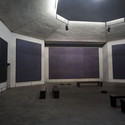
The Chapel paintings consist of a monochrome triptych in soft brown on the central wall (three 5-by-15-foot panels), and a pair of triptychs on the left and right made of opaque black rectangles. Between the triptychs are four individual paintings (11 by 15 feet each), and one additional individual painting faces the central triptych from the opposite wall. The effect is to surround the viewer with massive, imposing visions of darkness.

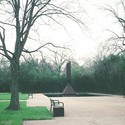
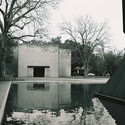
In keeping with Rothko’s wishes, the Chapel is a simple brick-exterior, flat-roofed, one-story building, entirely different from Johnson’s original idea for a white stucco, concrete block building monumentally topped by a pyramid. Live oak trees surround the Chapel, located next to a reflecting pool and the Cor-Ten steel sculpture Broken Obelisk. The building is irregularly octagonal in plan, with four wider principal walls alternating with four secondary walls, and with a rectangular apse and recessed floor and a baffled skylight. Rothko carefully configured his seven black canvases and seven plum-colored canvases; there is a triptych of paintings on each of the north, east, and west walls, one painting on the south wall, and one painting on each of the diagonal walls.

The Chapel is significant not only as a work of modernist architecture but also, because of Rothko’s paintings, as a work of modern art and as a means to capture the struggle with which Rothko lived his life. As such, the Chapel blurs the line between architecture, art, and the turmoil that often haunts life, challenging this distinction in both its aesthetic, effect and the ability to transcend the human experience.


