
Architects: JUNGLIM Architecture
Location: Onnuri, Republic of Korea
Client: Haeundae Onnuri Church
Site area: 2,688 sqm
Photographs: Namgoong Sun

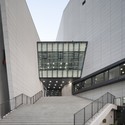
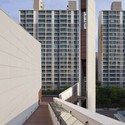
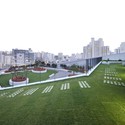
Silvery breaking waves reflected on Hawoonde beach and cultural local festival which give vitality and energy that respond to vivid context of Hawoonde. The site is located at interactive spaces where can be reached by many directions from existing church, market, and surroundings. It relatively formed by both simple streets that developed by urban planning and naturally created streets over times, also these are penetrate each other. According to these flows, dimensional space and continual routes are created which connects from the land to the chapel. Various levels of plaza respond to be gathering space which is culturally, religiously, and eco-friendly interactive programs accumulated for believers and neighbors. Exterior façade filled and voided by topology of the site and legal requirements, also created multi-facade face by light and view angle perceived as a sculpture of moderated city

Platform Polyhedron of polygon expanded as concept of platform, becomes a base which filled various programs and people’s activities. Also it is a field reflects an ideal objective of architecture which contains a range of activities, cultures, nature, and creates flow and lively space.
-Religious Platform: Symbolize religious form and meaning of streets, moreover generates concept of religions.
-Landscape Platform: Stretch streets of city and plaza by continuing route and plate.
-Cultural Platform: Aim to be open-church as an open community facility for local.

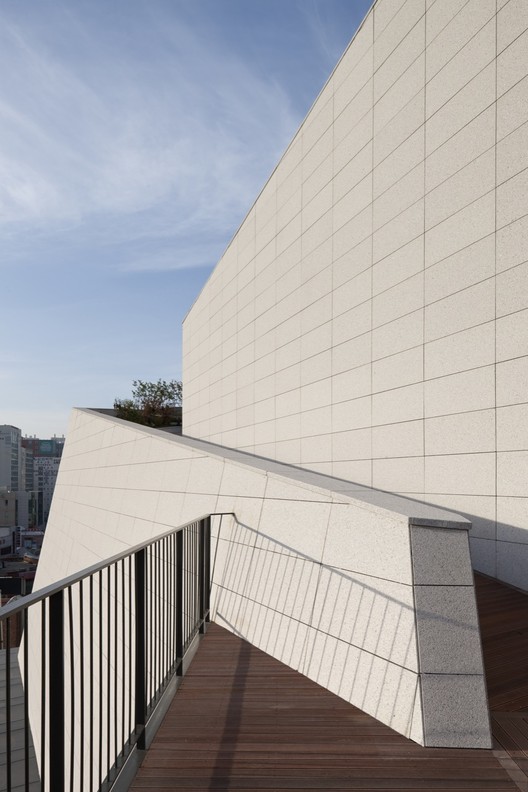
Wailing Wall The concept of ‘Wailing wall’, which covers exterior wall and main hall, is conceived from the idea of ‘sheltered wall for On-noo-ri church’. The idea of wall expresses symbol of religious origin, and give an identity of On-noo-ri church. Rough ‘Stone wall’ created by counterpointed relation and polygonal exterior put a symbolic attribute of main hall. Moreover, sermon place diverge from spatial point of existing altar, and expand a relationship between sermon place and chapel as religious interactive space, not as a dichotomous way. Finally, through that chapel get rid of the character as simple interior and becomes a meditation place of religious meaning.

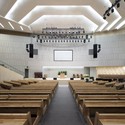
Light Dedicated light reflects on back wall of the sermon place and hall inside of the grand chapel is an interactive space with god, and creates gorgeous and faithful sounds.
- © Namgoong Sun
- © Namgoong Sun
- © Namgoong Sun
- © Namgoong Sun
- © Namgoong Sun
- © Namgoong Sun
- © Namgoong Sun
- © Namgoong Sun
- © Namgoong Sun
- © Namgoong Sun
- © Namgoong Sun
- © Namgoong Sun
- first floor plan
- second floor plan
- third floor plan
- fourth floor plan
- fifth floor plan
- roof plan
- basement plan 01
- basement plan 02
- basement plan 03
- east elevation
- front elevation
- rear elevation
- west elevation
- cross section 01
- cross section 02
- longitudinal section


This building – cross = multiplex.
Good architecture, but there is nothing spiritual in it.
spiritual architecture without the spiritual in it is not Good Architecture
How can you tell there is no spiritiual in it? what’s your criterias for judging spirituality in Architecture?
I’m getting tired of you guys critizing every building without any valid argument. Go get laid or something and then come back here and enjoy this wonderful piece of Architecture.
Well, if you think this project is a ‘piece of Architecture’ you should explain us your criteria too.
In my opinion the building looks like an auditorium or a conference hall. There is no spiritual space at all in this ‘church’ but a literal Cross on the wall (the only way to figure it out), and may be it was designed by the interior designer in the CD phase.
It would be a good place for a concert, watch a movie or attend a lecture. The last thing I could feel in this place is ‘spirituality’.
lovely piece of art…
it is really, really wonderful. the architects obviously understand that good architecture shouldn’t be limited to non-religious buildings.
so glad they decided to take a step away from the often uninspiring treatment religious buildings get.
Actually, if you have a look at the History of Architecture, religious buildings use to be the most inspiring and outstanding projects ever designed. However, in this case, the building is NOT. It could be a concert hall, auditorium or a cinema.
If you want to see a piece of art, check this church designed in the 80′s, also in Korea.
http://www.rjkoehler.com/2007/08/29/kyungdong-presbyterian-church/
toward a sustainable future