
I’m lost in Paris / R&Sie(n)

Architects: R&Sie(n)
Location: Paris, France
Creative Team: François Roche, Stéphanie Lavaux, Jean Navarro
Hydroponic System: R&Sie(n)
Key dimensions: 130 sqm
Construction year: 2008
Photographs: R&Sie(n)
Glass Beakers : Pedro Veloso including the consulting of Vanessa Mitrani
Structural development and construction of the green prototype: Christian Hubert De Lisle & Cie
Scenario:
1) Design of a Private laboratory as Duck Blind cabana
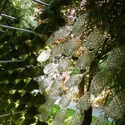
2) 1200 Hydroponics ferns
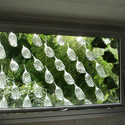
3) 300 glass beakers “blowing” components for bacterial culture / extra light through refraction / “Rear windows” negotiation with the neighbourhood opposite views on closed courtyard.
4) Collecting raining for watering plants with individual mechanical drop by drop system including nutritional adding on proportioning controls
5) Devil’s Rock emergences (“close encounters of the third kind”), with a nature (fern) coming from the Devonian period (dinosaur), technologically domesticated to come back in the actual regressive French period
According to the wiki, Hydroponics (from the Greek words hydro water and ponos labour) is a method of growing plants using mineral nutrient solutions, without soil. Terrestrial plants may be grown with their roots in the mineral nutrient solution only or in an inert medium, such as perlite, gravel, or mineral wool.
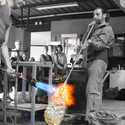
All the collecting glasses were made by a crafty technique, called Glassblowing. This is a glassforming technique that involves inflating the molten glass into a bubble, or parison, with the aid of the blowpipe, or blow tube. The transformation of raw materials into glass takes place around 2400°F (1315°C); the glass emits enough heat to appear almost white hot. The glass is then left to “fine out” (allowing the bubbles to rise out of the mass), and then the working temperature is reduced in the furnace to around 2000°F (1100°C). At this stage, the glass appears to be a bright orange color.
R&Sie has used this technique to make a new façade for a private laboratory in Paris, but most of the technical data are private, so enjoy the images and if you have more questions, you can use the comments to ask, we will get in touch with R&Sie and ask to take part in the forum, as they did in our previous post about the Waterflux.
You can see more from R&Sie(n) at the blogs from their studios at Columbia and Angewandte:
- basement plan
- first floor plan
- second floor plan
- axo 01
- axo 02
- section
- structure positioning 01
- structure positioning 02
- vegetations
- detail 01
- detail 02
- detail 03
- detail 04
- detail 05
- detail 06
- detail 07
- detail 08
- detail 09
- detail 10
- detail 11
- detail 12


This is lovely, actually. I’d be interested to see a diagram explaining how each individual bulb works, but even so it’s very pretty. They’re like giant transparent blackberries!
–
http://www.contemporaryartdaily.com
how work their bacterial aspect ?
wonderful… very poetic and great artistic pieces also… now the gardening must take a bit to look after
just love it.. just so natural done, not only the way the buidling looks, but the disign logic and touch throughout. nice one.
without much practical thought behind this… stunning.
Risky… like all the work from R&Sie(n).
I appreciate that.
Beautiful… Curious how it looks in winter though
I WANT THIS HOUSE
its seems that R&Sie(n) deal again ”the ghost in the shell” …is it an architecture post ”Blair witch project”, what kind of brewage is bewitching us for something not so readable.
Question / could we consider the difficulties to apprehend and capture by pictures a building as a kind of resistance against the panoptical addiction and de-territorialisation process…. / the post-picture of loneliness Totem under the sky for wall paper reviews and consuming madness are at the origin of its constitution and production… the worm was in the fruits…this ghost in the shell should be its antitote …a
It s your comment ”witch” is Not readable
Is the un-readable dimension of this project through the photographic report a attribut of quality ? or more precisely is it possible to develop an aesthetic of un-readable as a strategy …of resistance …for a non-panoptical dimension
Mainly, in archdaily, published projects are autonomously thought and reported, revendicating their own distinction…
At the contrary, could we emancipate the thinking and production to avoid to be slave about report ? or more clearly to develop a project which is not condamned to be slaved by the report (by pictures) and release the production which confuse subject and object ?
Quack-quack.
oh wow, this is so wonderfully sci-fi.. and thanks for providing so many detailed drawings, R&Sie(n), it’s a pleasure to look at your work.
and yea there’s nothing “unreadable” about this project unless you forgot how to read plan, section & detail.
I think it is beautiful. What Alain may be asking is the same question I have – beyond the beauty, how does this work? What are the practical benefits of the glass reservoirs? How are they filled? What is their connection to the nutrients and then how does it reach the ferns?
Please tell us more about the rubber tubes. Beyond the very impressive photos, I need more information to process the whole of it.
the fern are feed hydroponically, by collecting water in the roof, adding nutritional element in the basement and pumping up through 8 differents zones (depending of the sun light)with different time of watering. The beakers are in test now, the collecting of bacteria is done manually, they are from rhizobium gender, to increase the percent of azote without artificial manure in the ground.
The witch leaving inside is also preparing some love filter… (R&Sien)
Trackback: http://www.radarq.net/?top-shared-de-la-semana-1-2-3-4
I’ve got to say, I’m in love with the project and loathe the words… Any more pretentiousness, please? Amazingly inspired ideas, though, and in the end, that’s what counts.
uhm, you have to run exe, you retards. It wouldn
Hi,
I am Henry, a magazine editor from Taiwan. Our magazine is
MY LOHAS (Lifestyles Of Health And Sustainability.)
I have found this building designed by R&Sie(n) online, and I think it’s pretty
LOHAS. I’d like to introduce it in our next issue (will be
published on 5/5. Therefore I will need some high-res
images from you, of course I will credit every image.
Please contact me if you have any question about our mag, thank
you so much!
Best regards,
ohh! Architecture can be fun and modern and silly!
Love it! This guy is a trip and love his thinking of course with the exception at ORDOS where his brilliant thoughts went somewhere else!
hi…I am viola,I like it very much…
And I will ask you for something:
because I ‘ll write composition about LOHAS(style of life)for this web
http://140.122.101.121/
Could I use your pictures?
thank you & I’ll wait for your answer!
stunning
Very interesting work!
I were searching other advices about it and I found some conflicting informations… I didn’t understand if the beakers contain killing bacteria for plants or feeding bacteria for them. Or if there are both types.
I’d really like to have an answer.
Thanks!
6:06 AM Oct 20th
great Article on Paris Hydroponics Project -I’m lost in Paris / R&Sie(n) | ArchDaily http://t.co/5dIZLzs via @archdaily
6:08 AM Oct 20th
RT @Ecotelligence: great Article on Paris Hydroponics Project -I’m lost in Paris / R&Sie(n) | ArchDaily http://bit.ly/cq0tH0 via @archdaily
5:20 PM Oct 14th
I’m lost in Paris / R&Sie(n) | ArchDaily http://t.co/u6VlP6TH vía @archdaily