C+S Architects‘ contribution, Facecity, for the 2012 Venice Biennale, gives form to the idea of the curator, Fulvio Irace, of continuity in architecture. The exhibition reconsiders the architecture of Milan in the 50s and 60s, where architects, belonging to different generations and with different positions, built the identity of the city without giving up their personal poetics.
Grounds for Detroit – In this collaborative project, a distinct urban space – the mid-block of residential neighborhood – has been imported to Venice from Detroit. The installation is a recreation – and re-imagining – of a project undertaken in a abandoned single-family house in Detroit 2010.
Álvaro Siza. Viagem sem Programa, on display at the Fondazione Querini Stampalia through the duration of the Venice Biennale, narrates the most personal aspects of Álvaro Siza’s work in architecture and his concept of life. In response to Siza being announced as the recipient of the 2012 Golden Lion for Lifetime Achievement, curators Greta Ruffino and Raul Betti, along with organizer MedicinaMentis Cultural Association, began to work closely with the Portuguese master to put together this one-of-a-kind retrospective.
Each year, two million Mexican residents take part in the Ruta del Peregrino (Pilgrim’s Route) – a 117 kilometer pilgrimage through the mountains range of Jalisco that is centered around the adoration to the Virgin of Talpa. This religious voyage has been taking place since the 17th century and represents the pilgrim’s act of faith carried to penitence. In an effort to provide the route with better conditions, nine architecture firms collaborated to build seven architectural landmarks that provide shelter, services and outlook points for the pilgrims.
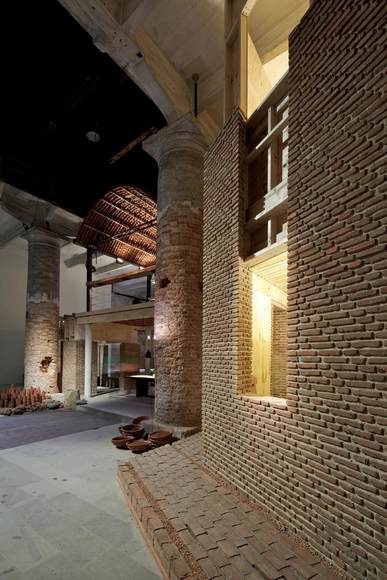
ArchDaily is proud to present images from the 2012 Venice Biennale featuring the reconstruction of Anupama Kundoo’s Wall House. The installation is an opportunity for the architect to reassess intial strategies and continue to explore the experiments of the original construction in Auroville, India. The replica was built by Indian craftspeople and Italian builders. The original design for the house aimed to respond to the environment and culture in which it is situated, taking into consideration construction techniques, material applications, and site strategies. The reconstruction, though absent from a landscape, displays spatial innovation and a collaborative use of materials that evokes an excitement about the integration of culture and structural techniques.
The Israeli pavilion at the 13th Venice Architecture Biennale, titled Aircraft Carrier, deals with the dramatic changes in Israeli architecture since 1973, and the American influences that made them possible.
The term “common ground” claims something shared: relationships between people and things. This installation intends to awaken an appropriate sense within the soul of the visitor.
Contemporary Athens is a city of strong contradictions: It is a city whose particular identity was shaped during post-World-War-II reconstruction. A city which has at its disposal an exceptionally talented cadre of young architects, international in orientation, well educated and with a wealth of professional experience. It is, however, the city that was most stricken by the current economic crisis. Currently the Athenian urban space is decomposing and there are increasingly frequent and greater disruptions of the social web. The younger generation of architects benefited from the positive aspects of globalization and today has come face-to-face with the harsh aspect of the global financial crisis, a plummeting standard of living and the need to redefine the priorities of architectural design.
Through this installation, Swiss architect Valerio Olgiati explores the ambiguous and complex “common ground” of inspiration and imagination in architecture. Images, selected by architects from around the world, represent the infinitely varied forms of visual material that are collected in their imaginations and subsequently transformed through the creative process.
During the opening of the Venice Biennale, we had the chance to sit down and talk with the curator and participants of the Japan Pavilion, awarded with the Gold Lion.
After a long struggle for independence, Kosovo became a new European country in 2008. Much of it’s urban landscape consists of Ottoman, Austro-Hungarian and Communist era architecture that has been mostly remained untouched by the war. As wealth returns and the economy slowly grows, a new building spur has ignited, covering the city with a sprawl of store fronts, apartments and office buildings.
As a contribution to the 13th Venice Architecture Biennale, Noero Architectsshowcase two powerful works of art in their exhibition Common Ground / Different Worlds to reveal that architects, and artists alike, work to reinterpret, reinvent and transform preexisting ideas and forms. However, Jo Noero, Principle of Noero Architects, believes that the “difference between good and bad work lies in an understanding of that which is shared and common and the ability to transform these ideas into forms and spaces which are both useful and satisfying within the community in which the work is located.”
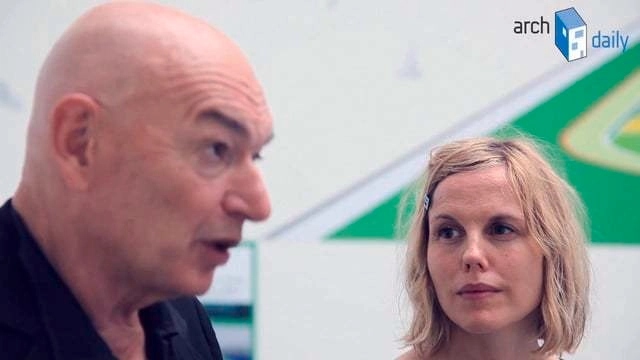
Jean Nouvel and Mia Hägg presented “Meetings Lines” at the Venice Biennale. For ‘Common Ground’ they decided to show their finalist project for the Slussen Masterplan competition, an ambitious urban design project that seeks to replace much of the degenerated water and transportation infrastructure in the heart of Stockholm. The project proposes three different public spaces, designed as living links for the city, inspired by infrastructure such as the Rialto Bridge in Venice.
The International Jury of the 13th Venice Architecture Biennale has awarded Cino Zucchi Architetti (CZA) a special mention for their installation, Copycat. Empathy and Envy as Form Makers. Their contribution is based on the notion that “we are all a bit copycats”, understanding that cultures are propagated by following “infectious” processes that combine imitation and innovation. CZA presents a collection of “almost-alike” objects and images with the idea that “similarity” rather than “originality” is where people find common ground.
Inhabitable Models presents the work of three practices -Eric Parry Architects, Haworth Tompkins, Lynch Architects- who find their common ground in an engagement with London, as a city of found fragments. Perhaps uniquely among world cities London exists as a series of largely unplanned, independent, layered fragments which nonetheless come together for a host of legal, political, and economic practicalities. In responding to this conception of London, each practice seeks to resist the temptation of “hallmark” architecture in favor of one which is contextually sensitive and rigorously place-specific. Indeed, the practices’ appreciation of the fragmentary and unplanned applies both to the London that they find, as well as to the London they leave behind.
“Forty years ago the public cause proved a powerful source of inspiration. Given the numbers of architects that chose to serve it, one might even speak of a common ground. In the age of the ‘starchitect’, the idea of suspending the pursuit of a private practice in favor of a shared ideology seems remote and untenable. In the context of the 2012 Venice Architecture Biennale, this exhibition hopes to provide a small contribution towards finding that common ground once more…” – OMA Partner Reinier de Graaf, August 2012