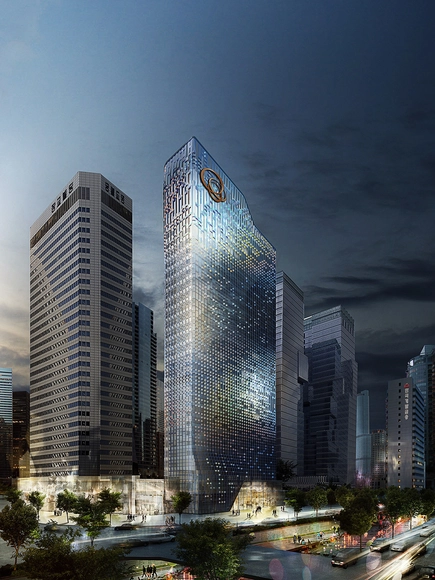
UNStudiohas won a competition to remodel the Hanwha headquarters in Seoul. With an aim to transform a building into a symbol of the leading environmental technology company’s values, UNStudio's winning scheme will replace the skyscraper’s opaque panelling and single layer of dark glass with an animated facade designed to reduce solar gain, increase natural light, generate energy, and interact with its surrounding.
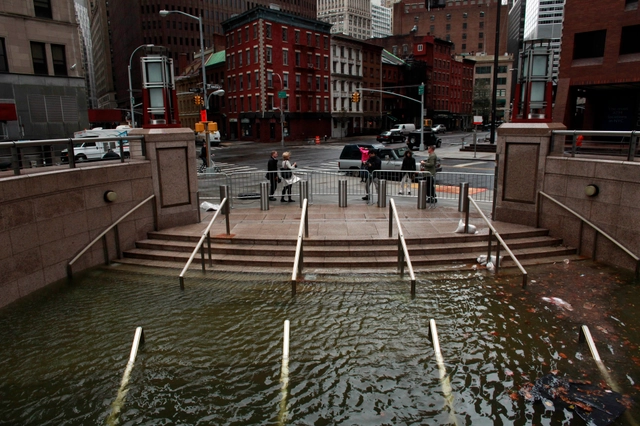
The challenges of sea-level rise cross boundaries of all sorts: geographic, political, social, economic. Proposed mitigation strategies will also necessarily shift and overlap. Here, we present five case studies from across the globe that offer intriguing ways—some operational, some philosophical—to address the threats associated with climate change. Drawing on a research initiative focused on vulnerabilities in Boston, a team at Sasaki Associates developed these additional design-strategy icons to illustrate the layered approaches. They are adaptable, the better to meet the unique demands of each coastal community.
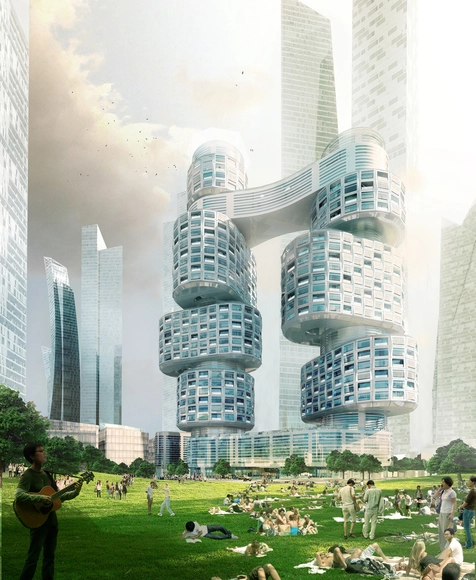
Asymptote's Velo Towers, designed for the Yongsan master plan in Seoul, Korea, are formed by vertical cluster of cylindrical volumes which were strategically stacked and rotated to maximize views, privacy and environmental conditions. Consisting of eight distinct residential components, each cluster is carefully choreographed to establish a strong visual connection with the adjacent Yongsan Park and distant Han River. These clusters are complimented by a series of roof gardens, shared amenities and internal circulation spaces centered around light filled open atriums.
Night View (Front). Image Courtesy of Asymptote Architecture
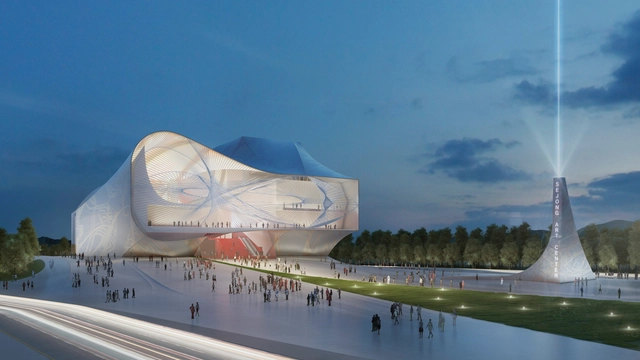
New York based Asymptote Architecture have unveiled designs for a new Centre of Performing Arts in Sejong, South Korea. Described as celebrating "the cities emergence and growth as a place of stature and culture," the arts centre is designed to "seamlessly connect to the city fabric." Containing two theaters, the program of the building has been designed to create a unified experience, allowing for a "powerful and 'episodic' interiority and experience."
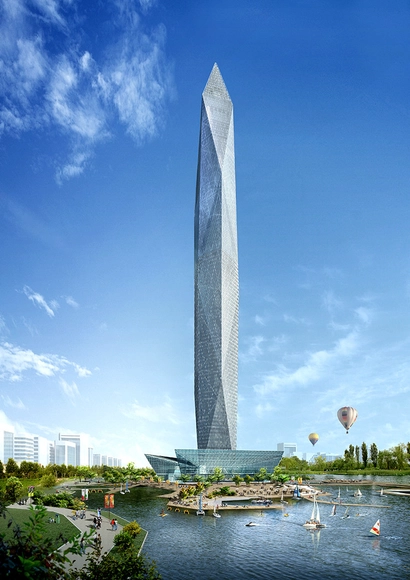
Infinity Tower / GDS Architects. Image Courtesy of fastcodesign.com
California-based GDS Architects' new proposal, dubbed Infinity Tower, is designed to disappear from its Korean skyline. How? Cameras will be mounted at six strategic points; thousands of LED screens on the facade will then broadcast the real-time photos captured and logged by the cameras. Though no estimated completion date has been announced, the developers have received construction permits to break ground. More about this incredible vanishing act and how it's done at Fast Co-Design.
Located in the intersection of the pedestrian axis of Festival Street within the heart of Magok city in Seoul, the competition winning proposal by Wooridongin Architects for the Magok Central Plaza weaves itself into the surrounding city. The plaza is a great traffic node since it is where the subway lines 5, 9 and Incheon Airport train cross. Its close location to Han River greenery and ecosystem aligning with the River, Jungang Park and Green Area Connectors makes it to be part of a continuous open space system. More images and architects’ description after the break.




















.jpg?1378307160)
.jpg?1378307514 "© Megabox")
.jpg?1378307201 "© Kyungsub Shin")
.jpg?1378307287 "© Kyungsub Shin")
.jpg?1378307396 "© Megabox")
.jpg?1378307160)
