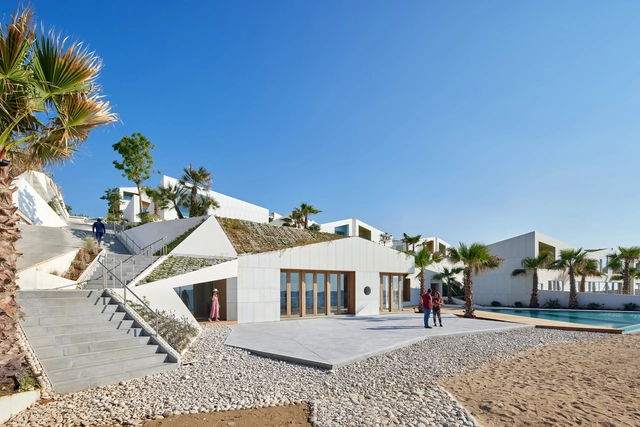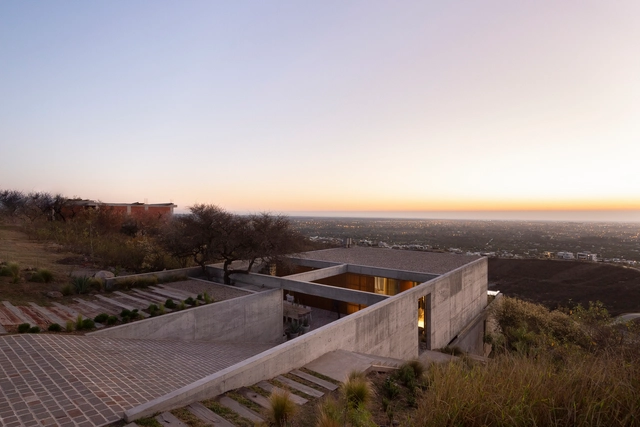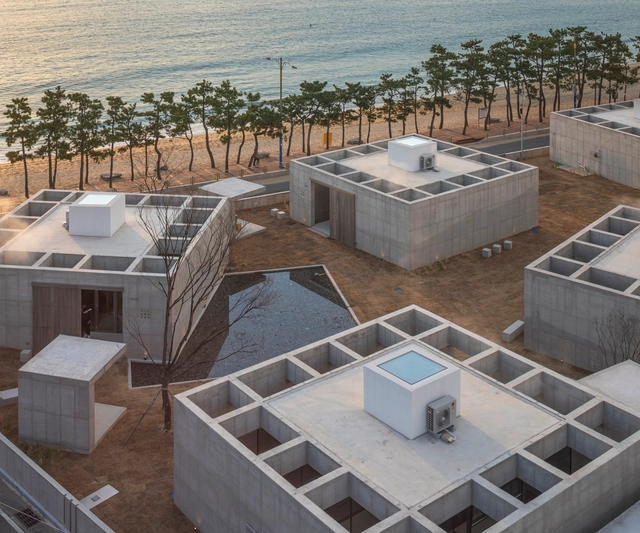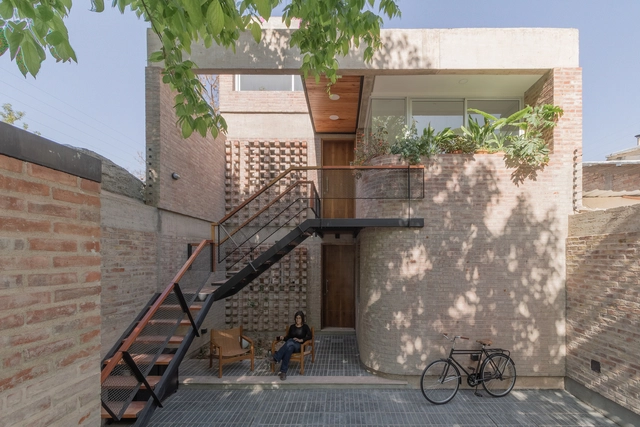
The most prominent characteristic of this two-storey new building is the rooftop landscape that forms the exterior expression of the building's interior use zones.

The most prominent characteristic of this two-storey new building is the rooftop landscape that forms the exterior expression of the building's interior use zones.

Casa Houlpoch is an old Yucatecan house from the end of the last century that gets its name from a snake from the region that regularly “visited” the property's ruins. The room, in pastel tones, has modern and casual furniture, integrating greenery and works of art, such as a playful Timoteo on the center table and a painting by Pedro Friedeberg on the sofa, crowning the space. The kitchen, with coatings in paste and quartz, has a reinterpretation of the old Yucatecan bells on the stove. The hanging lamps harmonize the space and are integrated into the wooden furniture such as the tzalam benches and the dining room, which was brought from Mozambique, a country where the Dutch owners lived before settling in the Yucatan peninsula.

For over a thousand years Mount Emei has persisted as one of the most deeply spiritual places in China and was named a UNESCO World Heritage Site in 1996. The revered ground upon which our site sits has a rich history itself – through the centuries, this land was once an impressive monastery, the site of several historic battles, and a stopping point along many pilgrimage and trade routes. While any built remnants of the past no longer remain on site, its very emptiness is powerfully suggestive of all of its fabled memories. Three years ago, Neri&Hu won the design competition and took up the challenge of designing a distillery and home for Pernod Ricard’s first whisky in China, an opportunity to create a timeless architecture that speaks to the core values of a visionary new brand as well as the material and cultural heritage it aspires to sustain.

Built for industrial designer Jenny Nordberg and artist Andreas Kurtson as an extension to an older villa, House for two artists had a simple brief: create a big, open atelier space at a low budget.

“This city has many squares where there is a continuous market and I try to buy and sell. It has a square as big as twice the city of Salamanca, still surrounded by portals around it; where there are over sixty thousand souls buying and selling daily." Hernán Cortés

Living on one floor implies continuity, articulation, composition, and fragmentation of spaces without losing the unity of the whole. The project of this house works the globality of the plot from its maximum use by its users.

Reinterpreting the cloister as a space imbued with infinite permutations of possibilities, living occurs organically around courtyards.

The real estate market in big cities like Paris is tenser and tenser. Rents shoot up whereas surface areas decrease. In this context, people are more and more obliged to live in small spaces. Especially for students or low incomes, studios from 10 to 15m² are becoming the norm. For architects, this new type of living is challenging because it forces us to maximize the feeling of space and the quality of living.

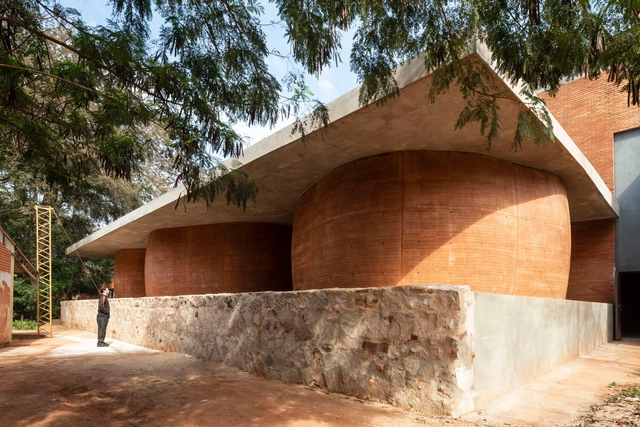
Folds, cubes, and sheets of bricks combine in this office building by Mínimo Común, transforming constructive experimentation into a game. In the city of Mariano Roque Alonso, in the immediate proximity of Asuncion, Paraguay, Mínimo Común Arquitectura completed an office building in which play and gravity challenge are combined in thorough experimentation in the use of brick.

In this house, a large staircase occupies 1/3 of the space, which stretches across the entire East-West axis central to the site, with the living quarter to the North, and an open sunny garden on the South. This glazed and elongated staircase offers up various views and scenery to its inhabitants.

Respect is the underlying theme driving the design for the infrastructure improvement strategy at Peggy’s Cove. Respect for the forces of nature on the barren landscape. Respect for the local families and character of their village. Respect for the balance between a manufactured and natural landscape. And finally, respect for those of all abilities to share in the atmosphere and spirit that is embedded in the iconic Canadian landmark that is Peggy’s Cove.

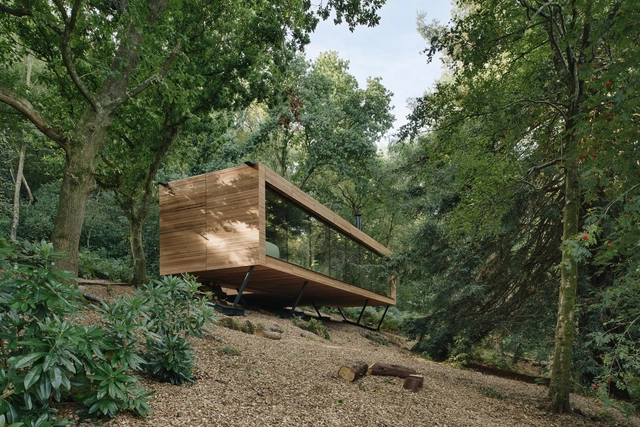
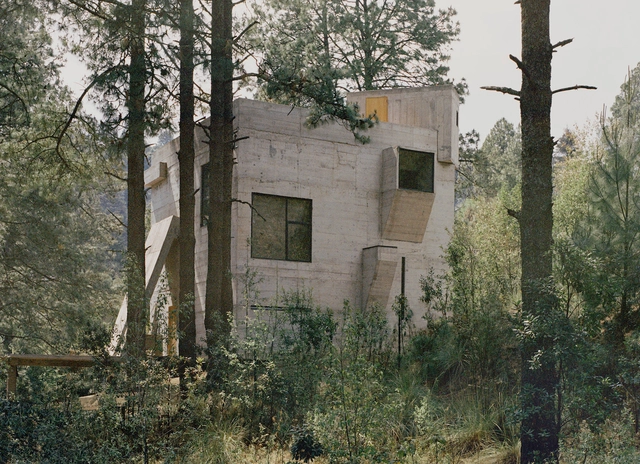
“Measure twice, dig once” - this was the driving force behind the smart foundation idea that Attila Béres and Attila Hideg figured out to protect the roots of the gigantic trees of the site. At the same time, their idea made it possible to sketch up a cabin that can be built by one person. Believe it or not, this little hideaway had been created by owner and builder Attila Hideg all alone.

The Canopy was conceived as a unified lightweight spatial installation within a gravel oven building located in Attisholz, Switzerland. The aim of the installation is to create a setting within the existing space to accommodate the 3-day temporary events organised for the fib Symposium on Conceptual Design of Structures, including symposium, exhibition, and Apéro. Such activities request a regular stage area for presentations and discussions, as well as a small exhibition space for models and panels.

Located on the north side of the historic center of the town of Cahors and a few steps away from the banks of the Lot River, this cinema stands on a former site dedicated to the army (today renamed Place Bessières). The project offered the opportunity to recreate and reinterpret the symmetry of the preexisting army barracks by occupying the area of the east wing of this complex, destroyed by fire in 1943. Previously serving as a parking lot, the Place Bessières has been transformed into a broad and welcoming urban space dedicated to pedestrians and protected by an existing canopy of trees.

Mannheim, a medium-sized city in southwestern Germany, is known for its grid-plan city layout, its baroque palace and its brutalist buildings – but also, and above all, for its ethnically and culturally diverse population. This diverse and colourful mix of people can be experienced, among other places, in Neckarstadt East and Neckarstadt West, two districts northwest of the city centre.

Several football fields, several green ponds, and a rest station float on a piece of water, as if the lotus leaves in the lotus pond are gathering and dispersing, forming a public activity site on the right bank of Maozhou River, which has the functions of sports, purifying the wetland, changing clothes and getting wet, and resting and entertainment. The site is far away from the bustling core city of Shenzhen, and the design hopes to retain the original and rough atmosphere of the site. Therefore, the expression form of plain concrete is selected to remove redundant and tedious decorations, so that the structure and space can be directly presented.

Context. Located in the center of a historical area, the site of the Museum is adjacent to the Imperial Kiln ruins surrounding with many ancient kiln complexes. Jingdezhen is known as the "Porcelain Capital" in the world because it has been producing pottery for 1,700 years. In the Ming and Qing dynasties, Jingdezhen exported a huge amount of porcelains to Europe.

The intervention focuses on the reform of a farmhouse from the 18th century hosting a pension linked to the north part of the Camino de Santiago, located on the outskirts of the traditional nucleus of Madelos en Sobrado dos Monxes and bordering Concello de Boimorto. The building has had different extensions over time, until the 1970s when it was abandoned due to its poor condition. During this time the wooden structure has deteriorated and part of the slate walls have collapsed. The process of abandonment, as in many rural areas due to the exodus from rural to urban areas, causes a transformation in the landscape. Thus, social and cultural changes end up shaping the landscape.