My old firm, the one I got laid off from almost exactly two years ago, has had another round of layoffs. I’ve lost count how many that is (over ten I think), but since it included several principles, I’m guessing that this is either a death knell or time for a major restructuring of that office.
And that got me thinking about my own situation. Again. Because if there’s one thing that triggers intense feelings when you’re unemployed, especially when it’s been a really long time, it’s hearing other people at your old firm have suffered the same sad fate.
https://www.archdaily.com/144419/the-indicator-it%25e2%2580%2599s-personalGuy Horton and Sherin Wing
When a major architecture critic heads for the exit, does anyone care? One would suspect most architects would hold the door open and wave him on through. Critics, after all, can be quite nasty and make one’s life work look like so much poop.
So, it depends. When Herbert Muschamp died in 2007 the collective tissue boxes of the architectural profession were emptied as architects of all stripes, especially those he championed, shed rivers of tears. Mr. Muschamp, it seems, was a critic of consequence. People listened to him. What then of his protégé, Nicolai Ouroussoff? (Hereafter, simplified to N.O.) Will be N.O. missed?
As the economy staggers through the pre-dawn streets of a slow and agonizing “recovery” – some economists including Robert Reich argue we are not in a recovery – it is important to remember what has been learned.
As far as architecture is concerned, the lessons learned were the same ones as in prior recessions. Maybe this time architects will not suffer from amnesia or lapse into denial when billings tick up once again. It is easy to forget how difficult things have been. People tend to just want to move on and not dwell on the past. Psychologically, people seem to just want the economy to be in a recovery – even if there is evidence to support that it is not necessarily at that stage yet. Recession this, recession that. Everybody is tired of hearing about it. I’m tired of writing about it! But it is still a reality that affects the ranks of our chosen profession. No one has been immune. Professionals at all levels of experience, whether licensed or un-licensed, domestic or international, healthcare or commercial have been impacted.
Focus! Focus! Focus! Why are you reading this! You should not be reading this now! Get back to work! You are being unproductive! You are DISTRACTED!
Architecture in an office environment often functions like the opposite of how it was in studio. For one, offices are businesses so there is a need for oversight, management, evaluation, assessment, leadership, discrete task assignments, meetings…the list goes on. Notice that all of these elements to running a firm somehow come down to time management and staffing issues. Leaders have to keep an eye on junior staff, not to be annoying and stand over their shoulders micro-managing them, but to stay aware of what everyone is doing and where the different aspects of complex projects stand. Of course, this also relates to project budgets.
Points of View (POV) is a Herman Miller series sharing architects’ perspective on design. Directed by Hello Design, POV provides five different California architects’ step by step process from approach and design development to materials choices. Architects include Leo Marmol and Ron Radziner of Marmol Radziner, Kim Coleman of Cigolle X Coleman, James Meyer of LeanArch, Jim Jennings of Jennings Architecture, and John Friedman of JFAK Architects.
The Tulane School of Architecture, theCharrette presents its May 2011 Issue. The culmination of a year with a new image for the publication, theCharette has included in this issue key architectural topics at Tulane and adjacent realms including the Richardson Memorial Hall renovations with FXFOWLE and el dorado.
The best of architects is not that they can use cool software or design buildings, or even that they can help create interesting spaces. If you think back to your school days, the best of architecture was problem-solving. You were given a challenge and then you had to think of good ways to address those challenges. That included addressing social, cultural, racial, environmental, and not least, spatial, needs.
Given the opportunity, architects use a myriad of tools and critical thinking skills to solve many different problems, not just strictly spatial ones. In fact, years ago, Guy Horton and I discussed the possibility of starting a round table or a colloquium, to brainstorm on different issues with others both in architecture and other academic fields, and to offer possible solutions.
According to Architecture I have what you might call a Past. I never thought I did, but there you go. I do. What I mean precisely is that at one time I had a life that did not revolve around architecture. I’m one of those suspicious Non-Architectural Background types—or a person from the realm of the Non-Architectural Background.
Architecture has found ways to accommodate people like me, but at times it is still an uncomfortable accommodation. Architecture likes to view itself as cosmopolitan, cultured, and intellectual, but when it comes face to face with individuals who have educations and experiences of non-architectural sorts it doesn’t always know what to do with us.
In March of 2011, a design-build class from the Maryland Institute College of Art (MICA) received a grant in support of their efforts to design a shelter for disaster relief. The money from the grant was used to travel to Haiti to see conditions on the ground, 14 months after the earthquake that reportedly amassed some 230,000 fatalities.
The goal of the trip was to investigate the myriads of different shelter construction projects still ongoing as Haiti transitions from the emergency tents and tarpaulins that still populate the landscape, into temporary housing for the foreseeable future until permanent housing can be provided through rebuilding.
One of the more ambitious and impressionable projects we came across was the UberShelter.
Kyle Lewis, an architecture student at CPIT in Christchurch, NZ, shared with us a call for design to help rebuilt Christchurch after last February’s earthquake. Here’s the message:
Documented here are abandoned theatres found throughout the United States. From small towns to large cities, these buildings were once places that housed a source of entertainment for their community. Why then would such places be abandoned and not even considered for renovation? Before the iPod, the television or even the Internet were around, theatres were major social gathering spots, so how could places such as these become so empty and lack any vitality? More images after the break.
An article in this week’s Economist about Italian business clusters—that is, where businesses in the same industry form geographic clusters—offered some interesting observations. First, that traditional business models cannot survive global competition. A strategy to deal with global competition includes innovation and building brands. In short, diversification.
This led to a question: how does one approach diversifying architecture firms so that they, too, will be more able to weather economic vicissitudes? For that, let’s turn to Paul Nakazawa. Of course, there is the more “traditional” model of diversification: “many architects have several different kinds of SEPARATE businesses, which serves to diversify dependency on one source of revenue. The time-honored diversification scheme is teaching and practice — we all know lots of people who do that gig.”
Brazil will be the first South American country to host the Summer Olympics which will be held in 2016, but first the country set their sites on building the world’s tallest LEGO tower, a record previously held by Chile. The community of Sao Paulo constructed their 500,000 piece LEGO tower last weekend which rose to a height of 102 feet-three inches. School groups, families both kids and adults, joined in the team effort assembling the independent LEGO bricks that were stacked on top of each other eventually using a crane.
This week I’d like to introduce you to some books I’ve come across while traveling the city. This first one is CLIP STAMP FOLD, an encyclopedic compendium of radical little architecture mags from the sixties and seventies. More than just clip stamp fold these were also draw cut paste scribble slash ink. This brick of a book is a portable archive and you don’t have to wear latex gloves to handle. These small, independent publications curated the contemporary and collected what may have been the disposable present. The challenged the orthodox historicism of architecture with a hippy slant. I would have stolen some images for you, but alas it was wrapped in protective hygienic cellophane.
Gaby Lingke shared with us a short documentary about architect Fritz Eisenhofer, who designed and built a futuristic earth-sheltered dome in Peka Peka, Aotearoa, New Zealand. Architect’s description and a plan of the dome after the break.
We saw this incredible set of posters from iconic architects created by artist Andrea Gallo and felt the need to share them with you. They will be available for sale soon, so we look forward to buy one and decorate our office! Which one would you get? Check the posters of Frank Lloyd Wright, Le Corbusier, Louis Kahn, Alvar Aalto and Walter Gropius after the break.
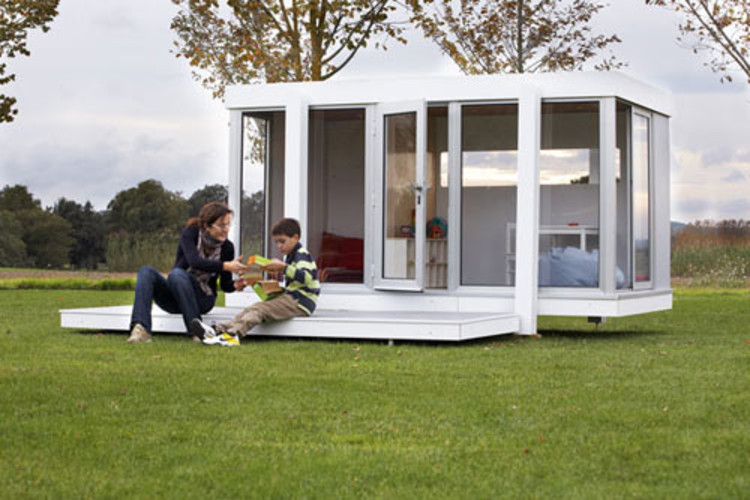
Inspired by contemporary architecture the SmartPlayhouse is architect David Lamolla Kristiansen’s answer to providing a modern, comfortable and safe play space for his daughter. The four playhouse versions, Kyoto, Casaforum, Hobikken, Illinois, are unique spaces that encourage creativity.