A finalist entry in the Transiting Cities – Low Carbon Futures competition, Studio One‘s proposal, titled, ‘Networked Ecologies: Rethinking Remediation’ a variety of programs ranging from landscape / mining remediation, to urban agriculture are defined. These “in-between” sites will grow and develop according to the specific conditions and uses, eventually creating a network of infrastructure that will provide robustness to the city. More images and architects’ description after the break.
mæ architects recently announced that they were selected to design a ‘split-site’ elderly housing and healthcare hub project in Lisson Grove, Central London. Intended for City West Homes, on behalf of Westminster City Council, the housing scheme, which will be designed to HAPPI recommendations (Housing for an Aging Population Panel for Innovation), will bring contemporary, socially-orientated architecture to a deprived community which is desperately in need of re-invigoration. Construction is due to start at the end of 2013 and will be completed in two phases. More images and architects’ description after the break.
Jestico + Whiles’ design for the new £61m National Graphene Institute at the University of Manchester has recently been granted planning consent. The new facility will be designed with the goal to be the world-leading research and incubator center dedicated to the development of graphene, helping the UK to remain at the forefront of the commercialization of this revolutionary material. The project will be housed within a compact 7,600m2 five-storey building, with the main cleanroom located on the lower ground floor to achieve best vibration performance.More images and architects’ description after the break.
Organized by International Art Consultants (IAC) and supported by The Royal Photographic Society, the Architect’s Eye competition has been celebrating and encouraging architects’ passion for photography since 2007. Now, in its fourth edition, UK architects are challenged to submit photos into two distinct categories: Architecture and Place and Architecture and People. The former focuses solely on the aesthetics of the architecture and places it creates, while the latter explores and celebrates the interaction of people with the environments created by architects. There are no restrictions on which buildings qualify for the competition.
The winner in each category will receive a weekend break for two anywhere in the EU. There will also be Special Commendation prizes awarded at the judges' discretion.
Organized by Christopher Marcinkoski and Javier Arpa, in cooperation with the Architectural League of New York, ‘The City That Never Was’ symposium will be taking place Friday, February 22, from 9:00am-5:30pm EST at the Scholastic Building in New York. The one day event will use the current economic and housing crisis in Spain as a lens to reconsider how planners, designers, politicians, and financiers conceive of and realize large-scale contemporary urbanization and settlement. It will be organized through four primary themes — infrastructure, waste, landscape, and instant urbanism – in order to explore new possibilities for how future patterns of urbanization can be conceived, financed, planned, deployed, and inhabited. For more details, including the complete itinerary and speaker information, please visit here.
The U.S. Department of State recently announced a request for proposals from any U.S. nonprofit organization at the 14th Venice Architecture Biennale, which is set to take place June 7-November 23, 2014. This includes museums, galleries, design centers, schools of architecture and design, and independent curators affiliated with a non-profit organization. The deadline for submissions is April 1, 2013. For more information, please visit here.
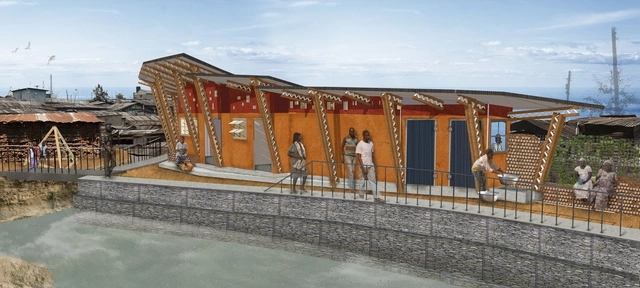
AECOM has announced 'Unslumming Kibera' as winner of the fourth annual Urban SOS competition.
The student competition received submissions from 118 universities in 41 countries. Three projects were shortlisted for a presentation to a panel of judges in New York on Jan 16.
Read about the finalists and their projects after the break
With urbanistic planning in mind, the proposal by Baumschlager Eberle for the law courts of Caen redefines a new domain in the center of the city. In collaboration with Atelier d’Architecture Pierre Champenois, the shape of the building agrees not only with the tradition but of course with the more complex duties of law courts in the 21st century. An orthogonal pattern constitutes the base for the organization of the needs of the law courts. More images and architects’ description after the break.
Taking place February 8-9, the Building Pulitzer Colloquium, which is free and open to the public, will bring together key participants in the design and construction of this iconic building. The colloquium will provide unique insight into the extraordinary collaboration and dedication required to realize this project. Hosted by the The Pulitzer Foundation for the Arts and Washington University in St. Louis, the event focuses on how this building, designed by an internationally recognized architect, was completed. Topics will include the working structure between Tadao Ando’s office and the St. Louis-based team, the realization of Ando’s design intent through the translation of American methods of construction, and the creation of a work environment that fostered construction excellence. More information on the event after the break.
Awarded the second prize in the recent Ramat Efal Education Campus Competition, the ‘Fields of Knowledge’ proposal by ShaGa Studio + Auerbach Halevy Architects/Ori Rittenberg(Rotem) integrates a series of linear ‘knowledge fields’ into a rich and varied learning experience, weaving together exteriors and interiors, the public and the community. Evoking the memories of old agriculture fields in Ramat Efal, their design criticizes an existing plan that splits the campus into three divided plots and suggests instead an integration of both school & public programs within an overall ‘field condition’. More images and architects’ description after the break.
San Rocco have been announced as the recipients of the inaugural Icon Award for Emerging Architectural Practice of the Year.
However, San Rocco is not your typical architectural practice. Departing from the traditional model, San Rocco is a collaboration of firms with different disciplines; Instead of buildings, they are known for their publishing projects.
Exhibited at the Designers’ Saturday 2012 in Langenthal, Switzerland and at the BAU 2013 in Munich, Germany, the experimental installation “Abstraction” transforms shadows and lights into predefined pixels. Created by architects Peter Thomas Hornung of Hornung and Jacobi Architecture and Axel Schenke, their patented system uses the given material properties of Corian and assigned it with so far unknown qualities. More images and architects’ description after the break.
With the site of the proposed project characterized by a 7m height difference between the south west corner and the north east one and the fastest way to access to it is from the roads west and north of it, the Huaihua Theater and Exhibition Center will be managed by three different subjects adding further difficulties in organizing the layout. Designed by United Design Group, the 60,000 m² complex is equally subdivided between the theater/cinema part (30,000 m²) and exhibitions: 12,000 m² for the museum; 10,000 m² for the urban planning hall; 3000 m² for the fine arts museum and 1000 m² for the local history exhibition. An extra 6000 m² will host the art training center. More images and architects’ description after the break.
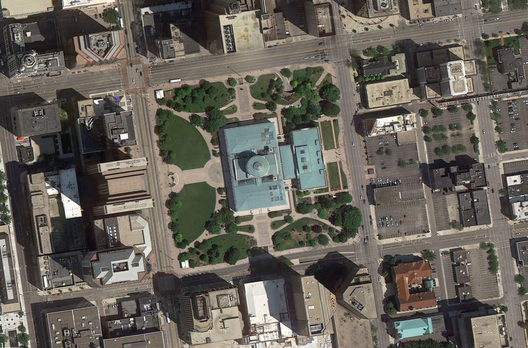
Daniel Libeskind is among three semi-finalists competing to design the Ohio Statehouse Holocaust Memorial in Columbus. The privately funded memorial will be built south of the Ohio Statehouse on the grassy 10 acre Capitol Square, just east of the Scioto River.
As stated in the competition brief, “The memorial itself must help everyone who visits and works in the Statehouse understand not just the history of the Holocaust, but also the fact that today we must continue to stand against evil. Artists are asked to create a piece that will serve as a permanent memorial in remembrance of all victims of the Holocaust (1933-1945) and those Ohioans who participated in the liberation of the death camps during World War II. The memorial should provide enlightenment on man's inhumanity to man and inspire people to think and act differently in the face of discrimination, hatred, antiSemitism and genocide.”
Designed by SHJ (Simon Hjermind Jensen) Works, Fire Shelter: 01 is a personal project located in at Sydhavnstippen in Copenhagen. Taking inspiration from architecture of ethnic and nomadic people, the starting point for the design emerged from a fascination of the place. It´s a temporary project and a design experiment that aims to celebrate the place. The project has public access, and it establishes experiences of spatial and social character. More images and architect’s description after the break.
Opening February 14, and on view until May 4, Yale School of Architecture‘s ‘White Cube, Green Maze: New Art Landscapes’ exhibition will examine emerging trends in museum design through six new art sites that share the common thread of moving beyond the traditional “white cube” gallery space, and that juxtapose the experience of culture, art, architecture, and landscape. Featuring newly commissioned photography of these sites by Iwan Baan, each site represents a unique expression of the ambitions and collaborations of patrons, architects, landscape architects, artists, and curators. For more information, please visit here.
Martin Barry, founder and director of reSITE in Prague and associate at W Architecture and Landscape Architecture in New York, will give an evening lecture at 6:30pm EST on February 7th. Taking place at the NYU Silver Center, his lecture will focus on how organization is advocating for more transparent, contemporary and sustainable urban planning in Czech cities. Martin will discuss the outcomes of reSITE 2012 and describe their plans for reSITE Festival and Conference to take place in June 2013. The event is presented by NYU Department of Art History & Urban Design and Architecture Studies with Czech House NYU. For more information, please visit here.
Designed for the “Vigdis Foundation”, the Languages Center aims to be a rational building, where modulation is a key aspect. Designed by OOIIO Architecture, there is no architectural excess that might increase the budget, but quite singular and special at the same time, comfortable for users and interesting enough to get the pedestrians attention. Built to host exhibitions, a cinema-theater, café, library, and more, the construction of the building is efficient, quick and with a rational materials use. More images and architects’ description after the break.More images and architects’ description after the break.