Once synonymous with monotony, “prefabricated” buildings often bring to mind the gray, repetitive housing blocks of the postwar era. But that image no longer fits today’s reality. Powered by digital design, robotics, and advanced materials, prefabrication has evolved into a language of innovation and precision. Far from uniform, it now enables flexible, efficient, and sustainable spaces that reflect the individuality of contemporary architecture.
Modern residential construction in the UAE demonstrates the need for advanced thermal envelope solutions in hot, arid climates where cooling can account for up to 70% of peak electricity consumption. Image Courtesy of Terraco
Terraco, a global leader in Exterior Insulation Finishing Systems, has demonstrated through independent studies that when planning building renovations, it is essential to adopt a deep retrofit strategy that includes energy-efficient measures, such as thermal insulation of external walls and roofs.
Videos
ARCHISONIC® Cotton MOSAIC and ARCHISONIC® Felt CIRC shaping spaces with sustainable elegance. Image Courtesy of Impact Acoustic
What defines a space first when entering: the sound or the visual impression? Architecture is often communicated through structure and surfaces, yet one of its most essential components moves unseen through the air: sound. It shapes how a space feels long before a wall or ceiling is noticed. Computational design brings these dimensions together, allowing architects and designers to create unique structures where acoustics and aesthetics inform one another rather than exist in parallel. By leveraging advanced algorithms, complex design processes transform into intuitive, accessible solutions that shape bespoke acoustic and visual highlights for every project. This approach combines parametric logic with material innovation, balancing efficiency, sustainability, and expressive design in equal measure.
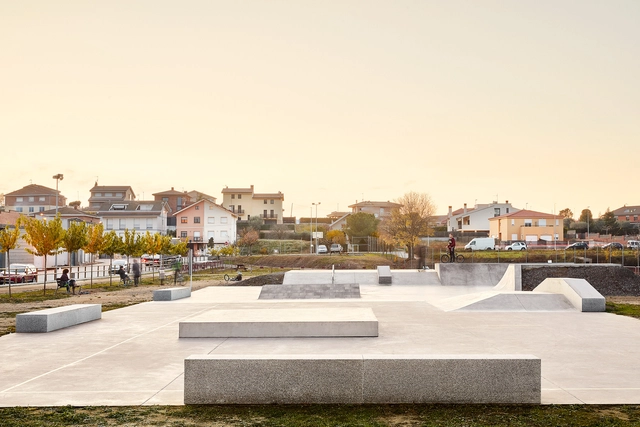
Created by California surfers who wanted to bring the lines of surfing onto asphalt, skateboarding soon outgrew its role as a simple alternative for flat days. It established itself as a practice that reads the city through a different logic, reinterpreting steps, handrails, walls, and interstitial spaces as possible lines, challenges, and opportunities. Over time, it evolved into a global urban culture, a way of inhabiting and transforming public space through movement. What was once marginal has become a catalyst for urban activation, community building, and new uses for overlooked spaces. At its core, skateboarding reveals how many cities coexist within the same city, depending on who moves through them and how each person is able to reinterpret their surroundings.
The prestigious BAUMunich, the world's leading trade fair for architecture, materials, and systems, served as the stage for Orama Minimal Frames' latest innovations in architectural frame technology. The exhibition offered a platform for industry connections and showcased advancements that challenge conventional boundaries in frame design.
Meta fitting in Matte Black. Image Courtesy of Dornbracht
Are living spaces getting smaller? As cities densify and the global population continues its steady migration toward urban centers—projected to reach around 70% by 2050—domestic space is becoming increasingly compressed. Rising land prices, high construction costs, and a surge in single-person households push developers toward smaller units and tighter floor plans. At the same time, cultural shifts toward resource efficiency and minimal living support this move. Shrinking living spaces require fewer materials, consume less energy, and encourage people to live closer to their means.
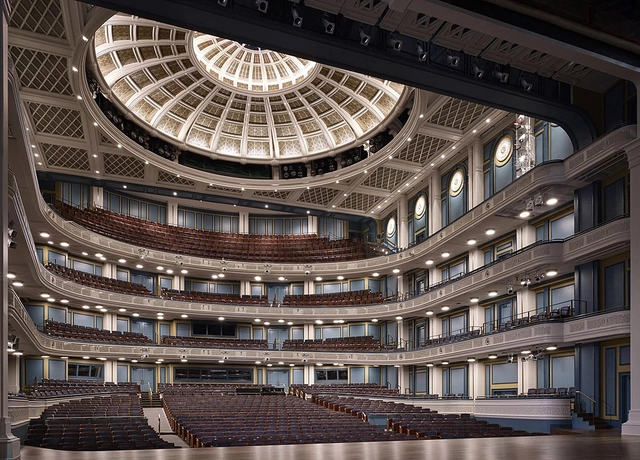
In 1952, American composer John Cage presented his groundbreaking piece "4'33''" for the first time. In it, the orchestra produces no intentional sound for four minutes and thirty-three seconds. What can be heard instead are breaths, movements, and subtle noises that would normally go unnoticed, but here become part of the composition itself. With this work, Cage revealed that absolute silence does not exist. There is always sound, even when unplanned.
Cities bring together the best and worst of the human condition. They concentrate opportunities for work, social networks, and cultural production, but they also expose deep social inequalities. Among the many forms of urban exclusion are limited access to transportation, housing, leisure, or safety issues. One form that is rarely discussed is thermal inequality. In lower-income neighborhoods, where there are fewer trees, parks, and permeable surfaces, heat accumulates and thermal discomfort dominates, resulting in higher energy consumption and health risks. As concern about the climate crisis grows, this discussion becomes more urgent: extreme heat is no longer just a climatic phenomenon but also a spatial expression of inequality.
There's a quiet rebellion happening in the bathroom. Forget glossy marble and showy gold fittings; the new mood in design is one of calm confidence. Luxury today is understated, sensory and precise. It celebrates craftsmanship over extravagance and authenticity over spectacle. The bathroom, once the most functional room in the house, has become a space where materiality, touch and light are orchestrated to create a sense of calm.
Behind layers of plaster, paint, and finishes lies an intricate network of pipes, electrical conduits, beams, and other structural elements that make a building function and stand, yet remain invisible to the everyday eye. Within these layers, traces of different periods accumulate: replaced systems, improvised adaptations, and technical solutions that once responded to specific contexts and urgencies. In adaptive reuse, the greatest challenge often begins before construction even starts, which is understanding what lies within when little or no reliable documentation exists. During a renovation, pleasant or unpleasant surprises are inevitable. The unexpected is part of the process, but it also represents cost, delay, and risk factors that often discourage investors and professionals from engaging in this type of project.
The Suzhou Museum of Contemporary Art (Suzhou MoCA), designed by BIG – Bjarke Ingels Group, is nearing completion along the Jinji Lake waterfront in Suzhou, China. Conceived as a cluster of twelve pavilions beneath a continuous, ribbon-like roof, the 60,000-square-meter complex reinterprets the traditional garden architecture that has long defined Suzhou's urban and cultural identity. Commissioned by the Suzhou Harmony Development Group and developed in collaboration with ARTS Group and Front Inc., the project is expected to open officially in 2026. The museum will debut with "Materialism," an exhibition curated by BIG that traces a material journey from stone to recyclate.
At voco Brussels City North, hansgrohe and Hydraloop unite for smarter water use. Image Courtesy of Hansgrohe
Water is the foundation of life. It shapes landscapes, regulates climates, and sustains every living organism. Yet on the only known inhabited planet, this essential resource faces a growing crisis: although 70% of Earth's surface is covered by water, less than 1% is actually available for human use. Most of it is consumed by agriculture and industry, while in households, activities like bathing and flushing use vast amounts of drinking water for non-essential purposes. The bathroom, therefore, has become a key space for innovation, where technology and design can help redefine how we use and reuse this vital element.
The practice of combining materials to achieve better performance has accompanied humanity since the earliest constructions. One of the first known examples emerged over five thousand years ago, when civilizations in Mesopotamia and Egypt mixed mud and straw to mold sun-dried adobe bricks. Light and fibrous, straw prevented cracking and increased strength, while mud acted as a binder and protection. This simple yet ingenious invention can be considered the first composite in history, illustrating the ancestral intuition that distinct materials, when combined, can become something stronger and better.
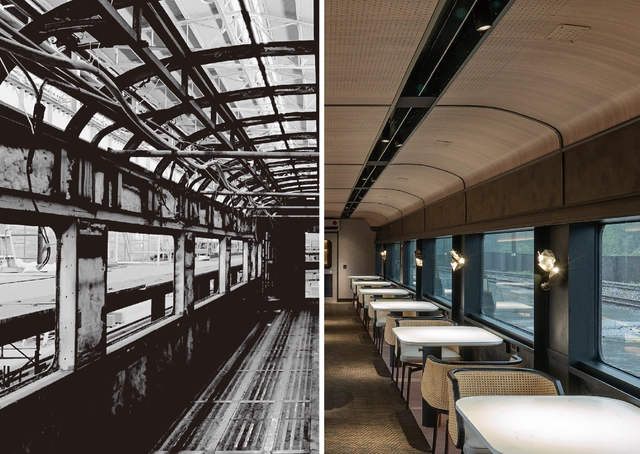
Faced with the combined forces of population growth, economic prosperity, and urban expansion, cities are witnessing a significant rise in the movement of people and goods—mirroring the evolution of diverse mobility systems within urban environments. As technologies advance and modes of transport evolve, the adaptive reuse of train carriages, airplane cabins, and other service infrastructures reveals opportunities to explore their creative potential. Materials, technologies, and design tools converge around a shared goal: refurbishing and repurposing disused structures to give them new life.
Architecture has entered a pivotal moment. As cities continue to grow under the weight of climatic and social pressures, the materials and systems that shape them are being redefined. Artificial intelligence and robotics, once used to accelerate construction processes, are now being rethought as tools for cultivation. Printed structures that grow, breathe, and decay. Cultivation, in this context, refers to designing with biological materials, where growth and decay are active parameters, merging digital precision with ecological intelligence. This evolution shows the shift from efficiency to empathy, where architecture becomes an agent of active repair. The introduction of mycelium and other natural materials into 3D printing presents a new paradigm in architecture: the logic of the living. A place where computation and fabrication meet biological adaptability.
Aristotle is credited with the proverb "One swallow does not make a summer." In nature, the arrival of these migratory birds often announces the change of seasons, a universal symbol of renewal and hope. Yet it is only when many take flight that the true warmth of summer begins. The same can happen in architecture: an isolated project, however exemplary, rarely changes a reality on its own. When, however, a work teaches, inspires, and can be replicated, it becomes the harbinger of something greater.
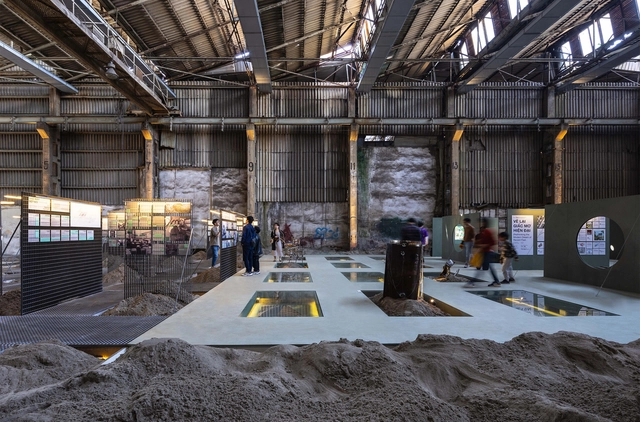
Concrete, steel, wood, glass. Every year, millions of tons of construction materials are discarded, piled up in landfills, and silenced beneath the weight of the next building. Entire structures disappear to make way for others, restarting a voracious cycle of resource extraction, material production, and replacement. Along with the debris that accumulates, something deeper is also lost: time, human labor, stories, and the collective memory embedded in matter. At a time when climate goals demand reducing emissions and extending the lifespan of what already exists, demolition is increasingly recognized as a form of urban amnesia, one that erases not only cultural continuity but also the embodied energy of buildings. And even though it is often said that the most sustainable building is the one that already exists, that principle rarely survives when other interests come into play.
For architects and specifiers, selecting the right cladding system is both a technical and creative act, connecting material science with architectural intent. More than simple visual envelopes, façades today are high-performance systems that balance protection, insulation, and expression. As the first barrier between exterior and interior, the right cladding system can define how a building behaves and ages over time, affecting its thermal comfort, acoustic performance, fire safety, and overall durability.