Learn more about this year's winners, and the BOTY Awards in general, by checking out our AD original infographic, presented by ArchDaily and our partners at HP, after the break.
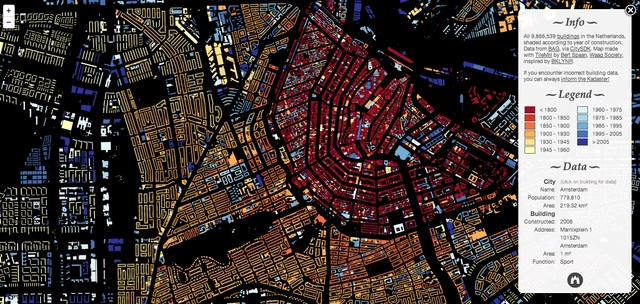
Aerial of Amsterdam. Image Courtesy of Waag Society
The Waag Society, together with designer and software engineer Bert Spaan, have put the Netherlands back on the map - the data map. After several months of coding and design, the partnership has managed to account for all 9,866,539 buildings in the country, visualized in varying colors to identify old and new buildings. After a user clicks on a specific block, additional building and city information displays square footages, addresses, populations and programs, among other stats. Users can navigate from Amsterdam to the Hague experiencing hundreds of years of urban development along the way, from the pre-1800s to post-2005 buildings, indicated by the red to blue gradient.
https://www.archdaily.com/424750/the-netherlands-software-engineers-create-data-map-of-all-buildingsJose Luis Gabriel Cruz
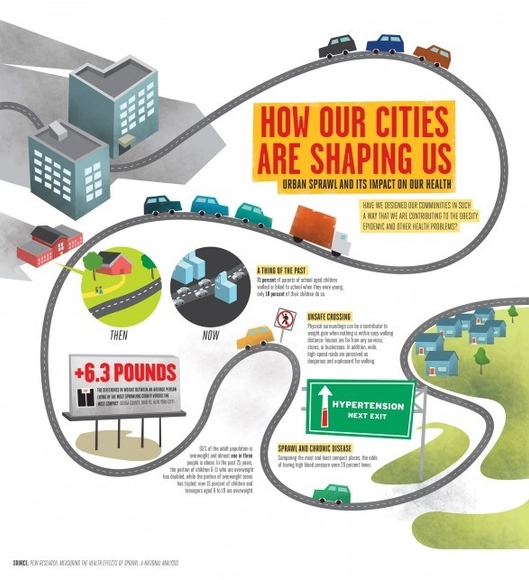
Architects and city planners are becoming more and more familiar with the health effects of our built environment. This to-the-point infographic designed by Chris Yoon cites a few ways in which mid-20th century city planning trends have contributed to a growing obesity problem in the United States. This data has alarmed scientists, planners and city officials into stressing the importance of redesigning the physical spaces so as to encourage physical activity and healthy choices.
Which cities are embracing the green revolution? This infographic compares the efforts of six leading cities - New York, Vancouver, Copenhagen, London, Amsterdam and Stockholm - in the race to drastically reduce global C02 emissions. Based predominantly on 2009 statistics, Stockholm seems to be leading the way in carbon reduction. Continue reading after the break to see who claims the blue ribbon for renewable energy, efficient water consumption and rigorous recycling.
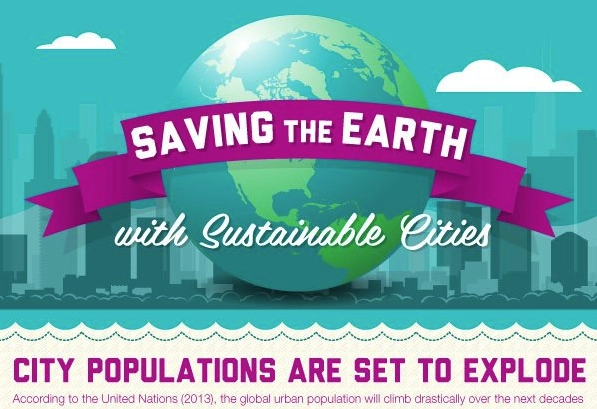
With Stockhom, Hamburg and Copenhagen leading the way, urban metropolis’ worldwide are beginning to rethink their infrastructure and envision ways to transform their city into an efficient, sustainable model of the future in an effort to preserve a high quality of life and stay competitive in the global society. This shift is already being reflected in the education system, with the rapid growth of sustainability-focused academic programs and a sizable, projected increase in “green” jobs.
Get an understanding as to how sustainable cities will save the earth with an infographic after the break.
The London 2012 Olympics start today, and once again architecture is on the spotlight. With a big focus on reusable and adaptable structures, the lineup includes renowned architecture firms such as Wilkinson Eyre Architects, Hopkins Architects, Populous and Zaha Hadid Architects.
Today, over 17,000 architects and designers, contractors and project managers, magazines and bloggers (including us) will converge on the Capital for the American Institute of Architects’ (AIA) 144th National Convention, Design Connects. So let’s take a moment to reflect on this Association’s long history, intertwined with our nation’s history, and look at how it’s evolved to become both a vital resource for working/emerging architects and the voice of the architecture profession today.
With the recent release of the design for the 2012 Serpentine Pavilion by Herzog & de Meuron and collaborator Ai Weiwei, we’re bringing you the 2012 updated infographic, a cheat sheet for the 12 years of the Serpentine Pavilion. Read more about the new design here


.jpg?1392998805&format=webp&width=640&height=580)