1. ArchDaily
  2. Heydar Aliyev Center

Heydar Aliyev Center: The Latest Architecture and News

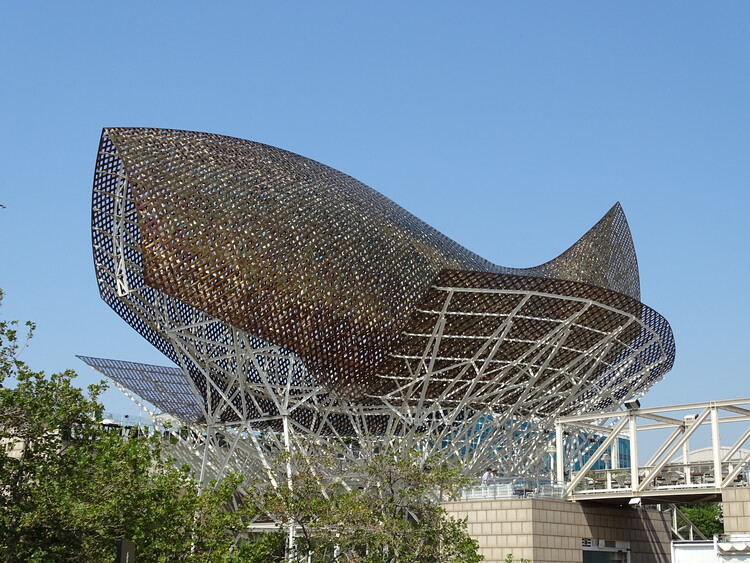
From the Fun Palace to the Fish: Architecture’s Triumph or Computation’s Takeover?

Audio available

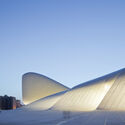
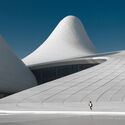
The Heydar Aliyev Center in Baku, Azerbaijan, rises in fluid curves and folds in the midst of a wide clearing in the city's gridded forest of urban blocks. The striking structure, completed in 2013 by Zaha Hadid Architects, acts as a primary venue for the country's cultural programs. Its curvaceous form sits in contrast to its rectilinear surroundings, marking its importance. The carefully curated curves epitomize a constant ambition in the studio's work–to dissolve the distinction between the horizontal and the vertical, between inside and outside, and between landscape and building. Needless to say, its complexity marks it as a feat of construction as well as of architecture. As Zaha Hadid Architects note, "Advanced computing allowed for the continuous control and communication of these complexities among the numerous project participants." Indeed, it is computing that made the building of the center possible, as well as other projects by the studio. As architecture becomes increasingly entangled with the digital realm, one can even ask if this is a triumph of the discipline or that of computation.

From the Fun Palace to the Fish: Architecture’s Triumph or Computation’s Takeover? - Imagen 1 de 4From the Fun Palace to the Fish: Architecture’s Triumph or Computation’s Takeover? - Imagen 2 de 4From the Fun Palace to the Fish: Architecture’s Triumph or Computation’s Takeover? - Imagen 3 de 4From the Fun Palace to the Fish: Architecture’s Triumph or Computation’s Takeover? - Imagen 4 de 4From the Fun Palace to the Fish: Architecture’s Triumph or Computation’s Takeover? - More Images+ 7

Subscriber Access

Baku Architecture City Guide: 15 Projects Reframing Azerbaijan’s Capital

Audio available

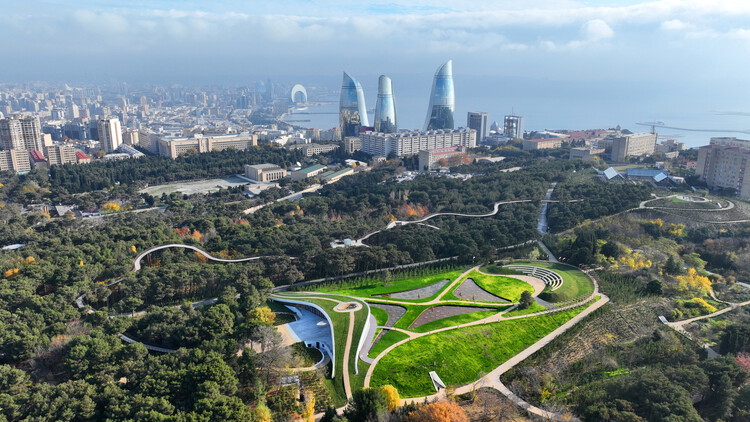
Some cities grow through continuity, others construct themselves through moments of acceleration. Baku, in Azerbaijan, seems to operate somewhere in between. Its historic core, the Icherisheher, still holds a spatial logic that resists expansion: dense, enclosed, defined by proximity and repetition. But just beyond its walls, the city begins to shift. Scale increases, distances expand, and the relationship between buildings becomes less about continuity and more about visibility.

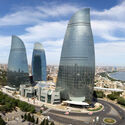
Over the past two decades, Baku has been the site of a deliberate effort to construct an image of itself. Oil wealth provided the means, but architecture became one of its primary tools. Projects such as the Heydar Aliyev Center by Zaha Hadid Architects or the Flame Towers are symbols of this transformation, their forms designed to circulate as much through media as through the city itself. They are precise, controlled, and highly resolved objects. But they also introduce a different urban logic, one that privileges singularity over continuity and positions architecture as an agent of representation.

Baku Architecture City Guide: 15 Projects Reframing Azerbaijan’s Capital - Image 1 of 4Baku Architecture City Guide: 15 Projects Reframing Azerbaijan’s Capital - Image 2 of 4Baku Architecture City Guide: 15 Projects Reframing Azerbaijan’s Capital - Image 3 of 4Baku Architecture City Guide: 15 Projects Reframing Azerbaijan’s Capital - Image 4 of 4Baku Architecture City Guide: 15 Projects Reframing Azerbaijan’s Capital - More Images+ 12

Subscriber Access

Video: Autoban Design For Heydar Aliyev International Airport

Video: Autoban Design For Heydar Aliyev International Airport - Image 1 of 4