TimeBox Prod

BROWSE ALL FROM THIS PHOTOGRAPHER HERE
↓

Ephemeral Architectures: Engaging Communities through Temporary Structures

Subscriber Access | 

Ephemeral architectures, characterized by their temporary and flexible nature, have emerged as powerful tools for revitalizing urban spaces and fostering architectural creativity. These transient installations transform public areas, engaging communities, and prompting reflections on the potential futures of our cities. By temporarily transforming environments, ephemeral architectures encourage both architects and the public to reimagine the possibilities of urban living. This dynamic interplay, between the temporary and the permanent, challenges traditional architectural practices and opens up new avenues for sustainable and inclusive urban development.

Ephemeral Architectures: Engaging Communities through Temporary Structures - Imagem 1 de 4Ephemeral Architectures: Engaging Communities through Temporary Structures - Imagem 2 de 4Ephemeral Architectures: Engaging Communities through Temporary Structures - Imagem 3 de 4Ephemeral Architectures: Engaging Communities through Temporary Structures - Imagem 4 de 4Ephemeral Architectures: Engaging Communities through Temporary Structures - More Images+ 32

Community Growth Through Architecture: Maximizing Limited Resources for Positive Impact

Limited resources are becoming an increasingly common challenge in architecture. Today, regardless of the region, projects are affected by the availability of resources, which are now compounded by environmental considerations. This situation, far from being restrictive, prompts us to explore new possibilities in how we conceive the built environment. In this context, it is crucial to understand that resources are not only limited to the economy but also include technological, material, and spatial aspects. Thus, we can enhance our creativity and efficiency by broadening our considerations when approaching architectural design and its challenges, doing more with less.

At the community level, the challenge becomes even more significant when we consider that our projects must not only be designed to overcome these "constraints," but also to positively impact their communities. Therefore, contemporary projects must present different strategies to overcome limited resources and materials depending on the context, always aiming to achieve a positive impact and become powerful and ingenious proposals while democratizing access to architecture.

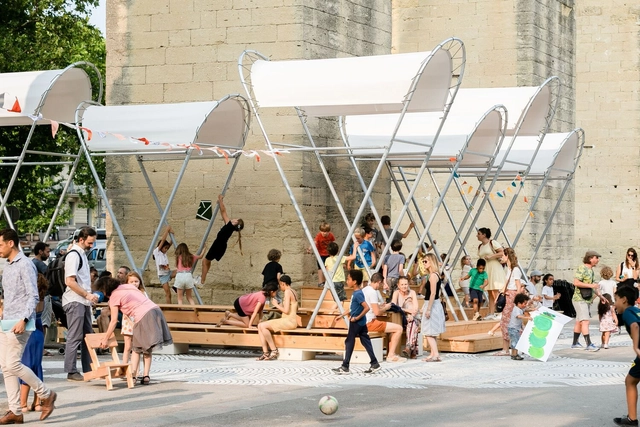
The Arches / Collectif Parenthèse

The Arches / Collectif Parenthèse - More Images+ 21