ArchDaily's curatorial team strives every day to present our readers with the most significant, inspiring, and innovative projects, while also ensuring a diverse representation of global architecture.
As part of our 2023 Year in Review retrospective on ArchDaily, we look back and reflect on what was published over the past year. Residential architecture remains one of our most visited categories of built projects, generating immense interest among our users worldwide. With this in mind, we have selected the 50 best houses published this year on ArchDaily en Español, offering a brief showcase of the form and character of residential architecture across the Spanish-speaking world.
In temperate and cold climates, architecture typically begins with a defensive gesture. The building envelope is a sealed boundary designed to resist the exterior environment through insulation, vapor barriers, and mechanical control. In cold countries like Canada, where winter temperatures can plunge well below freezing, airtightness is not a luxury. In this context, buildings must resist the exterior environment entirely to maintain interior comfort. However, in Central America, a region spanning from Belize to Panama, architectural logic shifts from exclusion to negotiation. In this region, the envelope is not a wall of defense but a specialized filter.
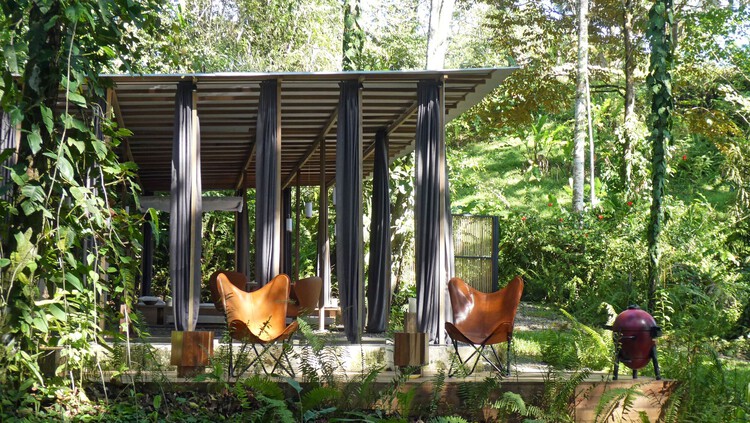
Costa Rica is a small country in Central America, internationally renowned for its tourism, biodiversity, and tropical climate. Given this context, tropical design strategies for hotel design are often more studied, but residential cabin projects can represent a more surgical approach to understanding the landscape. Often situated in remote forest or jungle locations, these cabins, apart from the common tropical design strategies, have to prioritize long-term durability and low-maintenance costs, particularly in regions where access for repairs is logistically difficult. This necessitates a design philosophy that favors both structural and climatic resilience.
Building in this context requires precise design responses to two primary environmental stressors: extreme precipitation and high humidity. Costa Rica's tropical climate, while varying by altitude, generally delivers an average monthly rainfall exceeding 150 mm in many regions. This constant water load can create a "wet-bulb" effect, where stagnant, saturated air accelerates interior material degradation and creates physiological discomfort for the inhabitants. To design effectively under these conditions, contemporary cabin architecture employs a three-fold strategy of minimal site invasion, the creation of thermal gradients, and passive climate mitigation.