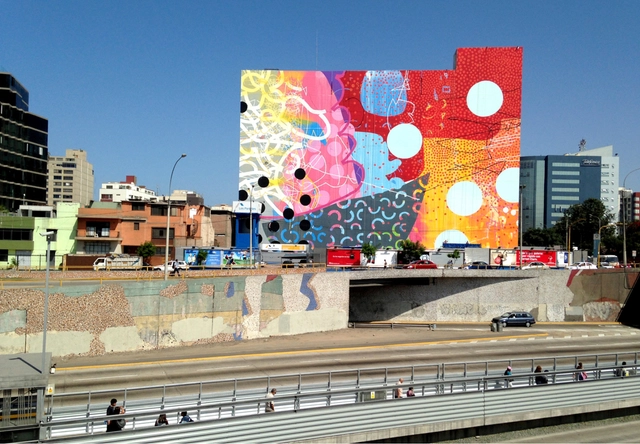
Blind walls that speak: a highly impactful intervention is underway, notable for its history, scale, and relevance.
The Paseo de la República Vía Expresa was inaugurated in 1967, more than 50 years ago. Coincidentally, its route aligns with one of the main branches of the Qhapaq Ñan (Inca Trail) that once crossed the Rímac Valley. As one of Lima's most vital thoroughfares, it spans 66 blocks, cutting through the city from north to south across the districts of Lima Centro, Lince, La Victoria, San Isidro, Surquillo, Miraflores, and Barranco. It is popularly known as the zanjón ("the ditch") because of its sunken, multi-lane design. While critics initially argued that low traffic volumes did not justify its construction, today the highway is heavily congested. In addition to hosting the Metropolitano bus rapid transit system along its entire length, bumper-to-bumper traffic jams are a daily reality during rush hour.
Today, the zanjón has a distinctly gray appearance, serving as a prominent showcase of concrete in Lima. Although it was once a canvas for mosaic murals—some fragments of which survive to this day—the walls now appear neglected amid spontaneous graffiti. Notable artists such as Fernando de Szyszlo, José Carlos Ramos, Bárbara Kukier, and Enrique Bustamante participated in these original mosaic murals along the Vía Expresa. During the 1980s, the mayor of Lima at the time, Eduardo Orrego, supported the creation of the "world's largest mural," which was intended to span Paseo de la República from Plaza Grau to the exit in Barranco. Although ambitious for its time, the project was left unfinished and remains pending.

.jpg?1556283875&format=webp&width=640&height=580)

_sel_-_destaque.jpg?1547123735&format=webp&width=640&height=580)