
Part of the CAC’s “What’s Next” series • Bringing people, ideas, goods and services together are hallmarks of urban life. So how are places designed with that in mind adapting to the challenges—both immediate and prolonged—of the current pandemic?


Part of the CAC’s “What’s Next” series • Bringing people, ideas, goods and services together are hallmarks of urban life. So how are places designed with that in mind adapting to the challenges—both immediate and prolonged—of the current pandemic?

As students dedicated to exploring the relationship between people and the places they inhabit, we were profoundly impacted by the shift to staying at home which the COVID-19 pandemic necessitated. This shift has forced us to contemplate now more than ever, how we use the spaces we call home, and how we adapt, and adapt to, these spaces under unique circumstances.

A lot of people view it as a tradition to visit the graduation show at the Aarhus School of Architecture and experience the many beautiful and inspiring projects made by the new architects.
Strelka Institute's 2020 Summer program has invited Delft University and Politecnico di Milano professor Filippo Santoni de Sio’s to give a lecture about keeping control of technology which is more and more intelligent and autonomous.
Our future is full of robots and artificial intelligence. Intelligent systems like the ones we already have in our smartphones assess our health, make financial transactions, take strategic decisions and actions in warfare, drive our cars, and more. Some people dream of intelligent systems that will perfectly match our desires and needs, be beneficial for everybody, and make us happier, healthier, richer, and smarter. Others fear intelligent systems will turn against us, make us unhappy and unemployed, damage us, enslave us, and dehumanize us (if not kill us). Which scenario will eventually be realised crucially depends on the question of whether we as a society will be able to control the direction of future technological development.
Digital fabrication is a manufacturing process that uses a machine controlled by computers. This method has sparked the interest of architects and product designers, as it opens the door to new possibilities in terms of solving complex processes and new approaches for mass construction.

This talk with designer Tom Lloyd of Pearson Lloyd and architect Louise Grassov of Schulze+Grassov, will look at the how urban design and architecture affect the way we live and move around our cities. With a presentation by both and an opportunity for questions, this talk will delve into how these two practitioners’ feel that lockdown and Covid 19 will influence the way they view their practice.
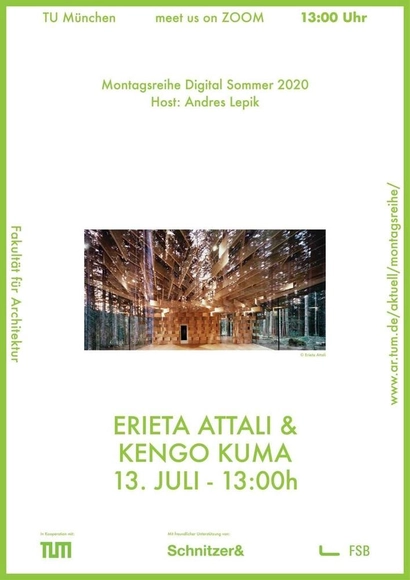
MONTAGSREIHE is a series of lectures by the Faculty of Architecture at the Technical University of Munich. The series sees itself as an enriching contribution to the Munich architecture discourse between architects, students, and those interested in architecture.

Free live event caters to major industries using real-time technology, including more on Unreal Engine 5
Epic Games announced Unreal Fest Online, a free global event taking place on Tuesday, July 14, with registration open now. Covering five content tracks with over 50 sessions (including live Q&A), and an attendee lounge for networking, the packed event caters to creators of all levels across games, media and entertainment, automotive, architecture/AEC, and other fields. To register, visit: unrealengine.com/unrealfestonl
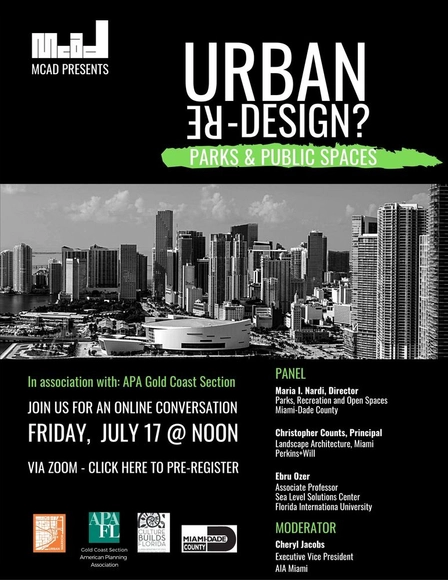
Miami Center for Architecture and Design (MCAD) will hold an online conversation where experts will discuss urban re-design in parks and public spaces.

In this first installment of Young Minds, a group of eight architects, designers, academics and professionals from award-winning practices and leading universities, will virtually interact with seven teams of five international students each, supported by tutors—currently collaborating with the Mexican design firm Estudio 3.14—and aided by six current interns. The workshop is structured by an open-access webinar, weekly workshops, two jury sessions and an award ceremony.
Tbilisi Architecture Biennial will accept proposals for its International Open Call from June 22 through July 31, 2020. The winning proposals will be realized during the event in October/November 2020 digitally and physically in selected locations in Tbilisi and around the world.

This project is mainly to upgrade the hardware facilities, improve the appearance of the museum building, and solve the problem of water leakage from the roof. It is expected to make KMFA a museum that can keep up with the times in terms of both hardware and software, becoming a real international exhibition venue.
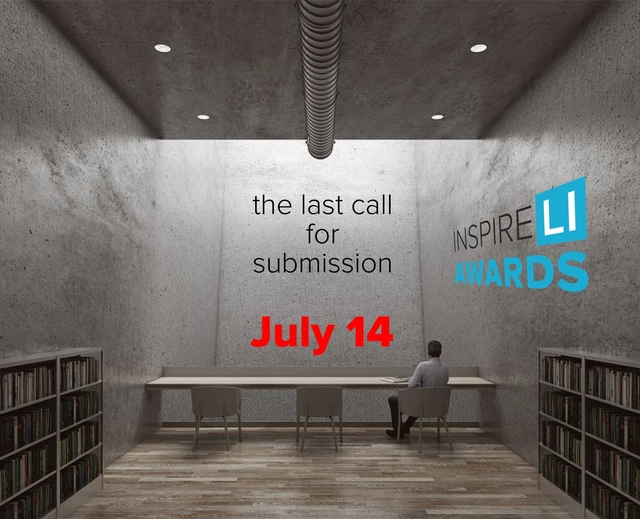
INSPIRELI AWARDS is the world’s largest global student contest in Architecture, Urban Design and Landscape, and Interior Design, which in 2019 involved 136 countries. INSPIRELI AWARDS are enabling new talent to tell their stories and raise awareness on their own world view before they get their chance to start building. It brings together up-and-coming students of architecture, as well as established professionals, and provides a forum for them to connect to the general public.

Xilofor invites young architects under the age of 40 to rethink the kitchen as a creative case study based on how post-COVID-19 kitchen furniture could develop new spatial scenarios that will influence its design.
The Timisoara Biennial of Architecture (Beta) is a platform for dialogue and collaboration, whose ultimate goal is to improve the processes through which we build our cities. Beta 2020 aims to generate a responsible dialogue on architectural education, training and professional practice, as well as to stimulate the involvement and professionalization of methods of dialogue and collaboration between the representatives of the trinomial administration – professional body – civil society.

MicroRoom is a room/furniture design competition with the aim of developing innovative and interactive multi-functional compact furniture for a micro portable house. This house is a future project for a couple of professionals looking for environmentally responsible housing that aims to reduce the area and the energy they consume.
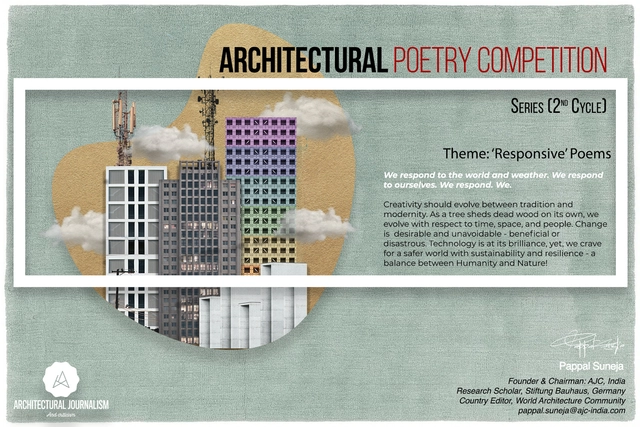
Architectural Poetry Competition Series, 2nd Cycle is the seventh initiative of the Architectural Journalism & Criticism Organization, India founded by architect Pappal Suneja to spread awareness about this subject and sow the seeds of inspiration to explore and write about Architecture and allied fields from a lyrical perspective.

“The Urban Rhetoric” is a bi-annual initiative by Innovature Research and Design Studio [IRDS] to create a platform for discussion and act as a catalyst in recreating the future of urbanism and urban development in India. We aim to do so with the help of an academic magazine with essays that inspire the agenda for future urbanism. A city is not just defined by the planners and architects that build it, but also by the users that occupy it. Thus, through this initiative, we strive to make these parallels meet by reinforcing the interactions between decision-makers and users. This prospective magazine crusading towards the agenda for future urbanism aims to provide a platform for dialogue and discussions on growth and development in Indian cities.