
As part of ArchDaily's coverage of the 2016 Venice Biennale, we are presenting a series of articles written by the curators of the exhibitions and installations on show.


As part of ArchDaily's coverage of the 2016 Venice Biennale, we are presenting a series of articles written by the curators of the exhibitions and installations on show.

The XV International Architecture Exhibition at the Venice Biennale opened its doors last month. Under the directorship of Chilean Pritzker Prize-winner Alejandro Aravena, “Reporting the front” asked architects to go beyond “business as usual” and investigate concealed built environments – conflict zones and urban slums, as well as locations suffering from housing shortage, migrations and environmental disasters. Clearly, the aim of this Biennale is to open the profession to new fields of engagement and share knowledge on how to improve people’s quality of life.

In this film, Jesús Granada visits the Nordic Pavilion, “In Therapy”, at the 2016 Venice Biennale. The video presents a series of measured stills in 4K resolution which introduce the central installation of the exhibition—a stepped pyramid, or ziggurat—and its series of reflective "rooms without walls." The pavilion itself, which was completed in 1969, was designed by Sverre Fehn to partially reflect and concretize certain ideas about Nordic society and its architecture – including a sense of openness. This year, therefore, the pavilion has been orchestrated as an extension of the public space of the Giardini.

In the latest edition of Section D, Monocle 24's weekly review of design, architecture and craft, Chiara Rimella reports from the Veneto in northern Italy for a report on the best at the 15th International Architecture Biennale – La Biennale di Venezia. Covering Aravena's central exhibitions, Reporting From the Front, and the designers and curators of the 61 national pavilions, the show seeks to understand how architecture can tackle some of the pressing social and political concerns of our time.

In his latest video, Jesús Granada visits the Russian Pavilion, “VDNh”, at the 2016 Venice Biennale. In the clip, viewers are introduced to the pavilion’s curator, Sergey Kuznetsov, who explains that “VDNh” is an acronym for a large area of Moscow known as Vystavka Dostizheniy Narodnogo Khozyaystva or Exhibition of Achievements of National Economy. Kuznetsov describes the territory as “[an] advertisement for the Soviet Union lifestyle…[meant] to meld lots of people and one nation."

As part of ArchDaily's coverage of the 2016 Venice Biennale, we are presenting a series of articles written by the curators of the exhibitions and installations on show.
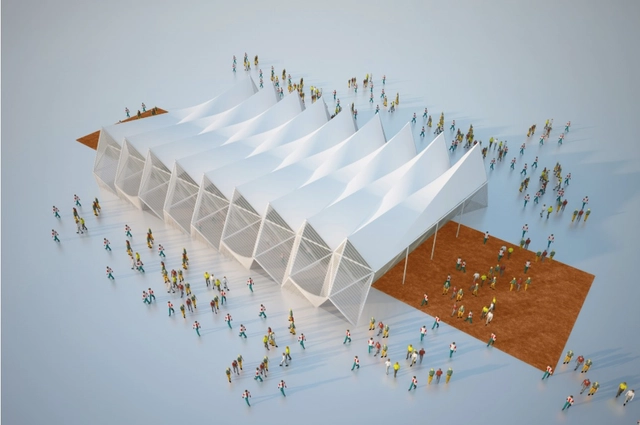
Commissioned by the Danish Foundation for Culture and Sports Facilities, Andersen & Sigurdsson Architects’ Light Pavilion design is open and transparent, encouraging participation. With an area of 1,200 square meters, the multi-purpose structure will house a range of planned and spontaneous activities. The architects’ vision was to create a space in which a multitude of events could take place in and around it.

As part of ArchDaily's coverage of the 2016 Venice Biennale, we are presenting a series of articles written by the curators of the exhibitions and installations on show.

In a short film exploring some of the National Participations at this year's Venice Biennale, Monocle Films take a considered look at how different countries have responded to the Biennale theme, Reporting From the Front in both explicit and more indirect ways. Visiting the Austrian Pavilion, the Nordic Pavilion, the Turkish Pavilion, the British Pavilion, the Irish Pavilion, the Australian Pavilion and the Romanian Pavilion, the film studies what discourses are being waged in the compressed geo-political world of the Giardini di Biennale.
As part of ArchDaily's coverage of the 2016 Venice Biennale, we are presenting a series of articles written by the curators of the exhibitions and installations on show.

In his latest video, Jesús Granada visits ‘The Pool,’ inside Australia’s Pavilion at the 2016 Venice Biennale. Curated by Amelia Holliday, Isabelle Toland & Michelle Tabet of Aileen Sage Architects, the exhibition explores the architectural typology of the swimming pool and its place in Australian culture.

To many, it might seem that the goals of Alejandro Aravena's 2016 Venice Biennale—as he describes it, "to understand what design tools are needed to subvert the forces that privilege the individual gain over the collective benefit"—are beyond reproach. In spite of these aims, a number of commentators nevertheless have emerged, perhaps led most vocally by Patrik Schumacher, criticizing the biennale. In this article, originally published on The Architecture Foundation's website as "Holier than thou," Phineas Harper responds to those criticisms.

In this video, Jesús Granada takes us inside the Austrian Pavilion at the 2016 Venice Biennale. The exhibition, titled Orte Für Menschen (Places for People), focuses on the creation of innovative housing solutions required to handle Austria’s current refugee crisis. The pavilion displays three projects currently underway in Vienna, where three architect teams have been paired with NGOs to convert abandoned buildings into temporary accommodation for asylum seekers, and later, into long-term residences.

As director of the 2016 Venice Biennale, Alejandro Aravena has sought to shift the very grounds of architecture. Rather than an inward-looking interrogation of the profession's shortcomings, as Rem Koolhaas undertook in 2014, the Chilean Pritzker Prize-winner asks us to gaze in the opposite direction—to the vast swathes of the built horizon that traditionally lay beyond the profession's purview: urban slums, denatured megacities, conflict zones, environmentally compromised ports, rural villages far off the grid.

Britain is suffering from a terrible housing crisis – one that is an incredibly predictable outcome of decades of neoliberal economic policy. The Chilean architect Alejandro Aravena has become well-known for building “half a house” – only completing core infrastructure in social housing, then encouraging residents to finish the other half with their own money over time. In effect, the first generation get a significantly cheaper home, but once the house has been doubled it could be sold at market rate. The discount, and profit, only applies to the original owners.

In early March, at the Presidential Palace in Chile, a never before seen event took place for Chilean architecture. Architects, government officials as well as the media gathered for the first Venice Biennale press conference to be held in Spanish.

As part of ArchDaily's coverage of the 2016 Venice Biennale, we are presenting a series of articles written by the curators of the exhibitions and installations on show. Here, Arielle Blonder, one of the curators (along with Dr. Ido Bachelet, Bnaya Bauer, Dr. Yael Eylat Van-Essen and Noy Lazarovich) of the Israeli Pavilion, gives us an insight into one of the exhibited works in the pavilion: LifeObject, "a freestanding structure inspired by a 3D scan of a bird's nest." The essay was originally published in LifeObject: Merging Biology and Architecture.

"Scrutinizing the horizon and looking for a new perspective" is what Alejandro Aravena has encouraged in the 2016 Venice Biennale, Reporting From the Front. "[He] has staged one of the most socially charged Biennales," Gillian Dobias reports, by "exploring the different ways that design can add value." In this, the first of two film reportages from the Biennale, Monocle talks to Aravena about his hopes for stimulating the debate on improving quality of life in the built environment, and tour the Central Pavilion and the Arsenale to uncover what's on show.