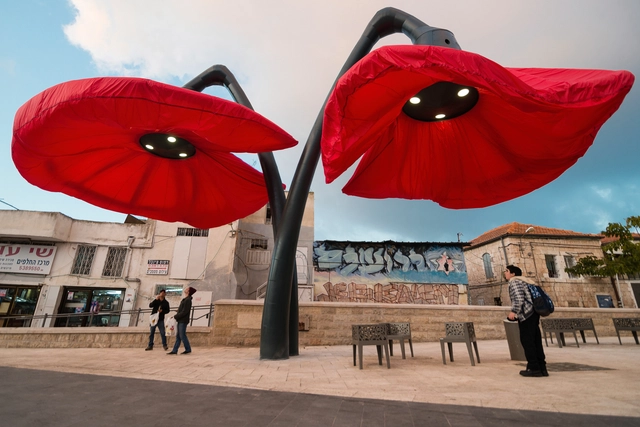
Shade isn't hard to find in Jerusalem's Vallero Square, thanks to these giant urban flowers designed by HQ Architects that bloom in the presence of pedestrians. "Warde," as the installation is called, is a set of four inflatable flowers at the entrance of the city's market square and adjacent tram station that "open up" whenever pedestrians walk by or the tram is approaching.
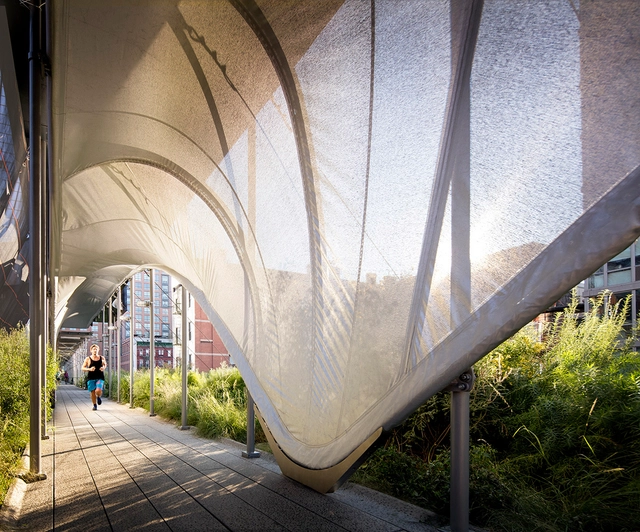
With the construction of their High Line-adjacent residential building 520 West 28th Street, Zaha Hadid Architects have constructed a temporary construction shelter to protect pedestrians in the event of any falling construction materials. However, as is often the case with Zaha Hadid designs, this is a construction shelter unlike any other, serving as a protective shelter but also as an artistic installation.
Named Allongé, the installation is "is inspired by the connectivity and dynamism of movement along the High Line," allowing visitors to the High Line to move through 34 meters (112 feet) of sweeping metallic fabric supported by a curvilinear steel frame, offering a spatial experience that foreshadows the presence of Hadid's building at the site.
In this TEDxTalk, the follow up to his popular TED Talk, "The Walkable City," urban planner Jeff Speck delves more deeply into his "General Theory of Walkability." The theory maintains there are four ground rules for increasing pedestrian traffic in urban areas: walking must be safe, comfortable, interesting, and - most importantly - there must be a reason to walk in the first place. Counterpointing this with America's fixation with accommodating the automobile, Speck shows us how beneficial a pedestrian city can be, both functionally and aesthetically.