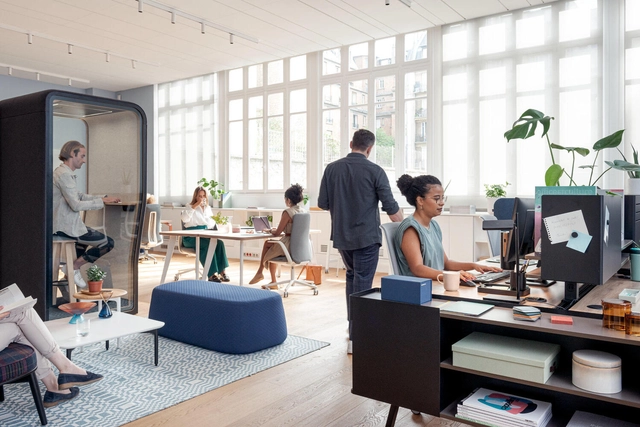
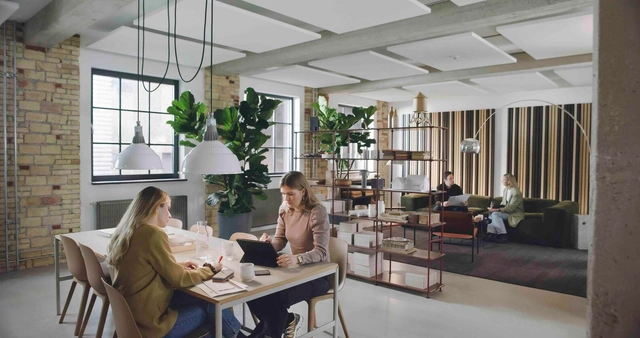
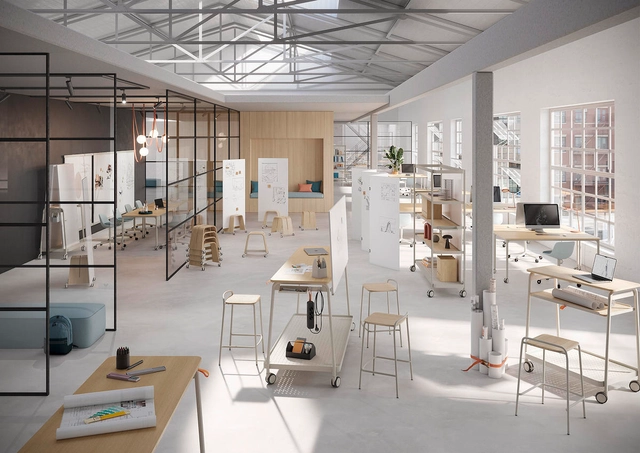
People’s tolerance for sound in the workplace is different at different times. Curating acoustics requires a hybrid approach, combining areas for focused work and comfortable conditions for meeting. Image Courtesy of Haworth
Is it the award-worthy barista skills at the third-floor coffee bar that make your days in the office bearable? Or is it being able to ring-fence a desk and height-adjusted chair and call them your own while the rest of the world hot desks? Perhaps it is knowing that the warming of your hands and toes is at someone else’s expense or that in this space you are you and not mum, dad, daughter, or husband. Or you might put it simply down to the camaraderie of the team and the common sense of purpose. One thing that is not in question, however, is that since the recent shake-up of our working practices, it matters now more than ever that productivity and wellbeing are in balance in the office, and contentment and comfort are key to both.
The Irmãos da Terra group, composed of residents from rural communities in Southwest São Paulo and technical teams from Escola da Cidade and Cânions Paulistas, invites you to a series of lecture-meetings on rural living and methods that respect and value local culture, identity, nature, water, energy, and food. The sessions will present best practices and references to support participatory plans within the involved communities.
Rockfon are to host a debate about what it means to be human-centric when it comes to office design, and is expected to address everything from acoustic comfort to engendering community and inclusion. Image Courtesy of Rockfon
What’s more important, work or wellbeing? Should we have to choose? A ‘good work ethic’ –as in placing work before all else– used to be a badge of honour, certainly among generation X-ers who grew up with post-war parents and a recession to wrestle with just as they were getting going on working life in the 1990s. Today’s economic situation might present similar wrangles in securing a wage among their off-spring, so-called generation Z, but it is nevertheless this emerging set of workers that are teaching the rest of us that work at any cost –particularly that of our mental and physical wellbeing– should not be a life ambition.
https://www.archdaily.com/997709/the-art-of-human-centric-design-for-healthy-office-spacesEmma Moore
No topic permeates more areas of society today than concerns about the global climate in the coming decades. How extreme will it become and above all how can we adapt as quickly as possible to better cope with and manage the situation? Because one thing is certain: The last hundred years could be characterised with the words 'too much' – in relation to emissions, resource consumption and imbalance in nature. Driven by the internationally declared motivation to limit climate change, the industry is reacting with determination and recognising the crisis as an opportunity.
So it is only natural that the largest international platform for HVAC (Heating, Ventialtion and Air Conditioning) and Water should also take up this challenge and make it the central theme of its upcoming event. ‘Solutions for a sustainable future’ will be the motto when the ISH once again invites visitors to Frankfurt am Main from 13 to 17 March 2023. After a longer break due to the pandemic, this time the fair will feature a particularly large number of innovations. As usual, the exhibitors are divided into two primary segments: ISH Energy, consisting of the heating and air segments, and ISH Water, with everything to do with bathroom design and installation technology.
If anyone can be said to know about the wishes and dreams of brides-to-be, surely it's those behind the creation of that mythical matrimonial object, the wedding dress. For more than 30 years, one of Sweden’s most famous fashion designers, Lars Wallin, has created dresses for women about to live, what is for many, the ultimate romantic experience. And with his design for a recently finished bridal suite at Gothenburg's SAS Radisson, Wallin has demonstrated not only his haute couture finesse in realising dreams of glamour and romance, but also an ability to seamlessly transfer his creative talents from the boutique to the bedroom.
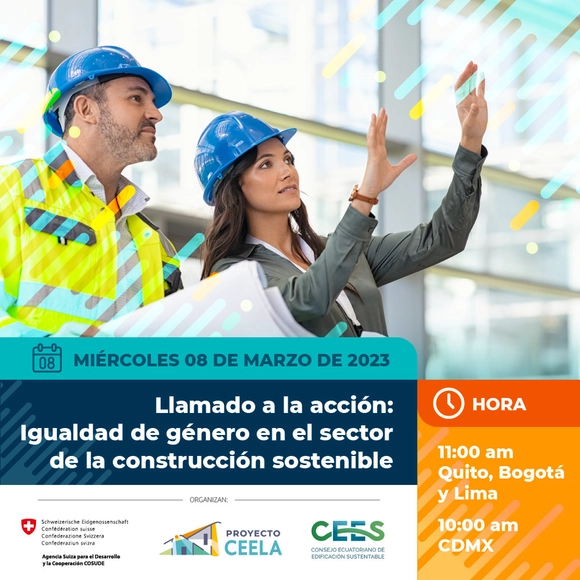
In commemoration of International Women's Day, we invite you to join the fourth webinar of the CEELA Project, organized in partnership with the Ecuadorian Council for Sustainable Building. During this free event, prominent leaders in the construction sector will share their professional experiences and strategies for promoting gender equity in work environments across the public, private, industry association, and international cooperation sectors.
The Design Center Baden-Württemberg has opened the call for submissions for the 2023 edition of its Focus Open International Design Award. As a non-commercial design prize, the Focus Open offers particularly low barriers to participation thanks to its moderate fees, while providing a high level of visibility from which, in the event of an award, smaller agencies, design studios and companies, in particular, can benefit. Entries can be submitted in a total of 14 categories including Bathroom, Kitchen, Light, Mobility, Investment products, Sport and Mobility.
Since its inception in 2008, the Bienal de Arquitectura Latinoamericana (BAL) has highlighted architectural developments in Latin America. For the 2023 edition, a new exhibition of Latin American architectural photography is being organized, aiming to expand the range of activities presented in order to achieve a broader and more precise vision of the region.
Videos
The self-explanatory simplicity and combination-friendliness of boards motivate to joint activity. Image Courtesy of Brunner
The last two years have turned society and its habits upside down. The working world, too, where hardly anything is the way it used to be. But this new start is proving to be a wonderful opportunity to rethink content and work processes and to reinvent oneself. Since last fall at the latest, it has been clear where this journey is headed. In October, the internationally active contract furniture manufacturer Brunner presented innovative design news that offers a solution to the issues and the changed situation.
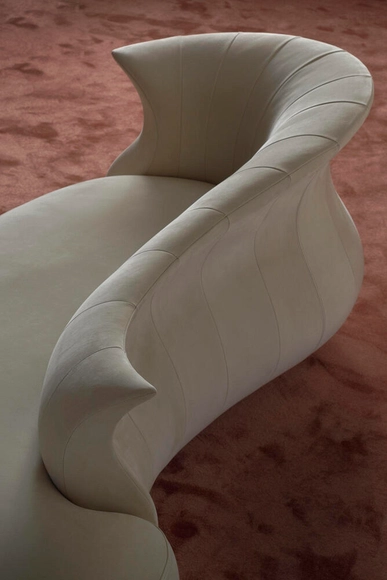
Set in open space, Desforma’s sinuous shifting designs are furniture as landscape. Image Courtesy of Desforma
The Desforma range is quite unique in the design world. It doesn't do reheated mid-century modern or strict straight lines or no-nonsense functionalism in powdered steel. Desforma does swooping, fluid lines and organic curves, sofas composed of sine waves that seem shaped by natural forces and summon up swaying sea life, chairs that might have blossomed into being.
As part of the activities taking place during the What Design Can Do festival, the Make It Circular Challenge has been launched, with a deadline of January 31. The challenge seeks proposals in the categories of "What We Eat," "What We Wear," "What We Buy," "How We Package," or "How We Build" to help address the devastating effects of overconsumption, waste, and climate change. The Make It Circular Challenge awards a prize of 10,000 euros for the development of circular design projects that help combat the climate crisis in a creative way.
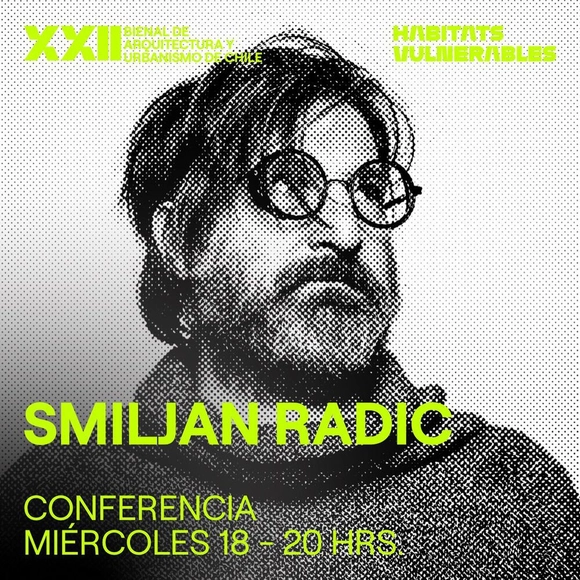
Chilean architect Smiljan Radic will deliver a lecture this Wednesday, January 18, at 8:00 PM as part of the XXII Architecture and Urbanism Biennial of Chile: 'Vulnerable Habitats.' The event will take place in the temporary inflatable structure designed by the architect in collaboration with Nicolás Schmidt, located in Plaza Bulnes, Santiago.
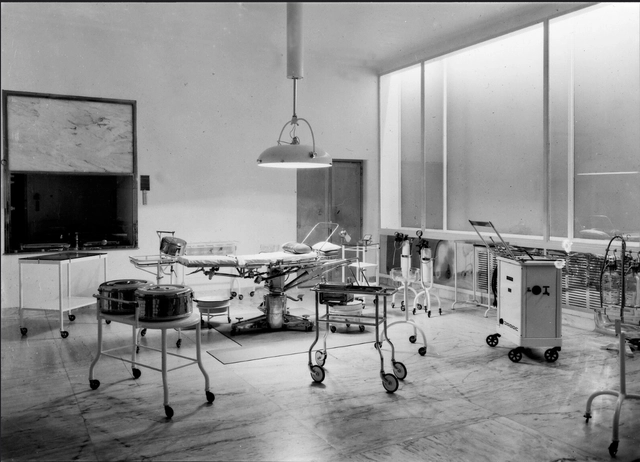
The modern design of a protected life, assuming a passive body constructed individually in the disease-health opposition, focuses on the elimination of disease through the use of the hospital as a fundamental device for biomedical knowledge and intervention. However, health is permanently reinvented through its social, ecological, and political dimensions, and the medicalization of life centered on the individual is expanding into spaces composed of less static and more complex visions, problematized by (re)emerging challenges such as the recent Covid-19 pandemic.
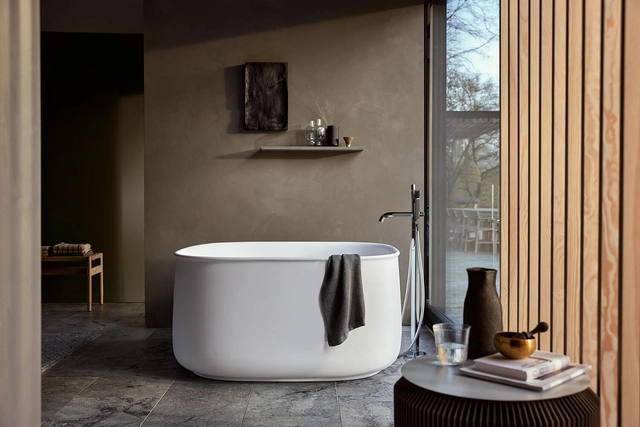
A bathroom in balance with Sebastian Herkner's Zencha series for Duravit, inspired by Japanese tea ceremonies. Image Courtesy of Duravit
With its curved, handcrafted shapes inspired by Japanese culture, the Zencha bathroom collection by Sebastian Herkner soothes its users in a meditative way.
Trends 23/24 at January's Heimtextil in Frankfurt will focus on material cycles and sustainability strategies for textiles – and use the analogue fair platform to promote exchange, present new products and bring experts together.
In early December, the global winners of the International VELUX Award 2022 were announced, a competition for architecture students that celebrates the innovative and creative use of daylight in a broad range of different projects.
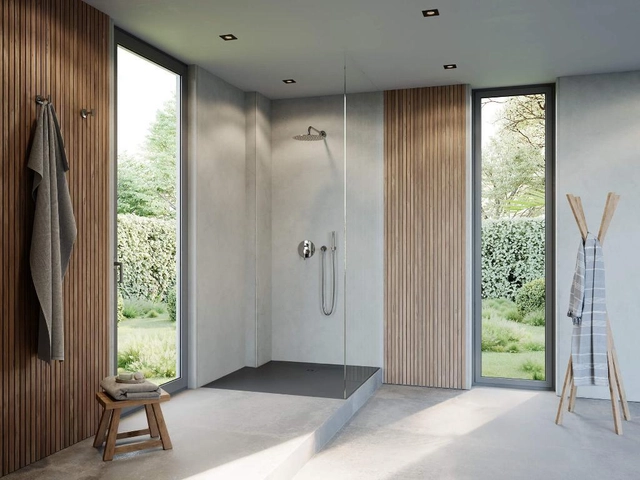
New perspectives: Duravit takes the topic of recyclability to the next level. With the Sustano shower tray, the bathroom specialist is presenting its first product made of the newly developed material DuraSolid Nature. Image Courtesy of Duravit
Innovative strength in industry is not only about developing new products, but also successfully establishing them on the market, because they make everyday life and the world a little bit better. As a full-range supplier of sanitary products, Duravit has a number of innovations in its range: the hygienic, easy-care ceramic surface HygieneGlaze, the efficient, water-saving HygieneFlush WC flushing technology or taps with the energy- and water-saving FreshStart or MinusFlow functions. Known for its acrylic bathtubs and shower trays, the Black Forest-based manufacturer continues to ask itself: How can we make it even better? Could a material be developed that has similarly positive properties to acrylic but can be completely recycled at the end of its life cycle? The answers can be found in its first product made of a new material called DuraSolid Nature: the Sustano shower tray range.
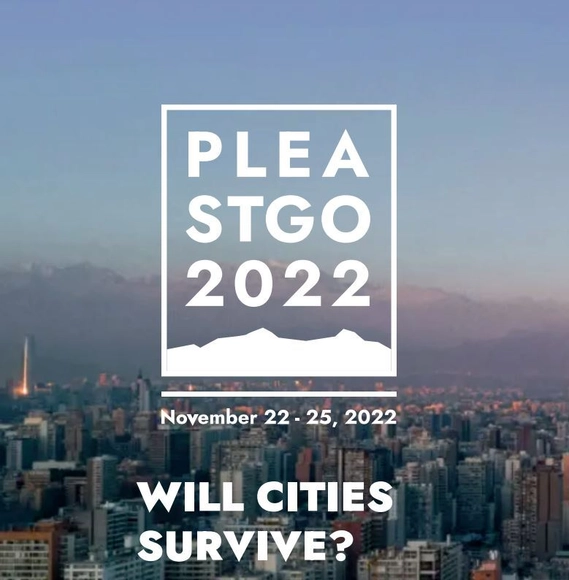
The 36th PLEA Conference will be held in Santiago, Chile, from November 23 to 25 at the Pontificia Universidad Católica de Chile. This year’s theme is influenced by the pandemic and questions the role of our future built environments: "The Future of Sustainable Buildings and Urbanism in the Age of Emergency."