Newman-Schmidt Studios, Workmen installing the first aluminum panel, 1951. Gelatin silver print. Director’s Discretionary Fund.
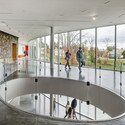
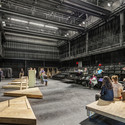
The city of Pittsburgh encountered and was transformed by modern architecture in an ambitious program of urban revitalization in the 1950s and ’60s. HAC Lab Pittsburgh: Imagining the Modern untangles Pittsburgh’s complicated relationship with modern architecture and urban planning. This experimental presentation at Carnegie Museum of Art’s Heinz Architectural Center includes abundant archival materials from the period, an active architecture studio, and a salon-style discussion space, unearthing layers of history and a range of perspectives.
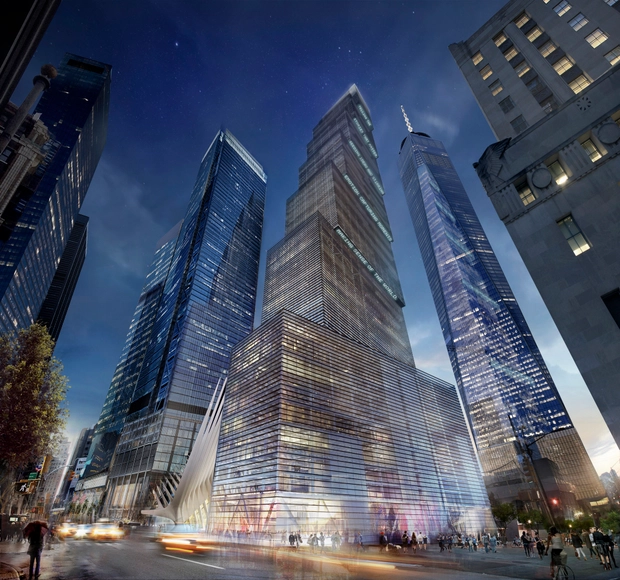
As announced by WIRED, the controversial take over is the result of James Murdoch's distaste for Foster's decade-old scheme and preference for a more integrated workplace. Though the foundation of Foster's building has already been built, the BIG scheme will now be realized and become the new headquarters of Rupert Murdoch’s media companies, 21st Century Fox and News Corp.
Designed as seven unique building stacked on top of each other, the stepped 2 WTC tower will rise 1,340 feet - a height that would make it Manhattan's third-tallest building if built today.
Watch Bjarke Ingels explain the concept in a video, after the break.
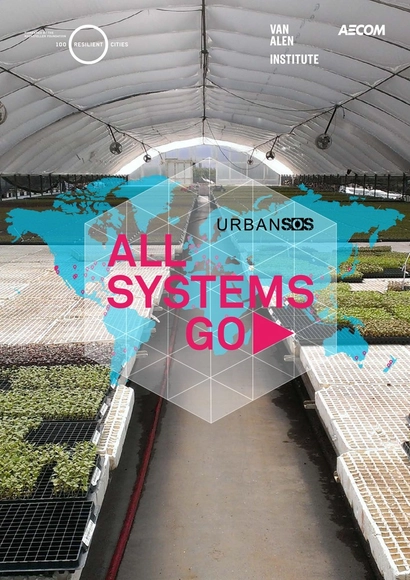
In collaboration with the Van Alen Institute and 100 Resilient Cities, AECOM has announced its international Urban SOS: All Systems Go competition for undergraduate and graduate students.
The competition “calls on multidisciplinary teams of students to envision more resilient food, water, and energy systems for supplying cities and regions today and in the future.” Teams should “identify an urban population facing the possibility of disruption to its food, energy, or water systems, and offer strategies that strengthen these systems’ ability to withstand future shocks or stresses, while also making them more efficient, equitable, and accessible to diverse populations.” All “proposals must be located in one of 67 cities that currently make up the 100 Resilient Cities network.”
DIGITAL INTELLIGENCE: CONVERSATIONS ON ARTIFICIAL INTELLIGENCE, SENSING & SIMULATION
This event hosted in collaboration with the NSF TUES grant’s Center for Performative Design & Engineering Technology will consist of a series of presentations and panel discussions, aiming to instigate a conversation from different perspectives on the areas of data visualization, sensing, simulation, and artificial intelligence.
The author goes along with the observer in a photographic stroll through the colors, surfaces and lights of the Grand Tour City of the Leaning Tower, Pisa. "Emotions from Pisa" is more than a collection of fine photographs: it is an exploration of the dialogue between place and photographer. The “emotions” of the shots are recognized, captured and made available to us. Pasqualetti preserves moments which we often miss and teaches us to read and feel the messages sent out by places and buildings. He shows us the Pisa that we know and above all a Pisa that we never noticed. This collection of photographs does not only record the face of the city, here shown in ways which truly surprise and move. His photos also demonstrate how architecture, through its forms and its surfaces, can evoke emotions that are constantly changing, as sun and seasons take their daily and yearly paths.
Join us July 6-17 for a unique educational experience devoted to exploring the intersection of natural systems and advanced manufacturing.
In its second year, Embedded Intelligence will examine the possibility for biological models to influence and enhance architectural systems. Workshop participants will fabricate and prototype composite high-performance surfaces in an intensive studio environment. The workshop will be supported by a series of lectures from leading academics and practitioners in the fields of architecture, engineering, biomimetics and computation, including Sean Ahlquist of The University of Michigan and Chuck Hoberman of Hoberman Associates.