It is well known that the construction industry is one of the world's largest producers of CO2. While significant progress has been made in technology and design and construction processes, a long road remains to minimize or virtually eliminate carbon emissions in the development of the built environment.
Is there a future for our cities without a sustainable way of life? For some time now, urban sustainability has been viewed primarily through the lens of climate change rather than a holistic vision that integrates society and the way we live in community.
What new ways of living are we experiencing amid social, economic, and ecological shifts? We need to bring to the table different reference cases from around the world and understand the latest trends shaping how we live in our cities.
We want you, our readers, to not only be the first to share examples of co-living, cooperatives, and any new types of social housing you consider benchmarks, but also to share your thoughts on the matter in the form below. Selected comments will be published in an upcoming article.
While walking through the exhibition of the reconstruction in the gardens and galleries of the Centro Cultural Las Condes in 2022, he explains in detail the innovative and unique construction aspects of this demolished work. The house was originally designed by Fabio Cruz Prieto, architect and founding master of the School of Architecture and Design at the Pontificia Universidad Católica de Valparaíso.
Florencia Rodríguez, the new director of the School of Architecture at the College of Architecture, Design, and the Arts. Photo by Pablo Gerson. Image via University of Illinois Chicago
The School of Architecture at the University of Illinois Chicago (UIC) has appointed Argentine editor and curator Florencia Rodríguez as its new director, effective August 2022.
Trained as an architect and founder of the magazines PLOT and -NESS, she has dedicated her career to editing, writing, and teaching. Throughout her career, she was a Loeb Fellow and taught architecture at Harvard GSD. Through her work, which focuses on disseminating new narratives and exploring alternative forms of design criticism, she has fostered and strengthened architectural discourse across the Americas.
The event featured two main award categories for built works and projects—national and international—with a selection jury composed of Ivo Renato Giroto (Brazil), Martin Padrón (Venezuela), Fabián Dejtiar (Argentina/Chile), Roberto Ameneiro (Spain), and Carlos Álvarez (Costa Rica). On the final day of the event, the winners were announced; you can view them below.
What do we mean by heritage? This is one of the main questions raised by Alejandro Orellana, director of Relatos de Barrios—a Chilean project that seeks to reclaim the heritage and historical value of housing complexes, highlighting the community dimension behind the lives of their residents.
A documentary and a book are the results of their experience with the “CCU Worker Housing” in La Serena, later renamed the “Rengifo Housing Complex.” Designed in 1957 by architect Carlos Feuereisen Polanco and built in 1958 by Negochea and Vergara, it represents a characteristic housing typology of the city.
Although the construction industry has spent years making strides in new fields such as biomaterials, nanotechnology, and 3D printing, it simultaneously remains one of the slowest to adopt new technology. Many of these innovations never progress past the experimental stage. How can this situation be reversed?
Teresa Moller, José Cubilla, Solano Benítez & Gloria Cabral were honored today with the 2021 Global Award for Sustainable Architecture, organized by the Cité de l’Architecture et du Patrimoine, a French institution dedicated, among other initiatives, to organizing events focused on heritage and architectural education.
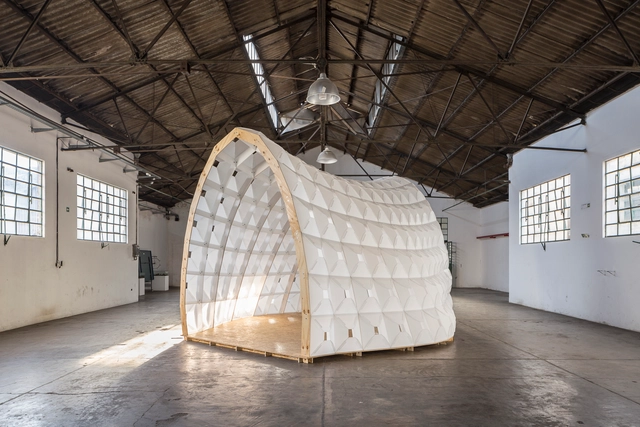
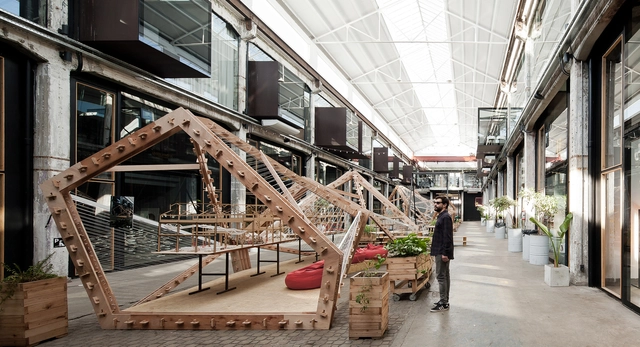
This mobile installation adapts to achieve structural parasitism, prompting us to rethink how we occupy the inert and hidden spaces that make up our cities.
Today is the day to discover the finalists of ODA2022: the award for the best Spanish-language architecture. Our expert jury—meaning you, our readers—has selected 15 of your favorite projects from nearly 1,000 architectural works built across Latin America and Spain.
This award has become a true tradition, now in its 14th edition. It is an invitation extended to all our readers to recognize the works published during 2021 that inspired them and represent the identity of their local contexts in a globalized planet, shaping the way architecture is made in Latin America and Spain within an increasingly heterogeneous and multicultural world.
Starting today, and until next Wednesday, March 30, at 11:59 PM (GMT -3), you can explore each of the finalists in detail and vote for the work that best represents the Spanish-language architecture that inspires us, defines us, and leaves a mark on us. Discover all the finalist projects below.
The 2022 Obra del Año Award is brought to you by Dornbracht, renowned for its leading architectural designs, which can be found internationally in bathrooms and kitchens.
Academic architectural production in Ibero-America is vast and valuable; therefore, we believe it is necessary to launch an open call to showcase the best final degree projects resulting from this work.
At ArchDaily en Español, we recognize the need to stay in constant contact with architecture students, who will be responsible for designing and building the cities of the future. For this reason, we periodically open a call for applications to join our editorial team through our internship program.
If you currently reside in Latin America, this could be your opportunity to contribute local content to the most-visited architecture platform in the world, which inspires and informs hundreds of thousands of architects globally. If you are interested, read on.
To promote sustainable construction in Latin America, the CEELA Project, in collaboration with the Colegio de Arquitectos del Ecuador - Pichincha, has established the "Social Habitat and Sustainability Award" for built projects and interventions as part of the BAQ 2022 Biennial Competition.
This Saturday, May 28, and Sunday, May 29, the Día de los Patrimonios (Heritage Day) will take place, a cultural event that provides an opportunity to engage with the various manifestations and heritage assets present in Chile.
On Wednesday, December 7, 2022, the Chilean Ministry of Housing and Urbanism (Minvu) announced that architect Joan MacDonald, who served as undersecretary of this ministry between 1990 and 1994, has become the first woman to win the National Urbanism Award. The award ceremony will be held in January 2023.
Architect Emilio Tuñón. Image via Ministerio de Transportes, Movilidad y Agenda Urbana
Today, it was announced that architect Emilio Tuñón has been awarded the 2022 National Architecture Prize, presented by the Ministry of Transport, Mobility, and Urban Agenda (Mitma).
Videos
Los augurios. Image Cortesía de Festival Model
How do we actually give citizens the ability to discover and understand what is happening around their cities? This is one of the key questions raised by Eva Franch, artistic director alongside Beth Galí and José Luis de Vicente of Model - Barcelona Architectures Festival.
How do we bring these issues to the table, into public debate, and into the public sphere? One answer could lie in augmented realities—technologies that allow us to visualize parts of the real world overlaid with new information through a technological device. For this architecture event, in addition to the five temporary physical installations scattered throughout the city, five augmented reality installations were produced, reflecting the event's different themes: Between-Generations, Between-Cultures, Between-Species, Between-Classes, and Between-Materials.