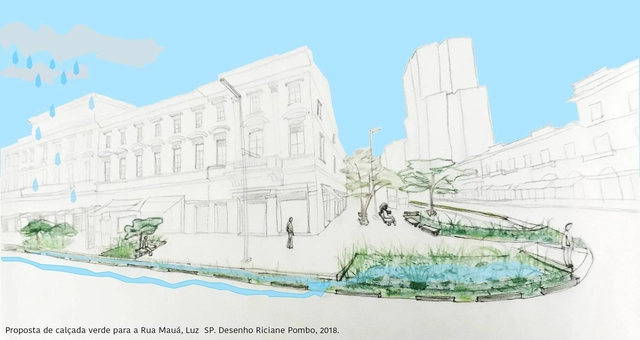
Green sidewalk proposal for Rua Mauá, 512 - Luz, SP. Architect and urban planner Riciane Pombo, 2018.
Sidewalks, also known as public walkways, can be understood as multifunctional open spaces where a range of activities occur, from pedestrian flow to social interaction. In this context, public walkways have significant potential to house green infrastructure solutions—such as rain gardens, bioswales, and stormwater planters—capable of providing a range of environmental services for cities. These include mitigating urban pollution (water, air, and soil), providing habitats for urban fauna, contributing to the control of stormwater runoff volume and velocity, and offering improved local microclimatic quality and thermal comfort for adjacent buildings through shading and evapotranspiration, in addition to serving as an aesthetic element. Emerging ecological sidewalk design techniques that add value and appeal to properties are currently well-known, utilized, and proven.
Sunday, April 14, is the final day to visit the "Santiago, Ciudad Destino" exhibition at the GAM Cultural Center. The closing event will take place at 6:30 PM with the vote count for the Migrant Citizen Consultation, which was part of an intervention proposed by the design collective Gt2p. As part of the closing celebrations, an open Afro-dance class will also be held on Saturday at 3:00 PM.
https://www.archdaily.com/1102813/santiago-destination-city-at-gam-concludes-this-sunday-with-a-public-consultation-for-migrantsPola Mora
The School of Architecture at Universidad Finis Terrae is launching the fourth edition of "Atraviesos Urbanos" (Urban Crossings), a series of tours designed and led by architects that provide an alternative perspective on a specific section of the city.
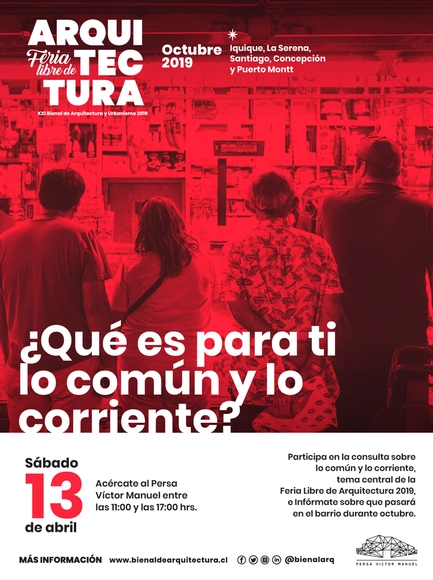
This year, the Chilean Biennial of Architecture and Urbanism will move from traditional buildings to the streets. Throughout the month of October, it will be presented as an "Open-Air Architecture Fair" in iconic spaces across five cities in the country: Iquique, La Serena, Santiago, Concepción, and Puerto Montt. The goal is to bring architecture closer to the general public while also directing the focus of architects toward the needs of the majority.
The John H. Daniels Faculty of Architecture, Landscape, and Design is pleased to announce its 2018/2019 public lecture series: Home and Away. The Faculty’s stunning 400-seat multichromatic Main Hall in the heart of the Daniels Building is now open. To inaugurate our first full year of public programming in this space, we are bringing together talent and ideas from near and far for a series of discussions and debates on design issues of global importance.
Registration is now open for the fourth cohort of the short-term Executive Education course at Insper, "Urban Innovation: New Ways of Shaping Cities," in partnership with Arq.Futuro. With a 40-hour curriculum starting on May 6, the course aims to help train individuals capable of interpreting the reality of urban spaces and adopting a critical stance on the future of cities. Registration is available via the website: http://bit.ly/2mecfdN.
The fourth edition of the "Arquitetura Soteropolitana" course will visit a classic: the Solar das Mangueiras, by architect Assis Reis. Featuring a testimonial from Márcia Reis and a guided tour, this is an incredible opportunity to gain a deeper understanding of the context that enabled the realization of this project.
Torres Colón is the first example of suspended architecture in Spain. Designed in 1969 by Antonio Lamela (Madrid, 1927–2017)—one of the most significant Spanish architects of the late 20th and early 21st centuries, who passed away two years ago this April—the towers stand as a symbol of the country's architecture and the Madrid skyline.
The workshop focuses on the living of a direct experience of the participants, showing the territory where the work of RCR Arquitectes is rooted, with the aim of understanding their relationship with the site and the landscape, to share and pass on an attitude to life, architecture, and creativity, putting into practice their working methods.
The workshop has the aim of broadening knowledge of audiovisual and photography, centered in Architecture and Space. The course develops from the approach to the territory and architecture of RCR and combines reflection on Visual Arts and its implementation in practice through creative work. The exercises are raised around the awakening of the senses, stimulating the creation of images that make us experience wanting to touch, listen and be in this specific place.
Creativity must be at the origin of the concept, present at the initial moment where we give answer to the question we are asked, and should be shared by all Scenography creates ephemeral spaces that due to their short life must express, without concessions to doubt, an intention, an idea. Space expresses, in short, a way of understanding a human story.
Mal Pelo, with the artistic co-direction of Pep Ramis and María Muñoz, is a creative group characterized by shared authorship. Since 1989, Mal Pelo has been developing its own artistic language through the movement, incorporating theatricality with the creation of dramaturgies that include the word, working with composers for the creation of original soundtracks, collaborating with video artists, among others.
The exhibition, presented by SOM and Fundación Arquitectura COAM spotlights SOM’s structural engineering practice and its integration with SOM’s architectural design.
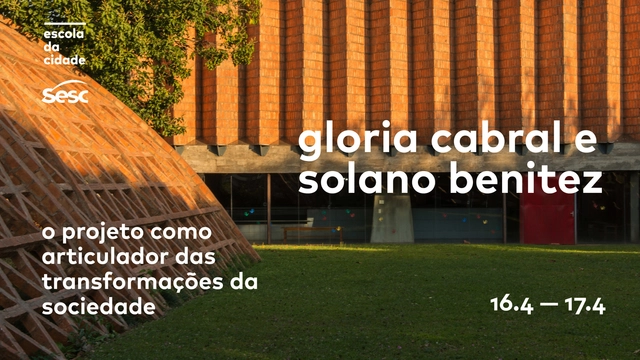
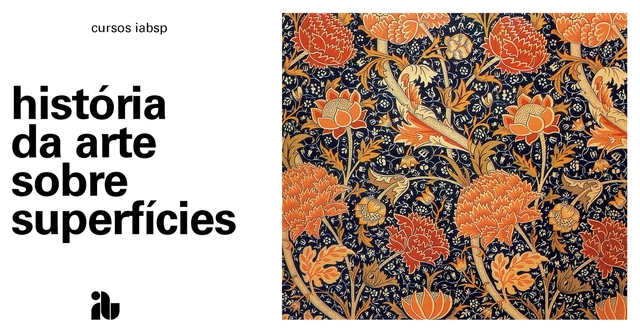
This course presents a historical narrative of surface design, covering authors and projects involving textile patterns, wallpaper, relief cladding, and cobogós from the 18th century to the present day. It highlights significant profiles and proposals from designers such as William Kilburn, William Morris, Varvara Stepanova, Frank Lloyd Wright, Lucienne Day, Regina Gomide Graz, and Athos Bulcão, among many others, while examining the influence of various artistic movements on these creators throughout history.
Costa Rica will host a session of the Chilean project #XFORMAS (X Ways of Doing Architecture) for the first time this Wednesday, April 10, at Universidad Veritas.