Drew Adams (M.Arch 2011) is a designer with a background spanning architecture, landscape architecture and urban design. He is an Associate at LGA Architectural Partners in Toronto with nearly 10 years experience leading innovative and high-profile public interest design projects. This includes affordable housing projects like Eva’s Phoenix to the Evergreen Brick Works carbon neutral Kiln Building while his own speculative work has been distinguished in numerous international design competitions. This work has received recognition ranging from the Mies Crown Hall America’s Prize nomination to material innovation awards and publication features ranging from Fast Company to Architectural Record. Drew recently co-authored a series for Azure on design and climate change, is a frequent speaker and guest critic, and occasional adjunct professor. In 2020, Drew was named recipient of the Royal Architectural Institute of Canada’s Emerging Architect Award.
"The method doesn’t always pay off, and comes with a good deal of frustrating moments and necessary plot twists. Projects we love are regularly thrown in the trash bin. But more often than not, they leave place for even more lovable ones. In short, we have to be resilient and stubborn. Being optimistic is an enjoyable burden."
Space Popular directors Fredrik Hellberg and Lara Lesmes will discuss their latest projects in both the physical and virtual realms with a focus on how new technologies are changing both how we think of and experience architecture.
This book The Architecture of Point William. A Laboratory for Living shares Shim-Sutcliffe’s significant work at Point William intertwines landscape and architecture with ancient rock and water reshaping and reimagining a site on the Canadian Shield for over two decades. The project is a laboratory for experimentation at many scales of design including the landscape, built form, furniture, lighting and hardware shared in this book through sketches, model photos and photographs. Kenneth Frampton provides an insightful introduction with his own selected sketches framing a way of seeing Point William for the reader. Michael Webb’s provocative interview with Brigitte Shim and Howard Sutcliffe describes the evolution of the site. Immersive spaces have been captured by three remarkable photographers Ed Burtynsky, James Dow and Scott Norsworthy.
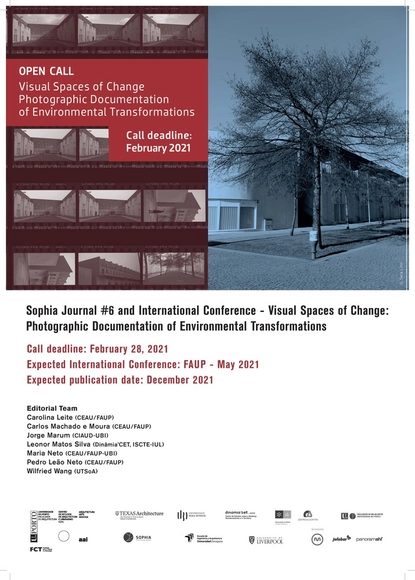
Open Call | Visual Spaces of Change: photographic documentation of environmental transformations
Sophia is currently accepting the submission of articles for consideration, following the external Peer Review process as per described on the Editorial Policies section. All articles submitted should address the topic for the upcoming issue and be written in accord to the Author Guidelines.
Issue #6: "Visual Spaces of Change: photographic documentation of environmental transformations" Call deadline: February 28, 2021 Expected publication date: December 2021 Expected International Conference: May 2021
The Daniels Faculty of Architecture, Landscape, and Design is pleased to announce that the 2020-21 Frank Gehry International Visiting Chair in Architectural Design is Douglas Cardinal, OC, FRAIC, a renowned Canadian architect known both for his inspiring designs and for his advocacy for the rights and dignity of Indigenous peoples. Cardinal will lead a series of public events including lectures and conversations in collaboration with the Daniels Faculty, throughout his appointment as Gehry Chair.
Organized by the research platform Justicia Espacial, the studio Teddy Cruz + Fonna Forman shares its experience with Participatory Action Research (PAR) processes within their architectural and political practice in San Diego.
The writings of historian Manfredo Tafuri (1935–1994) have had a significant impact on critical theory in Latin America. His theses on contemporary architecture were interpreted across the continent in various ways and at different times, leading to significant hubs of debate regarding the particularities of the discipline's historiography. This event presents recent studies concerning the relevance of the Italian author's work, seeking to broaden perspectives of thought within the field.
The postgraduate program in "Parametric Design in Architecture" aims to foster the development of technical skills and cognitive strategies, enabling students to create design methods using programming languages.
Organized by the research platform Justicia Espacial, Juan Carlos Vargas and Sulhee Yoon of Geoadaptive share their expertise in territorial intelligence to analyze geographies and specific forms of spatial inequality, showcasing tools and work developed in Central America.
The COVID-19 pandemic puts health and safety in homes and workplaces to the test. Improved ventilation and sanitation have taken on special urgency among the many performance aspects of building design. ESD Global executive chairman Raj Gupta and International WELL Building Institute president and CEO Rachel Hodgdon will present examples of office towers being adapted for safe re-occupancy, such as Chicago’s 150 North Riverside, and explain the growing use and relevance of the WELL Building Standard (a certification akin to LEED for energy efficiency) in the healthy buildings movement. Chicago Architecture Center President and CEO Lynn Osmond moderates a discussion to follow, during which speakers will delve into the challenges and opportunities of implementation and competitive advantages for healthy buildings. What will it take to transform our work environments?
Virtual Tour Series on Sustainable Urban Stragies by Guiding Architects
After the big success of the first virtual tour series by Guiding Architects, which took place in October and was joined by more than 550 participants, Guiding Architects now offers a second series of online guided tours.
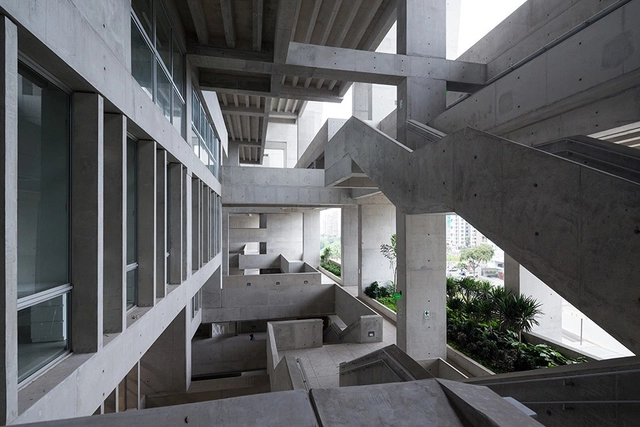
UTEC in Lima, Peru. Photo by Iwan Baan, courtesy of Grafton Architects.
The Chicago Architecture Center’s ongoing series of Architect Talks continues with a conversation and guest lecture with 2020 Pritzker Prize laureates Yvonne Farrell and Shelley McNamara of Grafton Architects, co-presented with the Irish Consulate General in Chicago. Founded in 1978, Grafton lays claim to noteworthy projects from Lima to London and is known for embedding each building within its own unique context. The studio’s forward-looking, influential designs have helped elevate modern architecture, cementing Ireland’s reputation as a design capital. Farrell and McNamara will spotlight several civic and institutional works including Milan’s Bocconi University, awarded the inaugural World Building of the Year Award at the World Architecture Festival; UTEC University in Lima, Peru, which received the RIBA International Prize in 2016; and ongoing projects for the City of Dublin, London School of Economics and the University of Arkansas, in addition to recounting their experiences as curators of the 2018 Venice Architecture Biennale. A discussion afterward will further illuminate the architects’ process, work and lifelong commitment to mentorship.
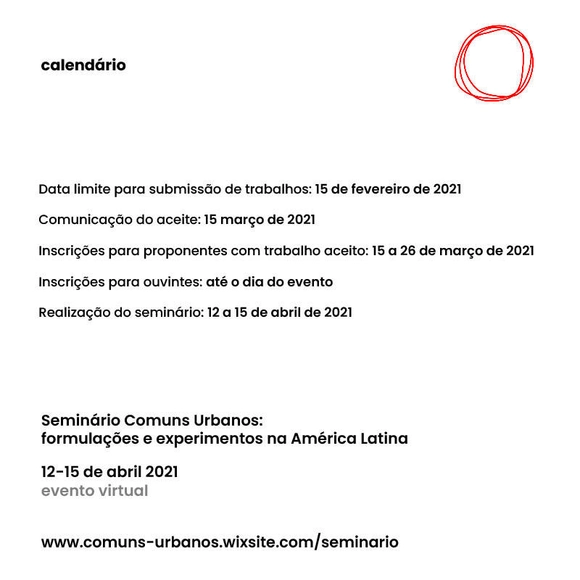
Open call for academic papers and non-academic practices:
The CUAL Research Group - Urban Commons in Latin America is pleased to invite you to the first seminar, "Urban Commons: Formulations and Experiments in Latin America," designed to establish a meeting platform for researchers, professors, architects, and practitioners involved in the production of thought, debate, and experience regarding the urban common. We understand the notion of the "common" as a collective construction and a political principle that proposes a certain communality of life built in daily practice, operating within the fissures between the State and the market. The varied perspectives and possibilities opened up by the common are explored through the articulations suggested by the thematic axes, using either descriptive or conceptual approaches. The event, as well as its organization, stems from collective work critically committed to building an equitable, inclusive, collaborative, and democratic society.
feminist architecture collaborative (f-architecture) is a three-woman* architectural research enterprise aimed at disentangling the contemporary spatial politics of bodies, intimately and globally. Their projects traverse theoretical and material registers to locate new forms of architectural work through critical relationships with collaborators across continents and an expanding definition of Designer. They think, write, and design about blood, teenage dreaming, sovereignty, fakeness, and protest—among other supposedly extra-disciplinary fixations.