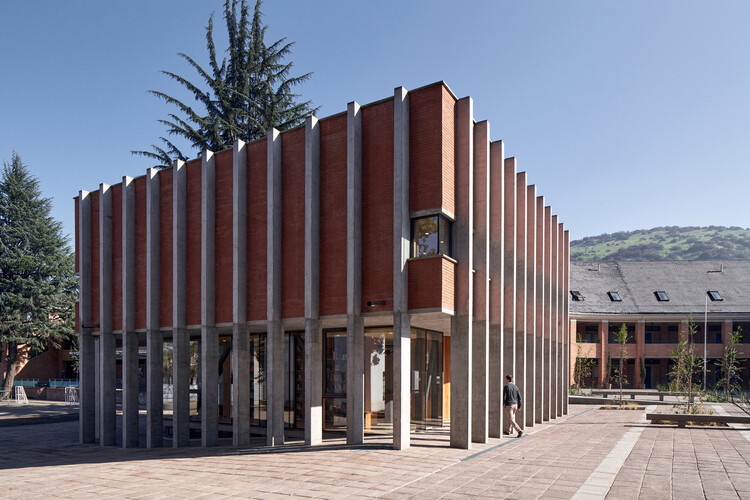
As part of the sustainable financing talk series by the ethical banking sector, the talk "Social Housing and Sustainable Cities" will be held on Wednesday, May 16, at 9 AM at the Doble Impacto offices, located at 727 Los Jesuitas, Providencia, Santiago, Chile.
We invite you to participate in the first National Meeting of Future Urbanists (ENUM), to be held on October 8 and 9 at the Faculty of Architecture and Urbanism of the University of Chile. This meeting is organized by graduates of the Master of Urbanism program and sponsored by the Postgraduate Department and the Postgraduate School of the Faculty of Architecture and Urbanism at the same institution.
The Design Lab UAI curriculum places knowledge at the service of the community, identifying and solving concrete problems, generating applicable innovations, and ultimately contributing to societal development.
Based on this premise, Design Engineering was born—a program that encompasses extensive mastery of new technologies in digital fabrication, programming, electronics, design, and material evaluation.
Awards Ceremony for the San Borja Footbridges Competition
The Municipality of Santiago, the San Borja Neighborhood Association, and the Pasarelas Verdes Project are pleased to invite you to the awards ceremony for the architectural and landscape ideas competition for the San Borja footbridges and their surroundings, held throughout 2018.
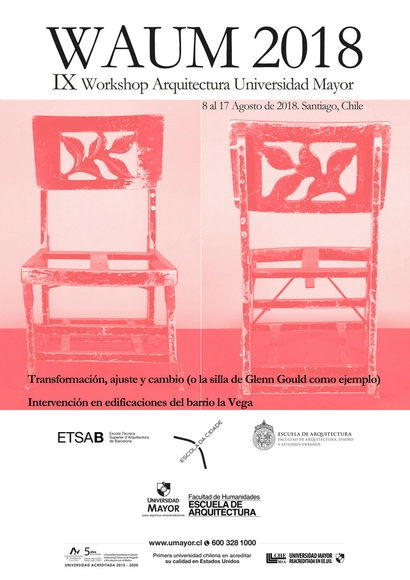
Since 2010, the School of Architecture at Universidad Mayor in Santiago has hosted an annual international workshop, inviting architecture schools from around the world to collaborate for nine days. In addition to the core work, related lectures are held, and the final results are presented to an external jury.
Attend the second edition of Architecture and Women in Chile, a panel discussion and reflection on the role and presence of women in national architecture.
Architecture, design, engineering, and innovation in wood take center stage at Wood Week 2018, where more than 100 projects from across Chile and Latin America will be presented to the jury. This showcase, which highlights wood in all its forms, will feature new regional ventures from Arica to Punta Arenas, as well as celebrate the work of female artisans who craft this noble material.
This discussion aims to create a space for proactive dialogue, featuring various guest speakers alongside students and the general public, to address pressing issues regarding the city's future challenges. We have invited four professionals who have led the coordination necessary to bring projects that foster social integration to fruition. The goal is for them to present each project as an example of urban best practice. Despite varying scales of intervention and diverse target users, these projects share a common thread: they serve as proactive contributions to the discussion on current and future urban challenges.
This discussion aims to foster a constructive dialogue, featuring presentations from various guest speakers alongside students and the general public, to address current issues and future challenges.
A course on timber structural design, organized by the startup ELIGEMADERA and the IDIEM of the University of Chile. The course features prominent national experts in timber design. Several instructors participated in the most recent committee for the modification of current national regulations, while others are part of the team that developed C+T, the first software for timber structural calculation in Latin America.
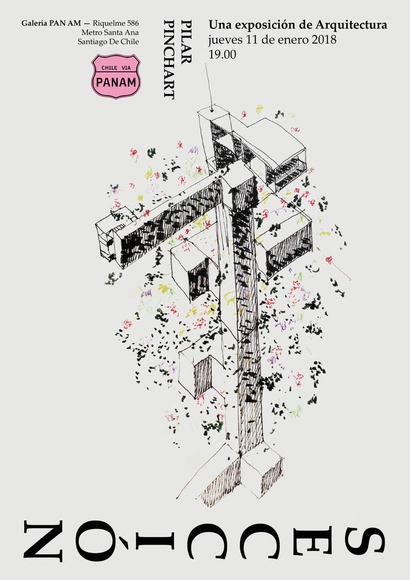
Santiago, January 5, 2018 – Chilean architect M. Pilar Pinchart presents an exhibition at Galería Pan Am showcasing the inquiries that have shaped her work over the last 10 years, synthesized into a conceptual installation on high-rise housing. The exhibition opens on January 11 and will remain on view for three weeks.
https://www.archdaily.com/1049508/section-an-architecture-exhibition-by-pilar-pinchartPola Mora
We invite you to participate in the seminar "Media, Spaces, and Documents: Cultural Access and Consumption of Architecture." We will be joined by renowned panelists to discuss their experience in the cataloging, dissemination, and exhibition of architecture.
On Wednesday, June 6, at 3:15 PM, the official signing of the agreement that will launch the XXI Architecture and Urbanism Biennial 2019 will take place. After two editions in Valparaíso, the event returns to Santiago to be held in the heart of the Matadero Franklin neighborhood, a cultural hub emerging on the outskirts of the city center.
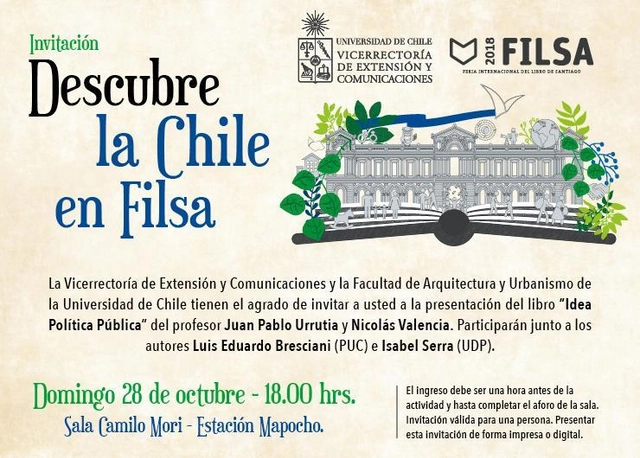
The Office of the Vice President for Outreach and Communications and the Faculty of Architecture and Urbanism at the University of Chile invite you to the presentation of the book Idea Política Pública at the 38th Santiago International Book Fair (FILSA 2018).
Thirty years after its founding, SIGraDi and the University of Chile invite the academic, professional, and creative community to participate in the 30th international congress of the Ibero-American Society of Digital Graphics, to be held in Santiago at the University of Chile from November 18 to 20, 2026. This gathering marks a symbolic return to the University of Chile, which hosted SIGraDi 2006 two decades ago under the theme "The Human Factor." At that time, we invited participants to reflect critically on the role humans played in the emerging world of digital design. That critical look at the past—and the future—is more relevant than ever in the face of even more disruptive technologies. In this spirit, we are proposing the concept of "AI_ded Design," a notion that updates the legacy of CAD (Computer-Aided Design) and projects it toward a new horizon where design, architecture, and urbanism are redefined by algorithmic structures, intelligent environments, and autonomous systems mediated by Artificial Intelligence. We invite you to think beyond computer-aided design. We aim to open a space for discussion on a form of design where computation—increasingly transparent, ubiquitous, and autonomous—gives way to new forms of cognition, agency, emergence, distributed processes, and a necessary technological ethics that reconfigures design practices. To stimulate this collective conversation, we propose four open questions: What have we learned in these 30 years? What have we improved in these 30 years? What have we achieved in these 30 years? What challenges are emerging in the relationship between humans, machines, and environments?


.jpg?1527685252&format=webp&width=640&height=580)