DAMPA® is a Danish company specialised in the development and production of acoustic steel and aluminium ceilings, as well as acoustic wall panels for the building industry, with sales exclusively in the European market.
Poor indoor conditions can reduce learning and performance by up to 10%, equivalent to an entire school year. A healthy indoor climate contributes to faster task completion, greater creativity, fewer conflicts and sick days, and better overall well-being.
Renovations should address environmental, economic, and social sustainability. Improved indoor climate can yield significant financial savings through enhanced learning and reduced absenteeism.
A good indoor climate requires attention to thermal, atmospheric, acoustic, and visual factors. The thermal indoor climate is improved by maintaining a stable temperature and minimizing drafts. DAMPA® Climate Ceilings offer energy-efficient temperature control with low maintenance requirements. Air quality is influenced by oxygen levels, humidity, odors, and materials, necessitating effective ventilation.
Diffuse ventilation ensures fresh air without draughts or noise, utilizing the existing perforations in DAMPA®’s metal ceilings. The acoustic indoor climate is enhanced with noise-reducing ceilings and sound-absorbing wall panels. DAMPA’s solutions can be delivered in acoustic classes A, B, or C. Good acoustics are essential for concentration, learning, and well-being in educational spaces.
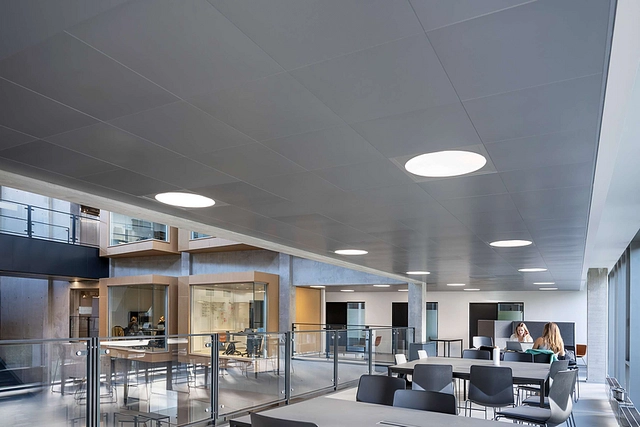
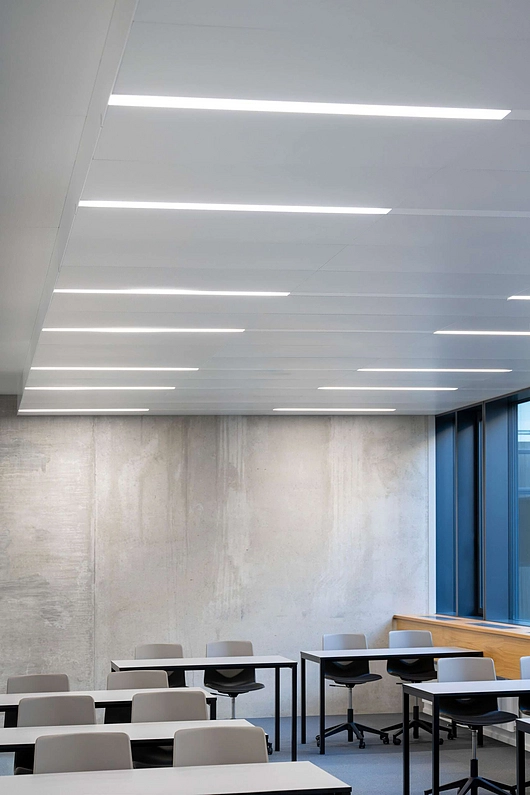
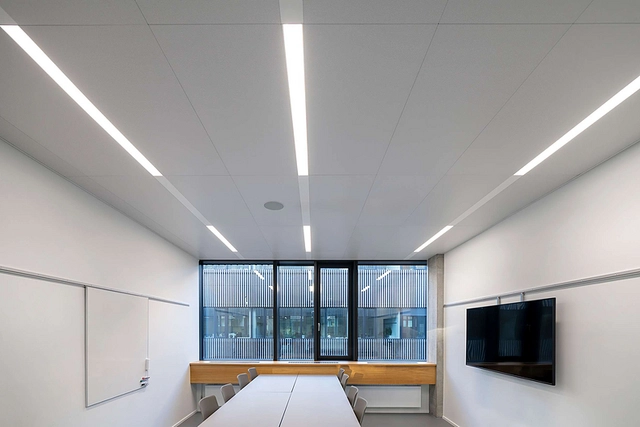
The visual indoor climate is ensured with adequate daylight, views, and appropriate electric lighting. DAMPA® integrates lighting design into their metal ceiling solutions to combine functionality and aesthetics. The four areas of indoor climate influence one another and must be carefully balanced to achieve optimal conditions in school construction projects.
Optimizing thermal, atmospheric, acoustic, and visual conditions is key to creating an ideal environment for learning and teaching.
- Thermal: Temperature changes can affect performance; for example, a rise from 22°C to 25.5°C can reduce productivity by up to 10%.
- Atmospheric: Poor air quality can lead to drowsiness and concentration issues, making proper ventilation essential.
- Acoustic: A balanced sound environment improves focus and speech clarity, critical for both teachers and students.
- Visual: Access to daylight and green surroundings enhances performance and reduces stress.
Thermal Indoor Climate
The thermal indoor climate is typically influenced by factors such as air temperature, draughts, and radiant temperature. According to building regulations, rooms must maintain a thermal environment that is satisfactory for both health and comfort, depending on their intended use and activity.
For buildings other than residences, the builder must determine the maximum number of hours per year during which the operative room temperature may exceed 26°C and 27°C, respectively. For many types of buildings with use patterns similar to offices, no more than 100 hours above 26°C and 25 hours above 27°C annually is usually acceptable.
The DAMPA® Climate Ceiling offers a comfortable indoor climate with excellent acoustics and stable temperatures.
A climate ceiling, also known as a cooling/heating ceiling, uses water-transporting elements to regulate room temperature via radiation. Radiant heat always moves from warmer to cooler objects. Practically, this means that when cold water flows through the ceiling pipes, it absorbs the room’s heat, cooling the space as cooler air radiates downward.
Example:
In a room with an air temperature of 29°C and an average surface temperature of 23.7°C across the floor, walls, and ceiling, the perceived temperature is calculated as:
(23.7 + 29) ÷ 2 = 26.35°C.
Thus, the perceived temperature is 26.35°C.
In addition to improving the indoor climate, climate ceilings allow for significantly smaller ventilation systems, reducing both construction height and operational costs, as they require minimal maintenance.
Atmospheric Indoor Climate
The atmospheric indoor climate concerns air quality, which depends on factors such as:
- Oxygen and humidity levels
- Odors
- Pollution from people, furniture, and building materials
Efficient ventilation is critical to students’ and teachers’ well-being, as poor air quality can cause drowsiness and concentration difficulties.
Diffuse Ventilation – Fresh Air Without Draughts or Noise
Air exchange is a typical solution for atmospheric indoor climate challenges, as it dilutes and removes airborne pollutants.
At DAMPA®, we recommend diffuse ventilation. This method creates overpressure above the ceiling surface, distributing fresh air evenly through perforations in the ceiling. The pressure is so low that it is silent, yet the air is evenly dispersed throughout the room. DAMPA®’s acoustic metal ceilings work seamlessly with diffuse ventilation, using existing perforations to distribute fresh air.
Acoustic Indoor Climate
This area focuses on acoustics in classrooms, group rooms, and communal spaces. The aim is to reduce noise and ensure speech intelligibility, especially in teaching environments. Building regulations specify requirements for sound insulation, noise from traffic, and technical installations, as well as room acoustics, including reverberation times and absorption areas.
Durable Acoustic Solutions in Metal
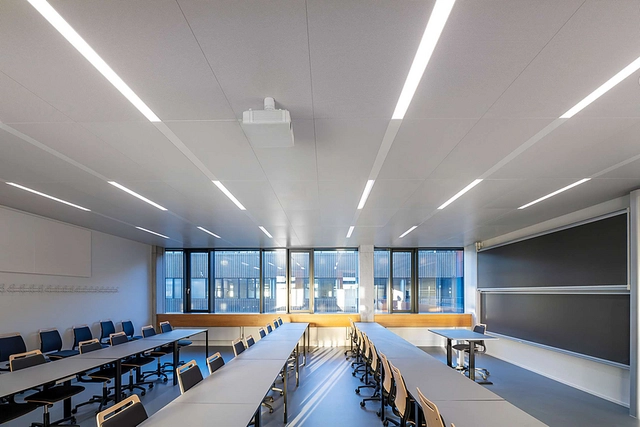
Acoustics may not be visible or tangible, but they are a crucial factor in overall well-being. Creating the best acoustic conditions in schools requires considering the room’s purpose and layout. For example, in classrooms, students at both the front and back need to hear the teacher clearly, without excessive noise.
The most effective solution is a fully covered acoustic ceiling. DAMPA® offers metal ceiling options in acoustic classes A, B, and C, tailored to specific needs.
Depending on the room’s design and purpose, it is not always sufficient to rely solely on sound-absorbing materials in the ceiling. An acoustic rule of thumb suggests that walls should be covered with sound-absorbing materials equivalent to approximately 10–20% of the floor area, depending on the room’s layout and function.
Visual Indoor Climate
The visual indoor climate includes factors such as daylight, light distribution, outdoor views, and artificial lighting.
Building regulations require:
- Workspaces, classrooms, and similar rooms must have windows providing views of the surroundings.
- Daylight access should be documented with a glass area at least 10% of the floor area, free from shading.
- Seamless Integration and Elegant Design
Balancing the Four Indoor Climate Areas
In the building regulations, you will find requirements that must be met as a minimum. However, it is always possible to go beyond these standards if desired. It is important to note that the four areas also influence one another and interact in various ways.
In the specific case of school construction, the four focus areas of indoor climate must be carefully balanced. There needs to be a consideration of requirements, priorities, and the allocation of resources and budget to create an optimal balance in each instance. This balance must ensure the best possible indoor climate for the resources used, both from a financial and a resource-efficiency perspective.
Renovating Schools with a Sustainable Perspective
Between 1950 and 1980, there was a substantial expansion of schools across the country. As a result, 80% of the nation’s schools were built before 1982, when insulation standards were first introduced, and only 10% were constructed after 1995, when ventilation requirements were implemented.
It is important to emphasize that sustainable construction must address three key aspects:
- Environmental sustainability: Protecting the environment and reducing energy and resource consumption.
- Economic sustainability: Making long-term investment decisions.
- Social sustainability: Ensuring healthy buildings that provide users with the best conditions for living and thriving.
Social sustainability includes a healthy indoor climate, which is vital. However, creating a good indoor climate must respect the other two perspectives to achieve a balanced approach, avoiding improvements at the expense of either finances or the environment.
A Socioeconomic Asset
More than half a million Danish children and young people, along with approximately 50,000 staff, spend a significant portion of their time in schools. Both older and newer schools provide the physical settings that should offer students the best conditions for learning. There is substantial socioeconomic potential in ensuring a good indoor climate, as it directly influences the performance of both students and teachers.
Four Key Areas for Improving Indoor Climate
Several factors influence perceived indoor climate. It is important to note that personal preferences will always vary, making it impossible to satisfy everyone entirely. Nonetheless, efforts should be made to create conditions that maximize comfort for as many people as possible.
When addressing indoor climate, focus is typically placed on four main areas:
- Thermal indoor climate
- Atmospheric indoor climate
- Acoustic indoor climate
- Visual indoor climate
Below, we explore these areas and their impact on indoor climate.
Thermal Indoor Climate
The thermal indoor climate concerns factors that influence whether a person feels warm or cold. Key factors include air temperature, draughts, and radiant temperature, which generally have the most significant effect on thermal conditions.
Atmospheric Indoor Climate
The atmospheric indoor climate refers to air quality, which depends on factors such as oxygen levels, humidity, odors, and pollutants from people, furnishings, and building materials.
This area typically involves managing ventilation to dilute and remove atmospheric pollutants. When atmospheric conditions are suboptimal, individuals often experience symptoms such as drowsiness and difficulty concentrating.
Acoustic Indoor Climate
This area focuses on sound conditions within classrooms, group rooms, and communal spaces. The emphasis is on reducing noise within the space and from surrounding areas while ensuring speech intelligibility, particularly in teaching environments.
Balancing the acoustic environment involves minimizing unwanted sounds—such as noise from installations or moving chairs—without over-dampening and compromising speech clarity, which is critical for understanding teachers. A poor acoustic environment significantly impacts concentration, sleep quality, and stress levels. Therefore, creating an acoustic environment that supports effective learning and teaching conditions is essential.
Visual Indoor Climate
The final area is visual indoor climate, encompassing factors such as the amount and distribution of daylight, views of the surroundings, artificial lighting, and glare.
DAMPA® offers a range of solutions to enhance the indoor climate, whether through acoustic improvements, temperature regulation, or integrating ventilation and lighting systems.