As you all may know, last month we started featuring a selection of the best pictures from our Flickr pool. The pool has been growing a lot lately so we will keep on showing you some pictures in the future. You can also add yours, just click here and learn how! And remember that besides our Flickr pool you can also follow us through Twitter and our Facebook Page.
The picture of the Neuer Zollhof in Düsseldorf, Germany, was taken by arne boell. Check the other four after the break.
The 2010 World Cup to be held in South Africa is less than one year away. Being perhaps the most important international competition in sports in the world, we would like to start featuring some of the stadiums that will host this magnificient competition.
Soccer City Stadium is located in Johannesburg and it was originally built in 1987. Among other important events, it hosted the first massive speech from Nelson Mandela after his liberation in 1990. However, it was completely renewed for the upcoming World Cup, becoming the stadium where the starting and the final game will be played.
Designed by Boogertman Urban Edge and Partners in partnership with Populous, it will allow for 94,000 spectators to enjoy the best soccer in the world. The design of the stadium was selected from a series of concept designs ranging from acknowledgement of Johannesburg’s disappearing mine dumps; the kgotla (defined by the tree) of the African city state; the African map as a horizontal representation, which included the roof as a desert plane supported on tropical trees set within the mineral wealth of Southern Africa; to a representation of the protea, South Africa’s national flower.
The calabash, or African pot, was selected as being the most recognizable object to represent what would automatically be associated with the African continent and not any other. The calabash, or ‘melting pot of African cultures’, sits on a raised podium, on top of which is located a ‘pit of fire’. Thus the pot sits in a depression, which is the ‘pit of fire’, as if it were being naturally fired.
In case you didn’t know, a couple of weeks ago we started with our Facebook Fan Page (different from ArchDaily’s group on Facebook). The interaction that we have been experiencing with you has been awesome, so we decided to turn things upside down for a change.
This is a sustainable design for a future development that possibly will be built. BURO II already built a project of this amplitude in Guangzhou (China) and won with this ‘Baiyun International Convention Centre’ an international prize at the World Architecture Festival in Barcelona in 2008.
The design of this hotel beach resort is a concept whereby a sustainable relationship with the local economy, culture and natural heritage is central. The hotel assimilates with the natural habitat of the island. The development of this exclusive residential resort of 22.000m² is situated along Mero Beach on the west coast of the Commonwealth of Dominica.
More images and architect’s description after the break.
Housing projects, a new City Hall for an Estonian city, a master plan for an island and the Danish Pavillion for Shanghai Expo 2010 are just some of the enormous variety of projects designed by BIG. Check them out on our first Round Up of the week.
What does ‘neighborhood character’ mean to you? Why is it important and what is the role of architecture? Join AIA Seattle as our own local characters Steve Scher of KUOW’s “Weekday”, author Knute Berger, activist Kent Kammerer, and real estate maven Bob Melvey debate and discuss specific projects shaping the future of residential architecture in our region.
Jacques Ferrier Architects were selected to design the French Pavillion at Shanghai Expo 2010. Their project ‘The Sensual City’ is a simple building with a big style French garden inside. Surrounded by water it appears to be floating.
The 6000 square meter pavillion will use advanced building materials and environmental protection technology including solar panels on top of the roof.
Last week, we featured the Quingpu Pedestrian Bridge designed by CA-DESIGN. The project received many good reviews from you, so they sent more images of the bridge, taken by Nacasa & Partners. See all the fantastic images of the project by day and night after the break.
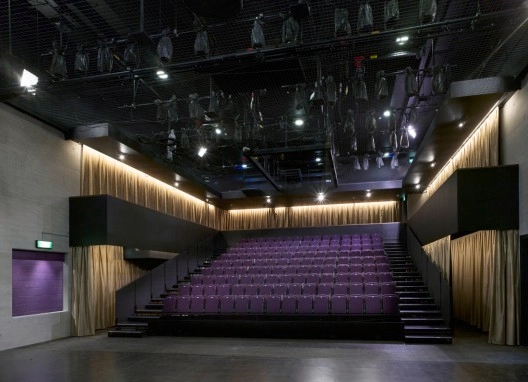
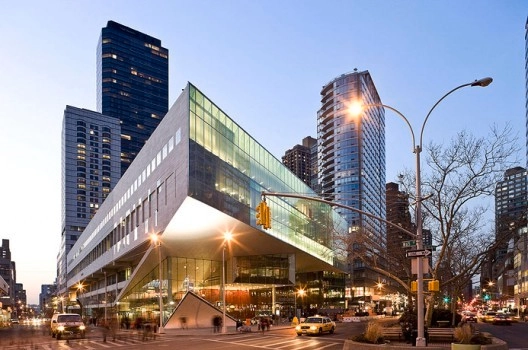
There are few things more entertaining than enjoying a good show in a good theatre. From all over Europe and USA, we bring you our Round Up of previously featured theatres in ArchDaily.
The structure of a brain cell is the dominant conceptual image for the pavilion. It aims to evokes the artistic and scientific richness of Belgium and the country’s central position within Europe.
The brain cell also refers directly to the role of Belgium as one of Europe’s main gathering centres and cross-points of 3 great cultural traditions: the Latin, the Germanic and the Anglo-Saxon. Belgium, closely connected to its surrounding countries, has always been a ‘place of balance’ where people have gathered with common interests that surpass their national needs.
The Dutch have been fighting the rising and falling tides for centuries, building dikes and pumping water out of areas that are below sea level. Now, rather than fight the water infiltrating their land, the Dutch will use it as part of a new development called ‘New Water‘, which will feature the world’s first floating apartment complex, The Citadel.
This “water-breaking” new project was designed by Koen Olthuis of Waterstudio, and developed by ONW OPP/BNG in the Netherlands, and will use 25% less energy than a conventional building on land thanks to the use of water cooling techniques.
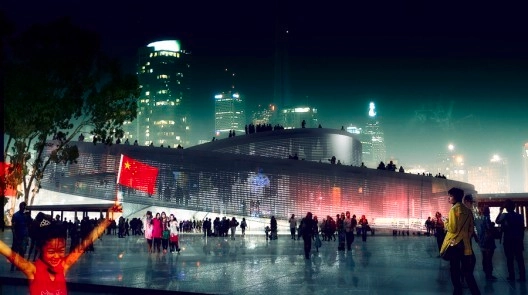
The Pavilion of Ideas, designed by Heatherwick Studio, beat five other short-listed designs, including plans put forward by the creators of the London Eye – the largest Ferris wheel in the world – to becomes the winner. The pavilion looks like a box with thousands of spines that hover without visible support above a public square.
All the spines, which can swing in the breeze, are tipped with tiny colored light sources which can display a variety of images together.
Inside the pavilion, visitors will see an enormous digital screen showing various contents. The outside area of the pavilion will be an exhibition space and auditorium as well as a cafe and shops surrounded by two strips of grass. The pavilion will be as ecological as possible and the designers are trying to make all the aspects recyclable and carbon-neutral. It is light, without heavy concrete foundations and will “touch the ground softly,” according to the introduction by Heatherwich.
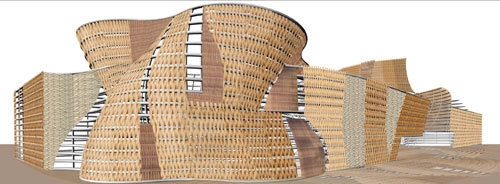
The SpainPavilion will have a steel structure and a wicker cover. Spanish handcrafters will weave out different patterns by using different colors of wicker, said Benedetta Tagliabue, designer of the pavilion. The wicker will be covered by a special material that is water-proof. It will also keep the pavilion at a comfortable temperature, said Tagliabue.
Switzerland unveiled the model of its national pavilion for World Expo Shanghai, a pavilion with soybean-fibre coverage and entertaining rooftop cable cars.
The design by Buchner Bründler Architects, chosen out of the 104 candidates through a world-wide competition, focuses on the sustainable development as well as harmony and balance, which coincide with the Chinese philosophy of Yin and Yang.
“This piece of work best shows the characteristics of modern Switzerland – pursuing excellence, innovation and high-quality life,” said Manuel Salchli, deputy commissioner general of the Swiss pavilion in the Expo. “We hope to attract a big percentage of the 70 million visitors to the Expo Shanghai.”
The most distinguished feature of the pavilion is the outside curtain, made from degradable soybeans and dye-sensitized solar cells that are capable of generating electricity, introduces Salchli. The curtain will present an image of forest, which will remind people of the nature, said Salchli. And the fibre of the curtain could be degraded after being disposed in the soil in two week.
OLIAROS, a young property development company, is calling architects up to 35 years old to submit proposals for the construction of an affordable student housing complex in Kerameikos and Metaxourgeio (KM), an area in the historic centre of Athens, Greece.