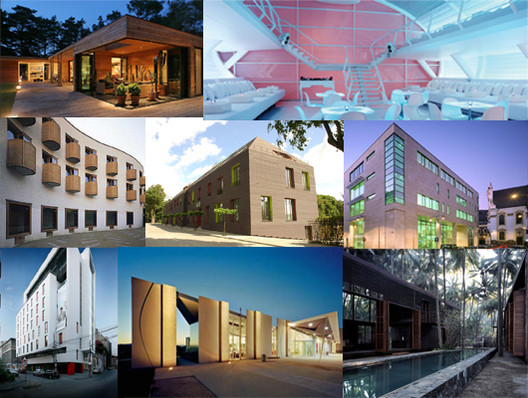
Swedish architects Tham & Videgård Hansson Arkitekter have done some interesting projects lately. So to finish this week’s Round Up, we bring you previously featured works from them, including an interesting concept for a camouflaged hotel and their ORDOS.
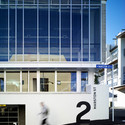
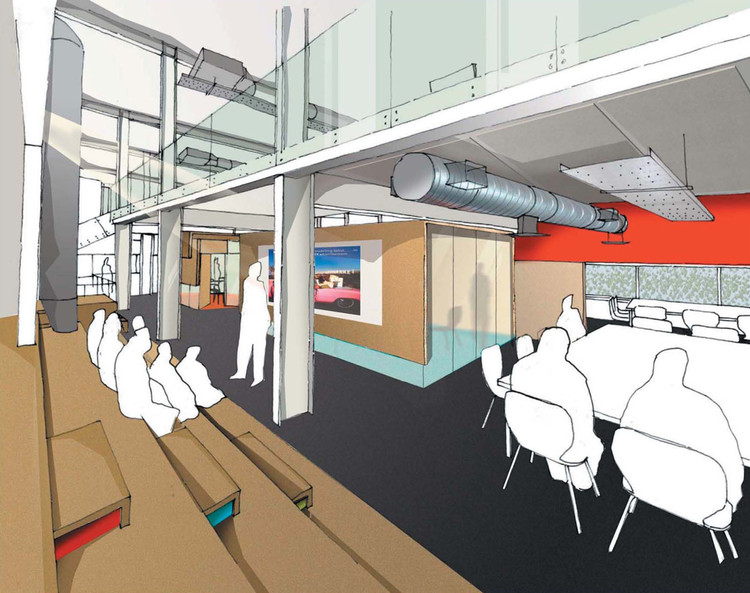
Architects: Jasmax Location: Auckland, New Zealand Program: Jasmax Auckland Studio Building Owner: KCL Property Construction Year: 2008-2009 Project Area: 2400 m2 Photographs: Simon Devitt
Hungary inveiled the design for their pavillion for next year’s Shanghai World Expo, designed by Tamás Lévai. Gömböc, as a hungarian invention, is the central element of the exhibition, a two meter high solid plexiglass moving object.
What is Gömböc (pronounced as ‘goemboets‘)? ‘Gömböc’ is the first known homogenous object with one stable and one unstable equilibrium point, thus with two equilibria altogether on a horizontal surface. It can be proven that no object with less than two equilibria exists. The discovery of the inaccessible path has led to the idea of GÖMBÖC. The pavilion as wood is intended to represent this path, and since it is of immaterial nature, we are trying to evoke it with non materials: empty space, light and sounds.
More images, a video and architect’s description after the break.
A week ago, through our Facebook Fan Page we asked which emergent local architect would you recommend us. We received 60 comments in which architects all over the world recommended great offices, many of who we had never heard before.
We decided to put together some of them so you can check them out as well. And in case you are still not a fan, go to our Facebook Fan Page and become one today! We have many more surprises coming. The full list after the break.
The Beijing 2008 Olympics happened less than a year ago, but the preparations for the next games in London already started. Beijing’s Bird’s Nest made quite an impression for everyone who enjoyed the 2008 Olympics so Populous faced a difficult challenge in designing the Olympic Stadium for London 2012. The new stadium will be complete summer 2011 and will host 80,000 spectators during the Games. More images and architect’s description, after the break.
Shanghai World Expo 2010 is closer every day, and new pavillions from all over the world have arrived to ArchDaily. So to start this week of Round Up, we bring you our second part (see the first one here), of previously featured pavillions for Shanghai.
The Shortlist for the RIBA Stirling Prize 2009 has been announced. The six shortlisted schemes were chosen from a midlist of 22 RIBA Award 2009 winners.
Our friends from Le 2 Workshop sent us House on the Water, a self-sufficient house for nomadic life offshore. Designed as a rental house for people who want to be independent it’s available only through water. It is located by Navagio beach, NW coast of the Greek Zante island.
The orientation was developed to maximize the use of solar energy. Strong decisions and consequence in driving its proportions guarantee the uniqueness of (formo)design. Dynamic and simple form are the result of the yach architecture interpretation. The core, made of concrete, is combined with steel cantilever structures. Foundation for the house is a concrete counterweight foot stabilizet with the sea bed pile system.The floating deck, which rises with the water level thanks to the railing installed in the core structure, leads you to the stairway. The top deck is available for the residents as well.
Eco-friendly features like the water desalination, energy accumulation, ventilation methods, water recycling, heat and energy consumption, tidal and solar energy systems are all there. HotW was designed to be sustainable. It is not only the installations, but it’s form and orientation. Vertical lines on the facade are the rails for computer driven shading system.
Chicago Architecture Today announced two competitions currently initiated and concluding in April 2010. The first is student-based Mock Firms International Skyscraper Challenge which focuses on a studio brief for Mexico City. More details here.
Today, we bring you our second Round Up of previously featured hotels around the world. This time, you can enjoy from an hotel in the middle of the Atacama Desert in Chile to a hotel and spa in Switzerland designed by last Pritzker Prize Peter Zumthor. Enjoy!
The Southern California Institute of Architecture (SCI-Arc), the downtown Los Angeles-based architecture school known for its progressive thinking and innovative design, is pleased to announce the fall 2009 schedule for lectures, talks and exhibitions. SCI-Arc hosts renowned architects and other practitioners in the fields of Architecture and Design from around the globe to discuss current theory and practice.
Inhabitat and Dwell have just announced the winners of the Reburbia Design Competition. The competition, which has been running for the past 6 weeks, challenged architects, designers and concerned citizens to come up with solutions that would address the problems that plague present-day suburbia by envisioning different scenarios for the future.
Proposals tackled foreclosed McMansions, vacant big box stores, strip malls, parking lots and more with design fixes ranging from community agriculture and algae-based biofuels to zeppelin-based transit and pools transformed into water treatment plants. The competition drew over 400 entries from countries all over the world.
i.M.A.D.E is an institute within Ball State University, focusing on digital design and fabrication techniques for both industry and education related to architecture and allied arts.
It acts as an effective link between the academy and the manufacturing industry, with all the benefits this alliances bring: the fresh ideas on one side, and the technical capacity on the other.
With strategic industry partners, students test knowledge through team-based projects dealing with the translation of bits into atoms, shifting scales between models, prototypes, 1:1 construction, and the development of solutions to real problems by managing a complex set of design constraints.
Among this partners we find our friends from CASE, experts in applying design technology to built environments. They partner with i.M.A.D.E in technology (workshops, lectures, crits, etc.). Our friend Federico from CASE collaborated with i.M.A.D.E’s director Kevin Klinger in the book “Manufacturing Material Effects”.
First, don’t forget to check our first Round Up of interviews done by our team. And then, you can move on to our second part of some of our greatest interviews featured in ArchDaily.
The luxury car brand Maserati organized a competition to search for the finest architectural garages. The competition was divided into two sections. One for existing garages and other for concept garages.
The existing competition was won by Holger Schubert from Archisis. This garage was designed with two main objectives in mind: to create a pure and restrained minimalist environment that allows one to focus on the car as a piece of art and to create the ultimate experience for the driver to arrive at home.
The concept garage winner was Chris Altman from Stubbs Muldrow Herin Architects. The design approach seeks to redefine the relationship between car, driver and garage. Unlike the typical garage of today, the design redefines the notion of the garage from a space of storage to a place that exhibits the quality and prestige of a Maserati. In concept, the garage is designed to refocus one’s attention on the car.
You can see more info on the winners and other entries in the competition’s official website. More images and a great video after the break.
Last week, we asked all of you to send photos of your architecture office through our Facebook Fan Page. Your response was huge, as we received a lot of photos from all over the world. Selecting the best was not easy, but we decided to focus on diversity, creativity and image quality. Thanks to everyone who got to send their photos and we hope you keep participating through our Facebook Fan Page.
The picture above was submitted by Catherine Dilly and belongs to Jasmax Studio in Auckland, New Zealand. You can see all 14 offices after the break. And remember, you can also become a fan of ArchDaily in Facebook, just click here!
Rotterdam’s Cube Houses, an iconic building designed in 1984 by Dutch architect Piet Blom, has been renewed and transformed into a new Stayokay hostel. The building consists in 38 small cubes and two bigger ones all attached to each other.
The expressive and colorful cube-shaped houses on concrete pillars are located right in the heart of the city, near the ‘Old Harbour’. Spending the night in a tilted cube is quite a unique experience. In addition to the 49 spacious rooms, Stayokay Rotterdam also has a restaurant, bar and two rooms for meetings and workshops. The interior concept of Dutch designer Edward van Vliet (SEVV) was used as a starting point. Kees van Lamoen and Personal Architecture were the rebuilding architects. More images, after the break.
PS: In the last Mark Magazine there’s an article with interviews to people who have lived in remarkable buildings, and the cube house was included.
Metals, as surface or structure-as the generators of space-play a role in nearly every strain of modernization in architecture. Bringing together a wide range of leading architects, engineers, and scholars, the Columbia Conference on Architecture, Engineering, and Materials is a multi-year project to explore the dramatically changing limits of known and new materials in an era of rapid urbanization and within unprecedented forms of technical measurement, coordination, and production that increasingly blur the boundaries of professions and of materials.