The Avery Review, a journal of critical essays on architecture published by the Office of Publications at Columbia University’s Graduate School of Architecture, Planning, and Preservation, invites submissions for its first-ever Essay Prize. The call is open to current students and recent graduates, whether in schools of architecture or elsewhere (eligibility details below). In keeping with the mission of the journal, we hope to receive submissions that use the genres of the review and the critical essay to explore the urgent ideas and problems that animate the field of architecture. We’re looking for essays that test and expand the author’s own intellectual commitments—theoretical, architectural, and political—through the work of others.
When there are so many powerful computer visualization and drafting programs available, why do architects still draw by hand? What intelligence does the body bring to paper? And what richness do pen and ink bring to a design?
Single-Handedly, a forthcoming book from Princeton Architectural Press (http://www.papress.com), looks closely to find out more, as it celebrates hand drawings by practicing architects worldwide.
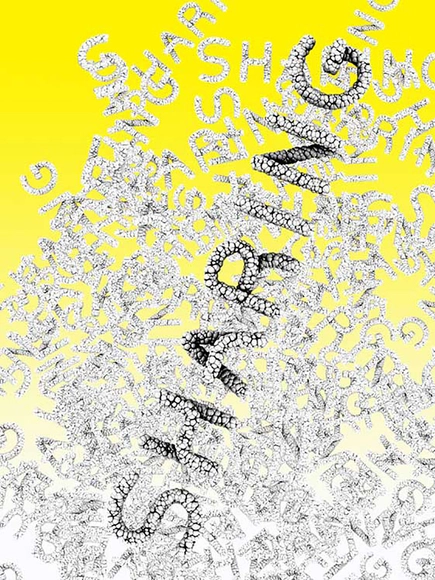
Many of the physical spaces that architects, landscape architects, urbanists, and engineers design are inherently locales of joint access and participation. Such long-existing typologies of sharing include plazas, living rooms, libraries, waiting areas, museums, and cohousing schemes. The built environment serves as the platform within which myriad sociological, cultural, and technological forces share legal parameters and broader audiences. Today, digitally-based platforms, supported by vast physical infrastructures, facilitate new types of exchange. Such platforms bring about liberating possibilities to actualize transnational networks that coalesce around food, shelter, transportation, and talent. Yet, for every emancipatory path an equally restrictive one exists. Digitally-mediated sharing can serve as a mask for diffuse forms of financialization and extraction in spatial domains that traditionally conducted their day-to-day operations outside of the flows of global capital.
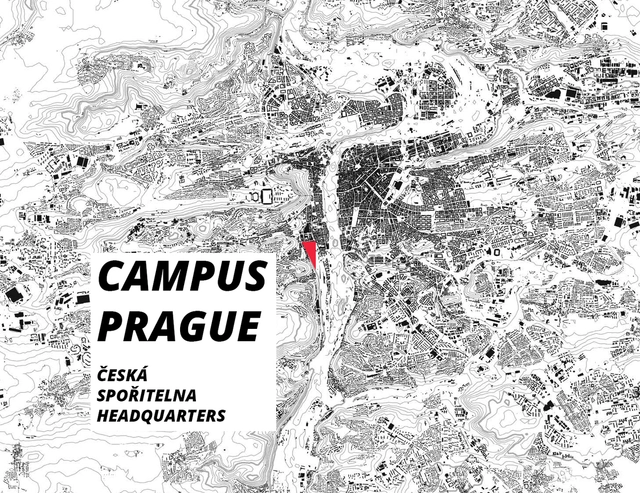
The biggest Czech bank is building its new headquarters – changing a brownfield neighbouring Prague’s historical core – supporting creation of a fresh, liveable city district – forming contemporary environment for its employees, visitors and inhabitants of Prague.
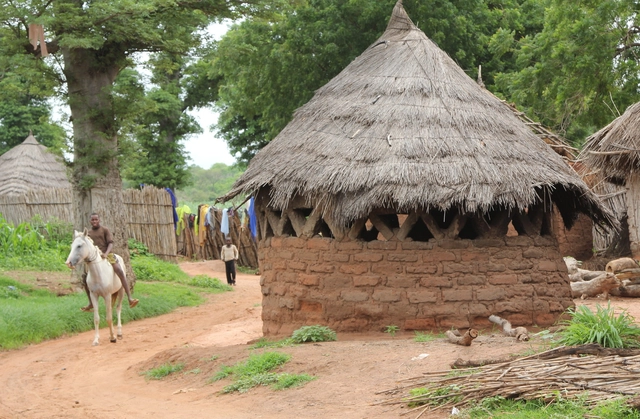
reTH!NKING team is delighted to introduce the new competition Sahara Eco House, The competition consists of the realization of a project that provides a new concept of housing in the existing environment based on the concepts of use of passive techniques that will provide a home with comfort and sufficient architectural quality.
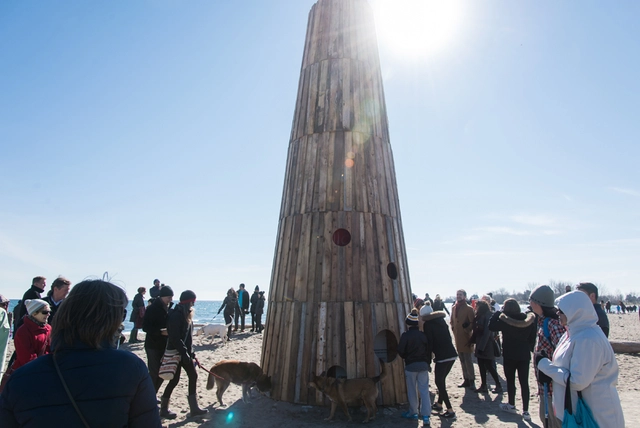
The Beacon by Joao Araujo Sousa and Joanna Correia Silva (credit: Khristel Stecher)
WinterStations is now embarking on its fourth year, again opening up an international design competition to bring temporary public art installations to The Beaches, an exhibition to celebrate Toronto's winter waterfront landscape.
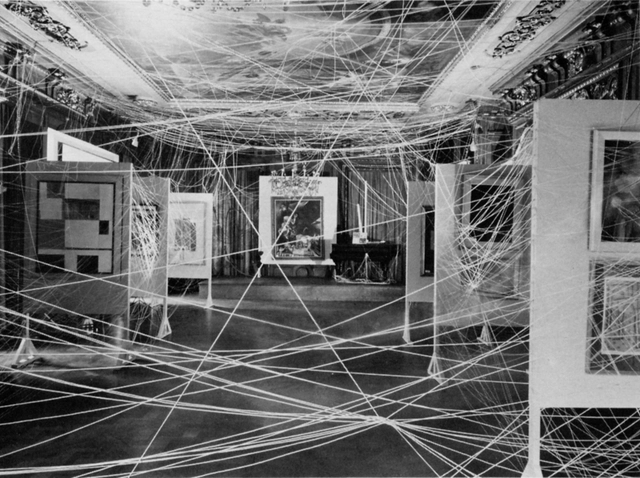
First Papers of Surrealism, 1942, New York. Installation view showing Marcel Duchamp’s Mile of String, 1942.
Are.na Grants is a new initiative to support research, writing, and other creative projects that are being developed and built on Are.na. For the first set of grants, we are especially interested in projects that address issues around the shifting nature of “knowledge work,” algorithmic governance, and networked learning, though proposals of all kinds are welcome.
cartasia, the international paper Biennale, is looking for artists and designers from around the world to collaborate and create works of art, sculptures, exhibitions and performances, through the medium of paper and following the theme chosen for the next edition: Chaos and Silence. Cartasia takes place in the beautiful city of Lucca between August and September 2018.
Architecturally Educated invites you to submit content to a new publication. The folly of architecturally education has begun to crumble. Overworked, underpaid and some may argue unnecessary, the profession of architecture has many questions to ask over the next 10 years. We believe these questions should first be posed to Architectural Education. An old decrepit model little changed since 1958, Architectural Education sets students up to fail, teaching very few practical skills which can be implemented in the real world. Instead it wallows in a void, somewhere between artistic representation and narrative’. Any quick google search for the term “Architectural Education” would reveal the state of the system with all top results returning calls for upheaval and overhaul.
Designing Buildings Wiki have joined forces with BSRIA to launch a new competition looking for fresh and innovative ideas in response to the question: How can tomorrow's challenges be met by today's buildings?
Edges, whether defining physical space or conceptual territories, provide a charged zone for interaction. The edge—solid or porous, fixed or fluctuating—formalizes difference and shapes relationships between different groups. The articulation of these zones becomes a political act, bringing conditions to public view, creating allegiances or separations, and generating dissonance through heterogeneity.
European Urban Green Infrastructure Conference 2017
EUGIC 2017 Budapest—interactive, dynamic, exciting—urban green infrastructure leaders share nature-based solutions for cities. Global practitioners, local experts, projects from Europe and around the world.
Location of the exhibition, Palazzo Corner Spinelli
Held during the Venice Biennale, photographers are invited to submit for consideration their work showcasing architecture. No exhibition fees; application fees apply.
The International Journal of Environmental Science & Sustainable Development (ESSD) is calling for papers for its third issue titled Environmental Sustainability: Methods for Green Energy Management.
The aim of the “Eating” competition is to develop a design proposal for the restaurant typology, intended as a place of preparation and consumption of food. It is asked to the participants to create innovative and unconventional projects on this theme, questioning the very basis of the notion of the restaurant.
Focusing on excellence in classical and new traditional design, the Institute of Classical Architecture & Art’s (ICAA) Stanford White Awards recognize achievement in architecture, interiors, landscape, urbanism, and building craftsmanship & artisanship throughout New York, New Jersey, and Fairfield County, Connecticut. The awards program is named for Stanford White (1853-1906), of the distinguished New York firm McKim, Mead & White, whose legacy of design excellence and creativity in architecture and the related arts continues to serve as a source of inspiration and delight.
Durham University and University College London are pleased to announce the establishment of a new multi-disciplinary research network called the BOVA (Building out vector-borne diseases in sub-Saharan Africa) Network. The Network, funded by the Global Challenges Research Fund aims to bring together researchers and practitioners working in the fields of the built environment and insect-borne diseases such as malaria and dengue.
12 Arte Laguna Prize: open call for artists and designers
The Arte Laguna Prize is an international art competition aimed at promoting and enhancing contemporary art. The contest stands out in the global art scene for the variety of its partnerships and opportunities offered to artists and designers, and is recognized worldwide as a real springboard for the artists’ career.
"The idea of using development as an engine to protect open space, strengthen communities, reduce auto-mobile use and even restore damaged ecosystems is an exciting one.... It will require a paradigm shift to move society 'from thinking the best it can do is to minimize negative impact, toward a view in which development is seen as both contributing to the growth of healthy human communities while simultaneously restoring (not merely sustaining) the natural environment. '" - Alex Wilson, Green Development, 1998
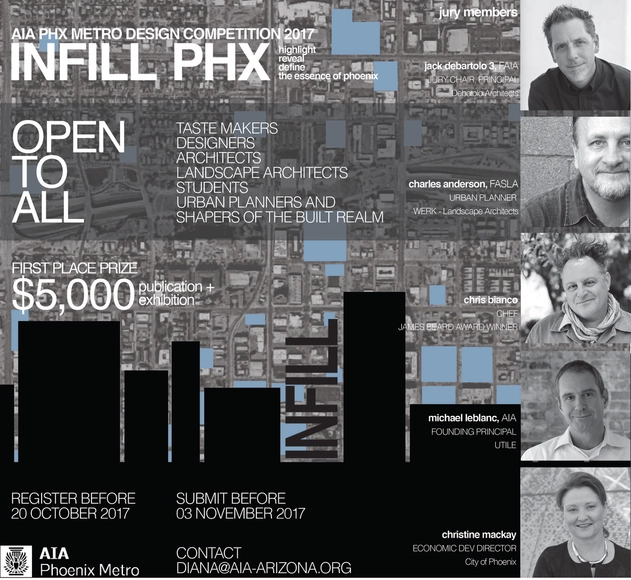
AIA Phoenix Metro Chapter Design Competition 2017 - INFILL PHOENIX
INTRODUCTION Phoenix, the fifth largest city in the United States by population and area, is very much a function of the 20th century technologies that enabled its rapid post WWII growth and inhabitation of an arid desert environment. While frequently cited for seemingly endless suburban sprawl, the metro area is in a state of transformation and is beginning to densify in line with other emergent urban centers. For decades, vacant land has made up a sizable portion of Phoenix’s land mass — up to 43 percent in the year 2000, according to a study by the Washington, D.C.-based Brookings Institution Center on Urban and Metropolitan Policy. This is especially true of the Phoenix downtown area, a location which has enjoyed positive, if not game-changing, developments over the past decade including light rail, a new university campus, thousands of new housing units, and an increasingly attractive business environment. The area also features a celebrated and long-standing arts and culture core with an emerging live music scene.
Drapers Field by Kinnear Landscape Architects. Photographer: Adrian Taylor
Making Places is a new initiative by Waltham Forest Council, which aims to deliver twenty new site-specific artworks across the borough during 2018. These projects are being commissioned at sites within the borough which residents have identified as needing transformation – and these parks, street corners, forest schools, library gardens and other public spaces are looking for long-term artworks, design interventions, and other creative approaches that will help support the local community’s positive engagement with the landscape of the borough.
UNFUSE serves as a platform to create a global community of architects and designers who are pushing the boundaries of architecture discipline to enrich our built environment. At UNFUSE we promote exceptional works, ideas, experimentations in the field of architecture, landscape, urban Design, society, culture and ecology.
Amsterdam, the capital of Netherlands is said to be a city with heart. The polycentric city of Amsterdam has its heart and soul lying in its ring of canals and bridges that bind the concentric and infinite loop that the city is. The city is popularly called the ‘Venice of North’, for its more than one hundred kilometers of canals, around 90 islands and about 1500 bridges.
"Earth Roots Renascence" is the theme of the 2017 Ruichang – L&A Design Star Competition. It takes the former site of the Jiangxi Jiangzhou Dockyard as the focal point of the competition, including the surrounding mountains, waterbody, and towns as the design site. Designers are asked to research the new "tourism plus" model; to consider the area's industrial heritage, which includes the Tongling Site, the Old 459 Factory, the 491 Factory, the Hongxia People Factory, the Xinmin Machine Factory and other old sites; to consider basic ecological establishments, creative tourism, art and public education; and to generate modern cultural tourism through appropriate planning. With this competition, Ruichang is envisioned as an “all-for-one” tourism experience with a global perspective, and a promotional tourism resource.